




How Diamond Testers Work — and What They Actually Measure
A diamond tester is a handheld gemological instrument that determines whether a gemstone is a diamond — or something else entirely. It does not grade beauty. It does not rank brilliance. It identifies stone type through a single physical property: thermal or electrical conductivity. Understanding how these devices work clarifies why professional gemologists treat them as one tool among many, rather than the final word on a gem.
This guide covers the science behind diamond testers, their well-documented limitations with materials such as moissanite, and what any tester result actually means for the gem in your hand. For context on how cubic zirconia and other diamond alternatives compare, that article covers the broader landscape of simulants and lab-created gems. Here we focus on the instrument itself — what it measures, where it falls short, and why the result matters less than most people assume.
Key Takeaways
- Thermal testers measure heat conductivity; electrical testers measure electron flow. Both identify stone type, not quality or value.
- Moissanite registers as diamond on older thermal-only testers — this is a documented physical property, not a defect or advantage.
- Dual thermal-electrical testers were developed specifically to distinguish moissanite from diamond and are the current standard.
- Lab-grown diamonds test identically to mined diamonds; only separate spectroscopic instruments can separate them.
- Satéur Gems® is a trademarked diamond simulant — it tests as a non-diamond, correctly, because that is what it is.
- Entry-level Satéur Gems® pieces start at approximately $138, delivering D-E colour and Excellent cut at roughly 1% of mined diamond prices.
The Two Types of Diamond Tester
All handheld diamond testers work on one of two principles, or a combination of both.
Thermal conductivity testers are the original consumer instrument, introduced in the 1970s. They work by pressing a heated metal probe tip against a gemstone. Diamonds conduct heat at an exceptionally high rate — higher than any common gem material. The instrument measures how rapidly heat dissipates into the stone and compares that rate against a calibrated diamond baseline. A fast dissipation rate triggers the "diamond" indicator. This type of test is fast, affordable, and widely available in jewelry settings around the world.
Electrical conductivity testers measure whether a stone conducts electricity. Pure natural diamond is an electrical insulator. Moissanite, however, conducts electricity — a property that exposes the limitation of thermal-only instruments. Dual testers combine both measurements. They apply both the thermal probe and an electrical current, comparing results against expected values for diamond, moissanite, and non-conductive simulants. Modern dual-mode devices are the industry standard for jewelers who regularly encounter moissanite.
Neither type assesses brilliance, fire, hardness, weight, or provenance. The instrument answers one question: is this stone a diamond, or is it not? Everything else — quality, value, origin — requires separate assessment.
Why Moissanite Registers Differently on Older Testers
Moissanite is a lab-created gemstone with a thermal conductivity remarkably close to diamond's. When pressed against an older thermal-only tester, moissanite often produces a "diamond" reading. This is not a trick or a defect — it is a straightforward consequence of the physical property the instrument measures.
Moissanite's thermal signature overlaps with diamond's within the tolerance range of early-generation instruments. The overlap was not anticipated when those devices were designed, because moissanite was not commercially available as a gemstone until the late 1990s. Once it entered the jewelry market at scale, the limitation of thermal-only testing became apparent, and instrument manufacturers developed dual-mode devices to address it.
A jeweller who tests with a current dual-mode instrument will correctly identify moissanite as moissanite. The electrical conductivity reading provides the distinguishing signal. Any discussion of diamond tester accuracy must specify which generation of instrument is being used — the difference between thermal-only and dual-mode is material.
Moissanite also differs from diamond in other measurable ways. Its refractive index of approximately 2.65 is higher than diamond's 2.42, which produces its distinctive vivid fire — more rainbow-coloured dispersion than diamond. Its Mohs hardness of approximately 9.25 makes it extremely durable for daily wear. Both properties are routinely disclosed by reputable sellers, including Satéur's moissanite ring collection.

What a Diamond Tester Result Actually Confirms
A "diamond" reading from a tester establishes one thing: the stone has thermal and electrical properties consistent with diamond. It does not confirm:
- Whether the diamond is natural or lab-grown
- Colour grade, clarity grade, or carat weight
- Whether the stone is treated, irradiated, or clarity-enhanced
- Monetary value or certificate status
- Whether the stone is from an ethical or conflict-free source
Distinguishing lab-grown diamonds from mined diamonds requires entirely separate equipment. The GIA and other grading laboratories use photoluminescence spectroscopy and UV fluorescence instruments — none of which resemble a consumer tester. A lab-grown diamond tests identically to a mined diamond on any handheld thermal or electrical instrument because its physical structure is chemically identical. Satéur's lab-grown diamond collection sits in this category: stones that test as diamonds because they are diamonds, grown in a controlled environment.
For simulants — materials engineered to replicate diamond's appearance without sharing its composition — a tester returns a "non-diamond" reading. This is expected, accurate, and exactly what the instrument is designed to do. A simulant is not a diamond; the tester correctly identifies the stone type. The result is not a judgement on quality or value. It is a material classification.
The Practical Limits of Tester Instruments
Gemologists rely on testers as a first-pass filter, not a complete assessment. Several practical variables affect reliability.
Temperature: A cold gemstone or a warm ambient environment shifts the thermal baseline. Consumer testers are calibrated for a standard room temperature. Testing a stone that has been refrigerated, or testing outdoors in high heat, can produce unreliable readings.
Stone size: Stones smaller than the probe tip are difficult to test accurately. Melee diamonds — the small stones used in pave settings and jewelry side-stones — are routinely tested with difficulty. The probe contact may not be clean, and the heat dissipation may register ambiguously.
Metal contact: Mounted stones, particularly those with thick prongs touching the probe tip, can produce false readings if metal conducts heat before the gem does. Testing a stone in a ring setting introduces a variable that free stones do not have.
What the test cannot do: The instrument tells a jeweller nothing about whether a diamond is worth what someone paid for it. Two diamonds of the same stone type — one D Flawless, one K with visible inclusions — produce identical readings. Quality, grading, and valuation are beyond the instrument's scope.
Professional graders who need authoritative gemstone identification use a suite of instruments alongside the tester: refractometers, spectroscopes, polariscopes, and UV lamps, followed by laboratory certification for high-value pieces. The handheld tester occupies a narrow, useful role at the start of that process — valuable precisely because it is fast and non-destructive, not because it is comprehensive.
Diamond Simulants, Testers, and Transparency
The question of what a diamond tester measures becomes more interesting when applied to the category of diamond simulants — gems engineered to replicate the visual appearance of a diamond without claiming to be one.
Cubic zirconia (CZ) is the most widely known simulant. It tests as non-diamond on any instrument. Its thermal conductivity and electrical conductivity are both clearly distinguishable from diamond. A tester identifies it immediately and correctly. Cubic zirconia also has a lower Mohs hardness — approximately 8 to 8.5 — which means it tends to develop surface scratches and lose brilliance over time in ways that harder materials do not. Its refractive index of approximately 2.15 produces a somewhat softer, less distinctive sparkle than diamond.
Glass is also used in low-quality costume jewelry as a diamond-like material. Its thermal and electrical properties are entirely unlike diamond's; any tester identifies it immediately. Glass has a Mohs hardness of around 5.5, which means it scratches readily from ordinary daily contact.
Satéur Gems® occupies a different tier. It is a trademarked diamond simulant that achieves D-E colour grades with Excellent cut specifications. Entry-level pieces start at approximately $88. Like all simulants, Satéur Gems® tests as a non-diamond — because that is what it is. The material delivers the clean, white brilliance of a flawless diamond, visually indistinguishable with the naked eye, at approximately 1% of the price of a comparable mined diamond. The transparency is the point.
Satéur has never positioned its gems as something to evade identification. There is no "passing the test" framing, no interest in creating ambiguity. The value proposition is openly comparative: the look of a fine diamond, chosen intelligently, without the premium driven by artificial scarcity. Over 100,000 customers across 150 countries have made that choice.

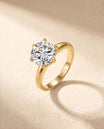
Satéur Destinée Ring™
The look of a flawless diamond, for 1% of the price.
Compare to a $10,000 mined diamond
Joined by 100,000+ couples across 150+ countries.
Discover The 1% RingFree worldwide shipping · 30-day returns · Lifetime Satéur Care
What "Fake Diamond" Actually Means
The phrase "fake diamond" is technically imprecise. It tends to collapse several distinct categories into one, which creates confusion about what testers are actually detecting.
- Diamond simulants: gems that look like diamonds but are a different material (cubic zirconia, glass, Satéur Gems®, and others)
- Lab-grown diamonds: chemically and physically identical to mined diamonds — not fake in any scientific sense
- Diamond-coated stones: glass or CZ with a thin diamond-like-carbon film — a misleading category that is rare in reputable retail contexts
- Misrepresented stones: a gem sold fraudulently as a diamond when it is not — this is where the term "fake" becomes legally relevant
A diamond tester addresses the first and last categories meaningfully. It identifies whether the stone in hand is diamond-type or not. It cannot resolve questions of misrepresentation, valuation, or certification. For that, a full laboratory report from an accredited grading body remains the only authoritative document.
A 6.5mm round brilliant moissanite, for example, weighs approximately 0.87 carats — slightly less than the 1.0 carat a mined diamond of the same diameter would weigh, due to moissanite's different specific gravity. A tester would return a moissanite reading on a dual-mode instrument. Neither result reflects on whether the gem is worth wearing. It simply tells you what it is.

Choosing Openly — The Alternative to the Tester Framing
The cultural preoccupation with diamond testers reflects a broader question: what do we want a gem to be? The tester's answer — "is this diamond or not?" — is a narrow one. It says nothing about beauty, craft, meaning, or longevity.
The more useful question is: what does this gemstone deliver, and at what cost? Moissanite offers vivid fire and laboratory certification at a fraction of diamond prices. Satéur Gems® offers the clean white brilliance of a D-E colour diamond, with Excellent cut precision and extreme durability, starting at $88 — approximately 1% of a comparable mined diamond. Lab-grown diamonds offer the real thing, certified, without the mining premium.
Each path is transparent. Each has its own advantages. None of them requires a tester to validate the choice. The Satéur approach — The New Diamond Standard® — is built on the idea that the intelligent choice is its own justification. A beautiful gem, openly chosen, is not diminished by what an instrument says about its composition.
Whether you are considering an engagement ring, a milestone gift, or a piece to wear every day, the Satéur 1% Ring collection and the engagement ring collection begin from that principle. The gem is exactly what it says it is. The look is exactly what you see.

Frequently Asked Questions About Diamond Testers
What is the difference between a diamond simulant and a mined diamond?
A diamond simulant is a different material engineered to replicate the visual appearance of a diamond — the colour, brilliance, and faceting. A mined diamond is carbon crystallised under geological pressure over millions of years. They share no chemical composition. A tester identifies them as different stone types, which is accurate. The simulant makes no claim to be diamond. Its value is the visual equivalence at a fraction of the cost — approximately 1% in the case of Satéur Gems®.
Can you wear a diamond simulant engagement ring every day?
Yes. Quality simulants such as Satéur Gems® are engineered for daily wear. Satéur Gems® rates approximately 8.8 on the Mohs scale — significantly harder than most materials encountered in daily life, including glass, most metals, and common dust. The gemstone will not cloud, chip, or dull under normal conditions. It is built to hold its brilliance for life.
How do diamond simulants perform under professional gemological inspection?
A trained gemologist examining a quality simulant will correctly identify it as a simulant. The refractive index, dispersion, and birefringence of materials such as Satéur Gems® differ from diamond in ways a range of instruments can reveal. This is expected. Satéur's position is one of transparency: the gem delivers the look of a flawless diamond to the naked eye, at approximately 1% of the price. Gemological classification and visual appeal serve different purposes.
What colour grades are available in diamond simulants?
Satéur Gems® achieves D-E colour grades with Excellent cut specifications — the top tier of the GIA diamond colour scale, the category reserved for colourless, optically pure stones. This places Satéur Gems® in the same colour band as the finest mined diamonds available. The clean, white brilliance is the material's defining visual characteristic and its primary differentiator from moissanite, which produces more coloured fire.
Why does a diamond simulant cost so much less than a mined diamond?
Diamond pricing is shaped by geological scarcity (or more precisely, the perception of it), a century of marketing infrastructure, and a global extraction and certification chain. The gem itself — crystallised carbon — is not the rarest mineral on earth. Simulants bypass the entire extraction, grading, and distribution structure. Satéur Gems® cost approximately 1% of a comparable mined diamond because the manufacturing process, not geological scarcity, determines the price. The look is the same. The cost structure is not.
How does fire in a diamond simulant compare to a mined diamond?
It depends on the material. Moissanite has a higher dispersion than diamond (refractive index approximately 2.65 versus diamond's 2.42), producing more rainbow fire — a vivid, coloured sparkle that some wearers prefer and others find distinct from diamond's character. Satéur Gems® is engineered differently: its dispersion and cut produce the clean, white brilliance associated with a flawless diamond rather than moissanite's more vivid fire. The two materials serve different aesthetic preferences within the simulant and alternative gem category.

















Leave a comment
This site is protected by hCaptcha and the hCaptcha Privacy Policy and Terms of Service apply.