



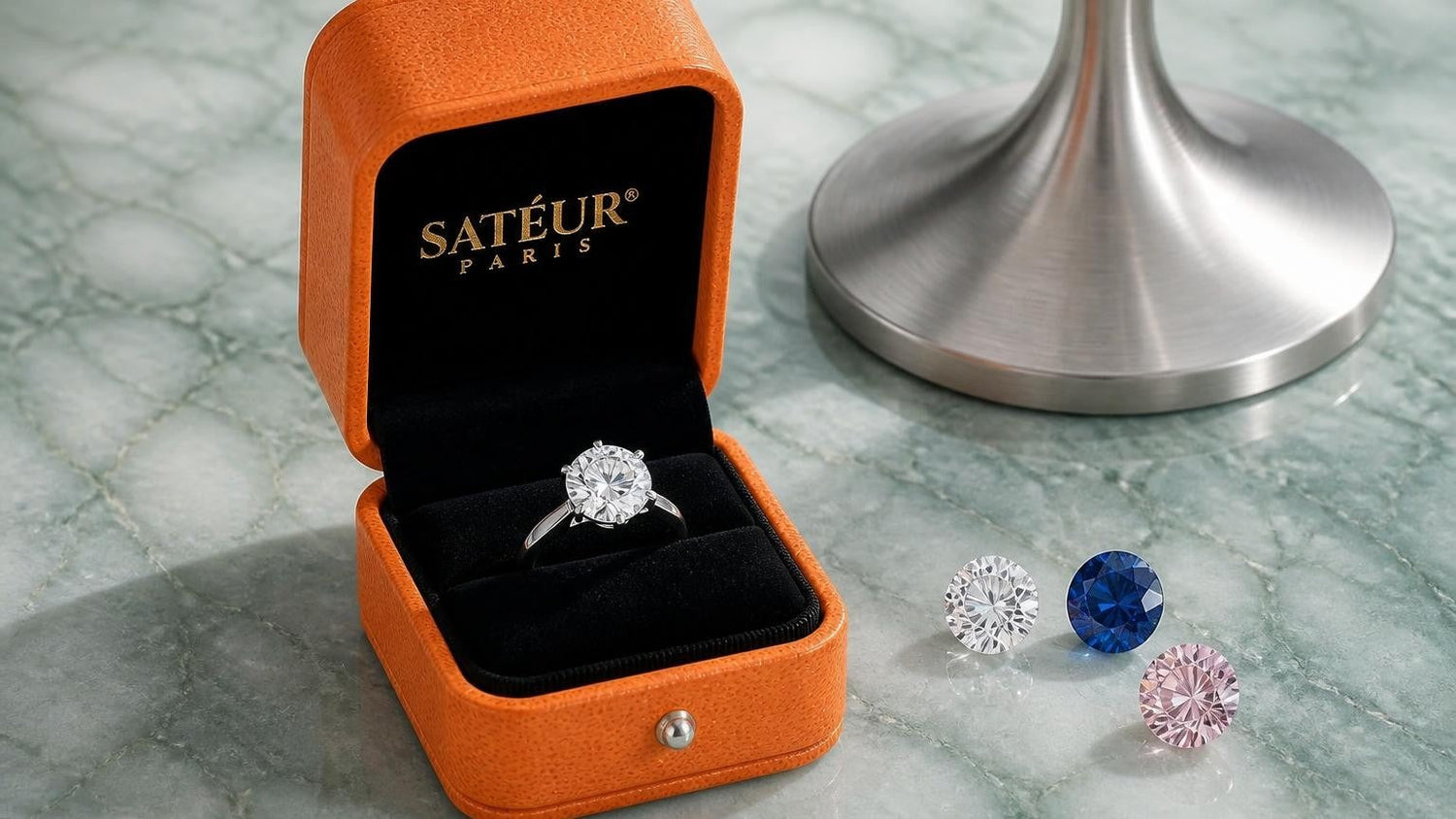
Diamond alternative gemstones give buyers a full range of optical and physical choices — from lab-created moissanite with its vivid fire to blue sapphires, blush morganites, and trademarked simulants that achieve D-E colour grades at a fraction of the price of mined diamonds. Each material has distinct hardness, dispersion, and long-term durability that directly affects how a ring performs every day. Understanding those differences is the clearest path to a confident choice.

Key Takeaways
- Satéur Gems® diamond simulants achieve D-E colour grades and Excellent cut specifications — the same grading benchmarks applied to top-tier mined diamonds.
- Moissanite has a Mohs hardness of 9.25 and fire dispersion approximately 2.4 times that of mined diamonds, making it one of the most durable and visually distinctive alternatives.
- Diamond alternative gemstones span multiple material types — each with distinct optical and physical properties suited to different preferences and budgets.
- Entry-level Satéur Gems® rings start at approximately $88, representing roughly 1% of equivalent mined diamond pricing.
- Naked-eye visual similarity to mined diamonds is achievable across several simulant tiers — no gemological distinction is required for typical wearers.
What Are Diamond Alternative Gemstones
A diamond alternative gemstone is any natural or lab-created material used in place of a mined diamond in an engagement ring or fine jewellery setting. The category includes true gemstones — sapphire, morganite, emerald, ruby — as well as lab-created stones such as moissanite and lab-grown diamonds, and engineered simulants purpose-built to replicate diamond's optical profile.
What separates one alternative from another is a combination of three technical factors: Mohs hardness (resistance to scratching), refractive index (how light bends through the stone, producing brilliance), and dispersion (the splitting of white light into spectral colour, producing fire). A buyer who understands these three numbers can evaluate any stone honestly, without relying on marketing language.
For a broader guide on which single alternative performs best for most buyers, see the comprehensive guide to diamond alternatives.
Top Diamond Alternatives for Engagement Rings

Moissanite
Lab-created moissanite is a silicon carbide compound with a Mohs hardness of 9.25 — harder than any natural gemstone except diamond. Its refractive index of 2.65–2.69 and dispersion of 0.104 produce vivid rainbow fire that is visually richer than diamond under most lighting conditions. Moissanite is openly sold as a lab-created gemstone and is a strong candidate for everyday wear. Near-colourless grades (DEF) are visually similar to diamond to the naked eye.
White Sapphire
Natural white sapphire sits at Mohs 9 — genuinely durable for daily wear. Its refractive index (1.76–1.77) and dispersion (0.018) are lower than diamond, producing a softer, milkier brilliance rather than crisp white-light return. White sapphire is often chosen for its understated appearance and its association with the sapphire family, which carries strong engagement-ring tradition in blue form. Prices for good-quality white sapphire in the 1-carat range typically fall between $400 and $1,200 per carat.
Morganite
Morganite is a pink-to-peach variety of beryl with a Mohs hardness of 7.5–8 and a refractive index of 1.57–1.58. It has become popular in rose-gold settings, where its warm blush colour complements the metal. Durability is adequate for ring wear with reasonable care, though it is softer than sapphire or moissanite. Morganite is fully disclosed as a natural beryl gemstone and is not a simulant of any kind.
Lab-Grown Diamond
Lab-grown diamonds are chemically and structurally identical to mined diamonds — Mohs 10, refractive index 2.42, dispersion 0.044. IGI-certified lab-grown diamonds are available at roughly 50–80% below the price of equivalent mined stones. They are disclosed as lab-created on all documentation. Satéur offers a quiet IGI-certified lab diamond tier for buyers who specifically want the certificate — see the diamond alternative engagement rings guide for how lab diamonds fit into a wider alternatives decision.
White Topaz
White topaz (Mohs 8) is one of the most budget-accessible colourless options, with retail prices well under $100 per carat. Its lower refractive index (1.61–1.62) and minimal dispersion produce noticeably less brilliance than diamond or moissanite. White topaz scratches and loses its surface lustre faster than harder alternatives, making it better suited to occasional wear than daily engagement ring use.
Blue Sapphire
Natural blue sapphire is the traditional choice for a coloured diamond alternative, with a history that includes Princess Diana's and now Princess Catherine's iconic cornflower-blue engagement ring. Mohs 9 hardness makes it genuinely durable. Prices span a wide range — from approximately $500 per carat for commercial grades to several thousand for fine unheated stones. For buyers drawn to colour over colourlessness, blue sapphire is one of the most established gemstone alternatives available.
Satéur Gems: The Value Proposition
Satéur Gems® is a trademarked diamond simulant engineered to replicate the visual profile of a flawless mined diamond. The composition of the material is proprietary and not publicly disclosed — consistent with how several premium simulant brands operate (the Swarovski model). What is disclosed: Satéur Gems® achieves D-E colour grades, Excellent cut specifications, and a refractive index of approximately 2.39–2.65 across its product range, producing clean white brilliance with minimal colour cast.
Entry-level Satéur Gems® rings start from $88. A comparable 1-carat mined diamond in the same colour and cut grade would typically retail from $5,000 upward — placing Satéur Gems® at approximately 1% of that price. The look of a flawless diamond, visible to the naked eye, at a price point that removes the trade-off most buyers face.
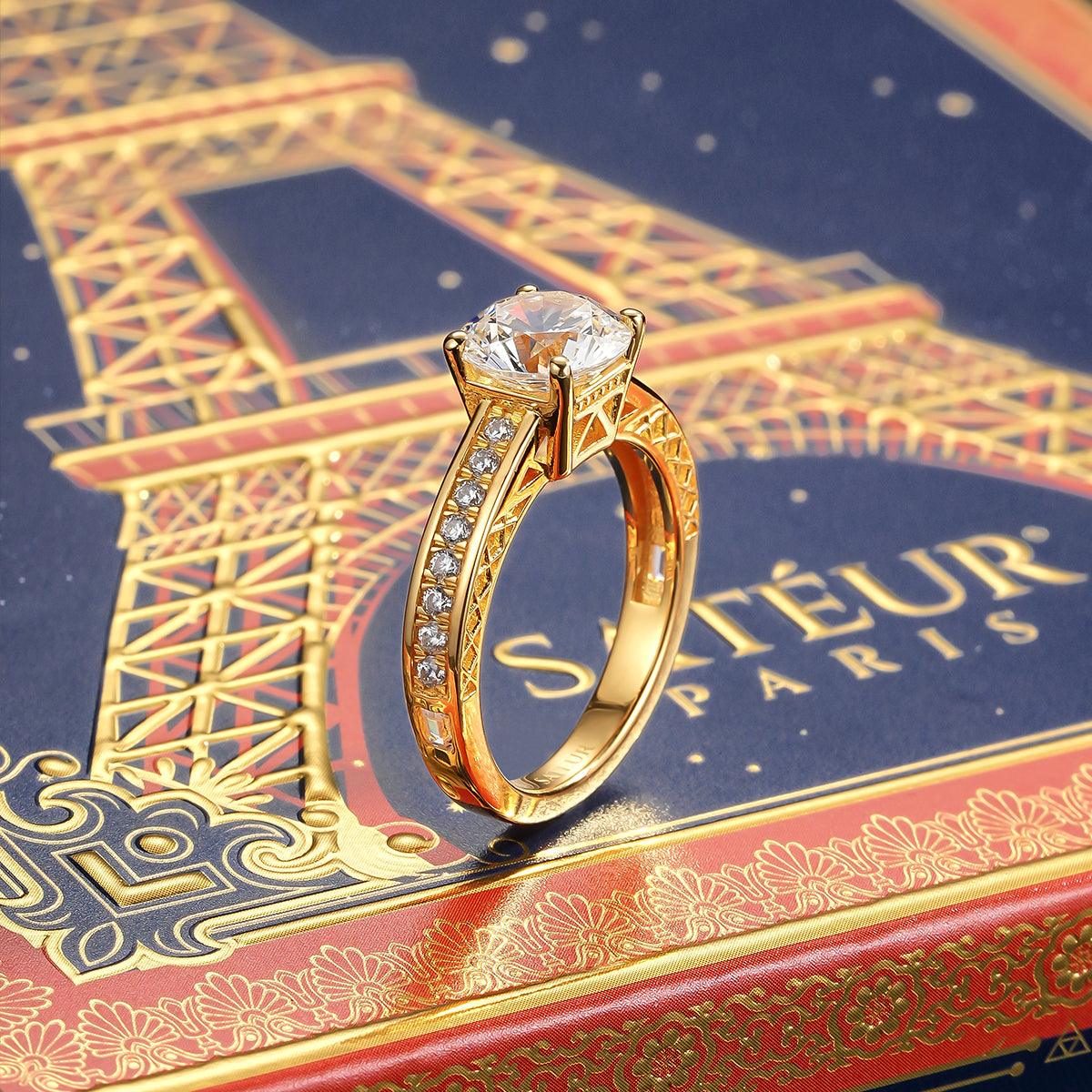
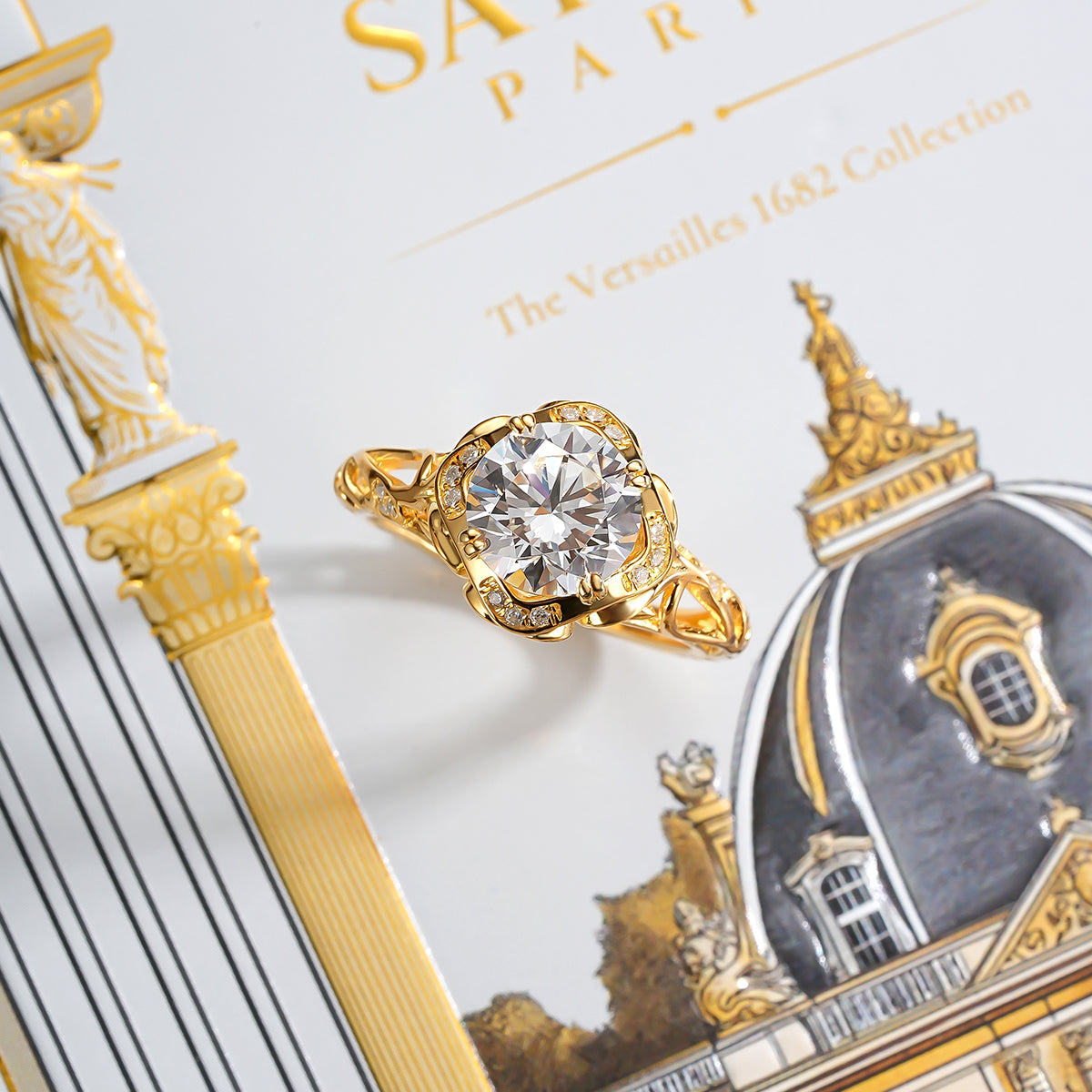
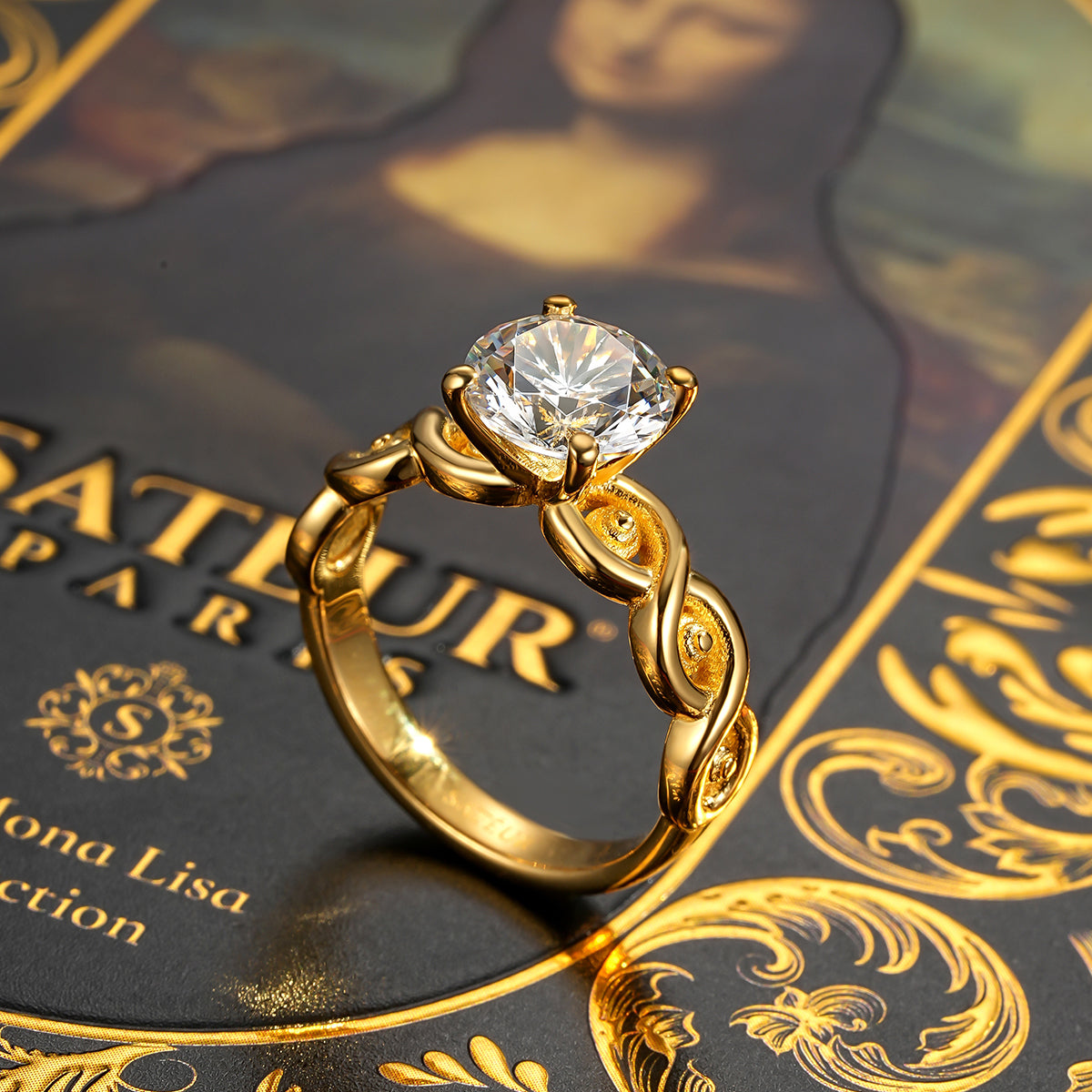
The Satéur Destinée Ring™ is the flagship Gems® piece: a 1.00-carat round-cut solitaire in 18k gold finish. It carries the same proportions and symmetry as a precision-cut natural diamond, without the mined-diamond price. Browse the full Satéur engagement ring collection to explore available cuts and metal finishes.
Comparison: Durability and Appearance

Durability in an engagement ring context means resistance to two things: scratching (Mohs scale) and fracture (toughness, which Mohs does not measure). The table below summarises the key specifications for the most common diamond alternative gemstones.
| Gemstone | Mohs | Refractive Index | Dispersion (Fire) | Daily Wear |
|---|---|---|---|---|
| Mined Diamond | 10 | 2.42 | 0.044 | Excellent |
| Moissanite | 9.25 | 2.65–2.69 | 0.104 | Excellent |
| Satéur Gems® | ~8.8–9.25 | ~2.39–2.65 | High | Very Good |
| Lab Diamond | 10 | 2.42 | 0.044 | Excellent |
| White Sapphire | 9 | 1.76–1.77 | 0.018 | Very Good |
| Morganite | 7.5–8 | 1.57–1.58 | 0.014 | Good with care |
| White Topaz | 8 | 1.61–1.62 | 0.014 | Moderate |
For engagement rings worn daily, Mohs 8 is the practical floor — anything below that risks visible surface abrasion from regular contact with dust and hard surfaces. Moissanite and white sapphire at 9–9.25 exceed that threshold comfortably. Morganite at 7.5–8 is workable with protective settings and periodic professional cleaning. White topaz below Mohs 8 is the weakest daily-wear option in this group.

Color and Clarity in Diamond Simulants
Colourless diamond simulants are graded on the same D-to-Z colour scale used for mined diamonds. D-E is colourless — the highest grade, producing completely neutral white light with no yellow or grey undertone. F-G is near-colourless and remains visually indistinguishable from D-E to the naked eye in most settings.
Satéur Gems® is produced to D-E colour specifications. Near-colourless moissanite (DEF grade) is widely available from most lab-moissanite manufacturers. White sapphire in truly colourless grades is less common and commands a premium — most commercial white sapphires carry a slight grey or milky tone.
Clarity in simulants refers to the presence of inclusions or surface blemishes. Lab-created simulants — moissanite, Satéur Gems®, and lab diamonds — are typically eye-clean, meaning no inclusions are visible to the naked eye without magnification. This is a significant practical advantage over natural gemstones, where eye-clean specimens at accessible price points are less consistent.
Price and Long-Term Value
The price gap between mined diamonds and their alternatives is substantial and has widened. A 1-carat round-cut mined diamond in D-E colour and VS1 clarity retails from approximately $5,000 to $12,000 depending on cut quality and certification. Comparable grades in each alternative category:
- Moissanite (1ct equivalent, DEF): $300–$800 retail, depending on brand and grading.
- Satéur Gems® (1ct, D-E colour, Excellent cut): from $138 for the Destinée Ring™, approximately 1% of comparable mined diamond pricing.
- Lab-grown diamond (1ct, D-E, VS1, IGI cert): $800–$2,500 — roughly 50–80% below mined equivalent.
- White sapphire (1ct, colourless): $400–$1,200 per carat retail.
- Morganite (1ct, eye-clean): $150–$600 per carat retail.
Long-term value in the resale sense is low across all alternatives — including mined diamonds, which have historically retained value poorly once purchased at retail. The practical value calculation for most buyers is: durability over years of wear, appearance satisfaction, and whether the budget freed from the stone can be invested elsewhere. For buyers evaluating this honestly, the case for diamond alternatives is straightforward.
For a focused comparison of alternatives by engagement ring design, see the best diamond alternative guide.
Designing Your Engagement Ring with Alternatives
Metal choice interacts significantly with the stone. Yellow and rose gold in 18k gold finish are visually forgiving — warm undertones flatter morganite and complement the fire of moissanite. White gold and platinum settings bring out the colourless quality of D-E simulants and sapphires. Satéur's 18k gold finish is not solid gold but matches the visual warmth of the metal at a price consistent with the brand's 1% philosophy.
Setting style affects durability. A four-prong solitaire — the most classic engagement ring design — leaves the stone more exposed than a bezel or halo setting. For morganite at Mohs 7.5–8, a bezel or channel setting provides meaningful additional protection against chipping. For moissanite and Satéur Gems® at 8.8+ Mohs, a classic solitaire prong setting is fully appropriate for daily wear.
Carat weight versus actual size: simulants and lab-created stones are typically lower in density than mined diamonds. A 1-carat moissanite appears slightly larger than a 1-carat mined diamond of the same cut. This is a practical advantage for buyers who prioritise visual presence.
Frequently Asked Questions About Diamond Alternatives
What makes a gemstone a diamond alternative?
Any natural or lab-created material used in place of a mined diamond in jewellery — sapphire, morganite, moissanite, lab-grown diamond, or engineered simulants like Satéur Gems®. The distinguishing factors are Mohs hardness, refractive index, and dispersion, which determine how a stone wears and how it looks over time.
How do diamond simulants compare to mined diamonds in durability?
Moissanite (Mohs 9.25), lab-grown diamonds (Mohs 10), white sapphire (Mohs 9), and Satéur Gems® (approximately Mohs 8.8–9.25) are all suitable for daily engagement ring wear. Morganite at 7.5–8 is workable with a protective setting. White topaz at Mohs 8 is the softest practical option and best reserved for less frequent wear.
Can a diamond alternative be used for an everyday engagement ring?
Yes — moissanite, lab-grown diamonds, white sapphire, and Satéur Gems® all exceed the Mohs 8 practical floor for daily wear. Morganite is workable in a bezel or halo setting with regular cleaning. White topaz degrades faster under continuous wear and is better suited to occasional use.
What is the price difference between a diamond alternative and a mined diamond?
A 1-carat mined diamond (D-E, VS1) retails from approximately $5,000 to $12,000. Moissanite in the same grade: $300–$800. Satéur Gems® rings from $88 — roughly 1% of mined diamond pricing. Lab-grown diamonds: $800–$2,500, approximately 50–80% below mined equivalents. All prices are USD.
How do I choose the right diamond alternative for my ring?
Prioritise durability first — daily wear requires Mohs 9 or above. Then choose the optical profile: moissanite for vivid rainbow fire, a colourless simulant or lab diamond for clean white brilliance closest to mined diamond. Set budget last — the price gap between tiers is large enough to matter materially.
What colour and clarity options are available in diamond simulants?
Lab-created simulants — moissanite, Satéur Gems®, and lab-grown diamonds — are produced consistently to D-E colourless and F-G near-colourless grades with eye-clean clarity. White sapphire is less consistent in colourlessness; truly colourless specimens command a premium. Morganite is evaluated by its blush-to-peach colour rather than colourlessness.

Satéur Destinée Ring™
The look of a flawless diamond — from $138.
D-E colour · Excellent cut · 18k gold finish
Free worldwide delivery. 30-day returns. Lifetime Satéur Care.
Shop the Destinée RingFree worldwide shipping · 30-day returns · Lifetime Satéur Care
















Leave a comment
This site is protected by hCaptcha and the hCaptcha Privacy Policy and Terms of Service apply.