





The average women's engagement ring size in the US is 6 to 6.5 — but that average means nothing if you are not measuring correctly. Measure your finger (or an existing ring) in millimetres, find your size on the chart below, and you will know within 30 seconds whether you need to order up or hold steady.
This guide gives you the full ring size conversion table — US, UK, EU sizes with inner diameter in mm and circumference — plus three measuring methods, a printable sizer, and the fitting rules that most guides skip.
Key Takeaways
- Measure inner circumference in mm, then divide by 3.14 for inner diameter — that number maps directly to the chart below.
- The average women's ring size is 6–6.5 (US); men's is 8.5–10.5 (US).
- Measure at the end of the day: fingers are at their largest then; cold mornings produce readings up to half a size small.
- Size up a half size for any band wider than 6 mm — wider metal compresses the finger.
- Most rings can be resized 1–2 sizes; significant alterations may affect pavé settings or engraving.
How to Find Your Ring Size
Ring size is simply a standardised label for the inner circumference of a ring. Every system — US numerical, UK alphabetical, EU numerical — maps to a circumference in millimetres. That measurement is the anchor; everything else is a conversion. The most reliable path is: measure in mm → look up the chart → confirm against an existing ring if you have one.
Fingers change size through the day, across seasons, and with hydration. The rules of thumb that protect against a bad reading: measure at the end of the day, measure twice, and measure on the hand you plan to wear the ring on.
Ring Size Chart (US / UK / EU / mm)
The table below covers US sizes 3 through 13 in half-size increments — the full range for women's and men's engagement rings. Inner diameter and circumference are in millimetres, accurate to one decimal place.
| US Size | UK Size | EU Size | Inner Diameter (mm) | Inner Circumference (mm) |
|---|---|---|---|---|
| 3 | F | 44 | 14.1 | 44.2 |
| 3.5 | G | 45.5 | 14.5 | 45.5 |
| 4 | H | 47 | 14.9 | 46.8 |
| 4.5 | I | 48 | 15.3 | 48.0 |
| 5 | J–K | 49 | 15.7 | 49.3 |
| 5.5 | K–L | 50.5 | 16.1 | 50.6 |
| 6 | L–M | 52 | 16.5 | 51.8 |
| 6.5 | M–N | 53 | 16.9 | 53.1 |
| 7 | N–O | 54 | 17.3 | 54.4 |
| 7.5 | O–P | 55.5 | 17.7 | 55.7 |
| 8 | P–Q | 57 | 18.1 | 56.9 |
| 8.5 | Q–R | 58 | 18.5 | 58.2 |
| 9 | R–S | 59 | 18.9 | 59.5 |
| 9.5 | S–T | 60.5 | 19.4 | 60.8 |
| 10 | T–U | 62 | 19.8 | 62.1 |
| 10.5 | U–V | 63 | 20.2 | 63.4 |
| 11 | V–W | 64 | 20.6 | 64.7 |
| 11.5 | W–X | 65.5 | 21.0 | 66.0 |
| 12 | X–Y | 67 | 21.4 | 67.2 |
| 12.5 | Y–Z | 68 | 21.8 | 68.5 |
| 13 | Z | 69 | 22.2 | 69.8 |
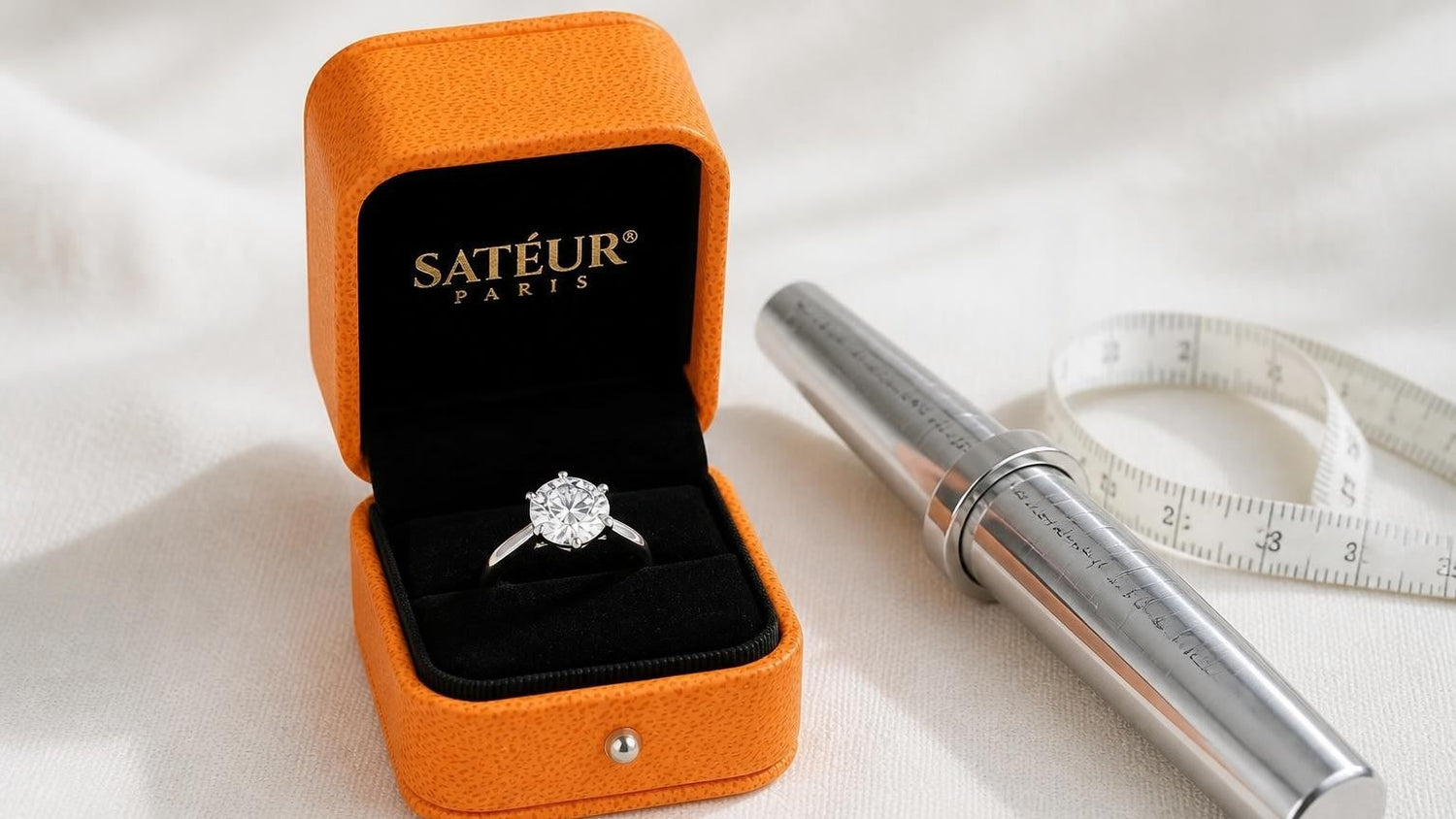
To use the chart as a converter: measure the inner circumference of an existing ring in mm and find the matching row. Or measure your finger circumference directly and look it up in the rightmost column. If your measurement falls between two rows, select the larger size. For a quick printable ring size chart, use the Satéur dedicated page — it includes a cut-out paper sizer you can wrap around your finger at home.

Measure with an Existing Ring
If you have a ring that already fits well on the correct finger, this is the most accurate home method. Place it face-down on a piece of paper and trace the inner circle. Measure the diameter of that circle — the distance across the inside, not the outside. Compare to the Inner Diameter column in the chart above.
- Use the ring from the same hand and same finger you plan to wear the new ring on — ring fingers differ between hands.
- If the ring is a half size between two rows, size up.
- Eternity bands with stones all the way round measure slightly smaller than solitaires of the same nominal size — size up half a size if ordering a full eternity.
For a UK size letter, use the Satéur ring size guide which maps the diameter directly to both UK and US scales.

Measure with String or Paper Strip
Cut a strip of paper roughly 10 mm wide and 10 cm long, or use a piece of string. Wrap it snugly around the base of the finger you plan to wear the ring on — snug enough to feel, loose enough to slide over the knuckle. Mark the point where the strip meets itself. Lay it flat and measure the length in millimetres with a ruler. That is your inner circumference — look it up in the rightmost column of the chart.
- Measure at the end of the day, when fingers are at their fullest.
- In cold weather, fingers can shrink by up to a half size — add 0.5 US if you are measuring in winter.
- If your knuckle is noticeably wider than the base of your finger, size for the knuckle and accept a slightly loose fit at the base, or ask your jeweller about a sizing bar insert.
Printable Ring Sizer
A printable ring sizer is a paper template with pre-marked size slots or a graduated ring-sizer strip. Print it at 100% scale (do not use "fit to page" — this stretches the template and gives a wrong reading), cut out the strip, and fold it through the slot to form a loop around your finger.
The Satéur printable ring size chart is designed for home use: print, cut, and measure in under two minutes. It covers US, UK and EU sizes with the corresponding mm diameter printed beside each slot so you can cross-reference against this chart.
Getting the Right Fit (Knuckle · Temperature · Band Width)

Three variables cause more poorly fitting rings than any measuring error:
Knuckle width
If your knuckle is wider than the base of your finger, the ring needs to pass over the knuckle but sit snugly at the base. The rule: measure both the knuckle circumference and the base circumference, then size between the two — closer to the knuckle if the gap is large. A well-fitting ring should require light resistance to come off, not force.
Temperature and time of day
Fingers are at their smallest first thing in the morning and when cold, and at their largest in the evening and in warm weather. Always measure at the end of the day. If you are between sizes and live in a cold climate, size up; if you live in a warm climate year-round, your room-temperature reading is likely accurate.
Band width
A narrow band (under 3 mm) sits loosely and matches your measured size exactly. A wider band (6 mm or more) compresses more of the finger and effectively runs small. Size up half a size for any band 6–8 mm wide; size up a full size for anything over 8 mm. This is particularly relevant for wedding bands, which tend to run wider than solitaire engagement rings.

Measuring Her Size Secretly
Proposing without knowing the size is common. There are three reliable approaches:
- Borrow an existing ring. Take a ring she wears on her ring finger, trace the inside on paper, and measure the diameter. This is the most accurate secret method. Return the ring within a few hours.
- Ask a close friend or family member. Someone in her circle may know her size, or be willing to ask naturally.
- Estimate from context. The average women's ring size in the US is 6–6.5. If her hands appear smaller than average, start at 5.5–6; larger, start at 7. Always size up rather than down — resizing down is easier than up for most ring styles.
All Satéur engagement rings can be exchanged for a different size. See the Satéur sizing policy for current exchange terms — a worry-free option when proposing blind.
Ring Resizing
Most rings can be resized 1–2 sizes up or down by a jeweller. The process involves cutting the band, adding or removing metal, and soldering it closed. A straightforward resize on a plain gold or platinum band takes one to three days and costs between $50 and $150 at most jewellers.
Resizing becomes more complex — and in some cases impossible — in the following situations:
- Eternity bands with stones set all the way around the shank (adding metal disrupts the stone pattern).
- Rings with significant engraving on the inside of the band (the cut removes the text).
- Tungsten, titanium, and some stainless steel rings — these metals cannot be cut and re-soldered. Replacement is usually the only option.
- Resizing more than 2 sizes in either direction risks distorting the shape of the ring or weakening the structural integrity of the setting.
For a rough size estimate before purchasing, visit the how to figure out ring size guide on sateur.com — it walks through three measurement methods with illustrated diagrams.
The Satéur Destinée Ring™

The Satéur Destinée Ring™ is the piece that defines The New Diamond Standard® — a round-cut Satéur Gems® centrepiece, hand-set in an 18k white-gold finish band, with the clean, white brilliance of a flawless diamond. Available from 1 to 7 carats. From $68.
- The look. Visually indistinguishable from a fine diamond with the naked eye — crisp, white, brilliant, with a D–F colour grade.
- The price. From $68. Compare to a $10,000 mined diamond solitaire.
- The fit. All Satéur engagement rings are available across a full range of ring sizes. If your size is uncertain, Satéur's team can advise.
Browse the full Satéur engagement ring collection — the 1% Ring® that over 100,000 couples across 150+ countries chose instead.
Satéur Destinée Ring™
The look of a flawless diamond — from $138.
Compare to a $10,000 mined diamond
Chosen by 100,000+ couples across 150+ countries.
Shop the Destinée RingFree worldwide shipping · 30-day returns · Lifetime Satéur Care
Engagement Ring Size FAQs
How do I know my engagement ring size?
Measure the inner circumference of your finger in millimetres using a strip of paper or string, then look up that number in the circumference column of the chart above. Alternatively, measure the inner diameter of an existing well-fitting ring and match it to the diameter column. The average women's US ring size is 6–6.5; if you are between sizes, size up.
How can I measure her ring size without her knowing?
The most reliable method is to borrow a ring she already wears on her ring finger. Place it on paper, trace the inner circle, and measure the diameter. Match that measurement to the inner diameter column in the chart above. If borrowing is not possible, the average women's ring size in the US is 6–6.5 — start there and size up. All Satéur engagement rings can be exchanged if the size is not quite right.
What is the 3-month rule for engagement rings?
The three-month salary guideline was a marketing convention created by De Beers in the 1980s to increase diamond sales. It has no basis in etiquette or tradition. Most couples today spend what is comfortable for their financial situation — the ring's meaning is not linked to its price.
Can a ring be resized?
Most rings can be resized 1–2 sizes up or down by a jeweller. Plain gold and platinum bands are straightforward to resize. Eternity rings with stones set all the way around the shank are difficult or impossible to resize without disturbing the stone setting. Tungsten and titanium bands cannot be cut and re-soldered — replacement is typically the only option for those metals.


















Leave a comment
This site is protected by hCaptcha and the hCaptcha Privacy Policy and Terms of Service apply.