




Hidden Halo Engagement Rings: What the Setting Is and Why It Endures
A hidden halo engagement ring places a ring of small accent gemstones directly beneath the centre stone — tucked into the base of the setting rather than displayed around its crown. From above, the ring reads as a clean solitaire. From the side, a halo of light lifts the centre gem, making it appear to float. The effect is architectural without being ornate. It is the kind of detail a wearer notices before anyone else does.
For those drawn to engagement rings that reward closer attention, the hidden halo has become a lasting choice. This guide explains how the setting works, which centre stone shapes suit it best, how it sits against a wedding band, and why Satéur Gems® make an exceptional centre stone for the design.
Key Takeaways
- A hidden halo sets accent stones beneath the centre gem, below the girdle — the halo is visible from the side, not the top.
- The design suits round, cushion, oval, and emerald centre stone shapes particularly well.
- Hidden halo rings sit flush against most flat or low-profile wedding bands without a visible gap.
- Satéur Gems® — D–E colour, Excellent cut — deliver the visual presence of a flawless diamond in this setting at approximately 1% of the price.
- Entry price for a hidden halo engagement ring with a Satéur Gems® centre starts at approximately £88.
- The under-halo design eliminates the crown-width problem that makes traditional halo rings harder to pair with a wedding band.
What Is a Hidden Halo Setting
A traditional halo setting encircles the centre stone with a band of smaller accent gems at the same level as its crown — visible from every angle, including from above. A hidden halo reverses the logic. The accent stones are set into a groove or ledge on the underside of the centre stone's mount, so they remain concealed when the ring is viewed face-on.
The practical effect is a clean profile from above and a luminous one from the side. When light enters the ring at an angle — across a table, in candlelight, during a conversation — the hidden stones scatter brightness upward through the base of the centre gem. The centre stone appears larger and more dimensional than its carat weight alone would suggest.
The setting developed as jewellers sought to answer a persistent request: the visual warmth and perceived size-increase of a halo, without the added width at the crown that a traditional halo introduces. Hidden halos achieve this by moving the accent stones down, below the girdle, where they enhance the centre stone without competing with it. The ring's profile stays slender. The setting's intelligence becomes visible only when the ring is turned in the light.
It is a design that rewards the wearer rather than the observer — which is precisely why it has remained in consistent demand, independent of trend cycles.
Shapes That Work Best With an Under-Halo Design
Not every centre stone shape benefits equally from an under-halo setting. The design works best when the accent stones can be fitted snugly and symmetrically beneath the base of the centre gem, following its natural outline.
Round brilliant centres are the most natural pairing. The circular footprint of a round gemstone accommodates a uniform ring of accent stones beneath it with no awkward spacing. The brilliance of the centre gem and the hidden halo reinforce each other directly beneath the table facet, with light bouncing between the two planes.
Cushion cuts share a broadly rounded outline and suit the setting for similar reasons. The softer corners allow the accent stones to follow the perimeter without sharp transitions, and the cushion's characteristic warmth is amplified by the sub-girdle light.
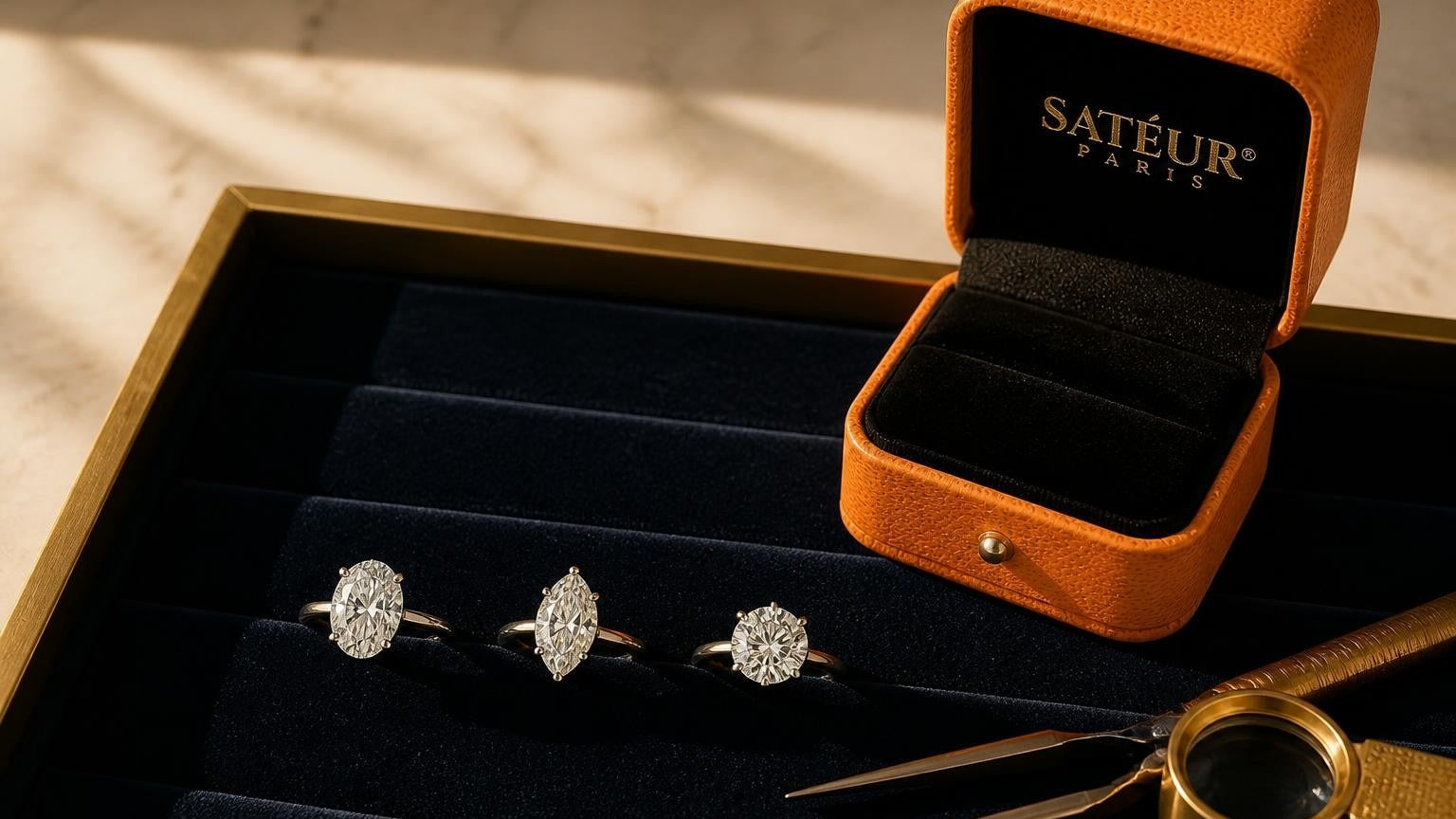
Oval centres work well when the hidden halo follows the elongated shape. The added apparent length of an oval is amplified further by the ring of light beneath it, creating a particularly graceful effect — the centre stone appears to stretch both longer and taller simultaneously. Oval halo engagement rings built on this principle are among the most photographed engagement ring styles in current circulation.
Emerald cuts — with their rectangular step facets and open, mirror-like table — benefit from hidden halos in a different way. The halo adds brilliance beneath a gemstone that is by nature quieter than a brilliant cut, bringing warmth and movement without disrupting the stone's characteristic directional clarity. The result is an emerald-cut ring that reads as sharp from above and alive from the side.
Pear and marquise shapes can accommodate hidden halos, though the pointed tips require precision setting work to maintain symmetry. Princess cuts are less common in hidden halo designs because the square corners limit how closely the accent stones can follow the outline without creating visible gaps or requiring individual prong settings at each corner.

Satéur Gems® Hidden Halo Value
The hidden halo setting is, at its core, a precision design. It demands a centre stone that holds its presence — one whose colour and cut justify the architectural work beneath it. Satéur Gems® are built for exactly that role.
Each Satéur Gems® centre stone is graded D–E colour and cut to Excellent standard. The result is the clean, white brilliance of a flawless diamond — diamond-accurate in its optical character, with none of the rainbow dispersion that reads as something other than the intended stone. In a hidden halo ring, where the design exists to elevate the centre gem, this precision matters. The accent stones beneath should amplify what is already there, not compensate for a centre that lacks presence.
The comparative value position is direct. A round brilliant diamond of equivalent D–E colour and Excellent cut — the type of gemstone a hidden halo setting was originally designed around — retails from $8,000 to $15,000 for one carat. A Satéur Gems® hidden halo engagement ring begins at approximately £88. The construction is identical. The look, viewed with the naked eye, is indistinguishable. The price differential is a matter of record, not of opinion.
This is The New Diamond Standard applied to one of fine jewellery's most considered settings. Over 100,000 customers across 150 countries have chosen a different path. The hidden halo ring is one expression of that choice — a design where every structural decision exists in service of a single outcome: a centre stone that commands attention without announcing its cost.
For those who prefer a lab-created gemstone with more fire, the moissanite hidden halo ring collection offers the same under-halo architecture with a moissanite centre stone — openly disclosed, vivid, and set to the same construction standard.

Satéur Destinée Ring™
The look of a flawless diamond, for approximately 1% of the price.
Compare to a $10,000 mined diamond
Joined by 100,000+ couples across 150+ countries.
Discover The 1% RingFree worldwide shipping · 30-day returns · Lifetime Satéur Care

Pairing a Hidden Halo Ring With Your Wedding Band
One of the practical advantages of the hidden halo design is how it sits against a wedding band. Because the accent stones are positioned beneath the centre stone rather than around its perimeter at crown level, the outer profile of the ring at the crown remains narrow. Most plain wedding bands — flat court, D-shaped, and straight-edged styles — sit flush against a hidden halo engagement ring without a visible gap or a need for custom fitting.
A traditional halo setting creates a raised perimeter of accent stones that can make flush pairing difficult. Couples either accept a small gap between the two rings or commission a custom-shaped shadow band that follows the halo's contour. The hidden halo avoids this entirely. The under-setting keeps the crown narrow; the wedding band rests against the shank, meeting the engagement ring at a clean line.
For those who want both rings to complement each other visually, a slender pavé or eternity band in matching metal shares the language of small accent gemstones without duplicating the hidden halo's defining structural feature. The hidden halo works from below; the wedding band works from the finger. Each holds its own position without competing.
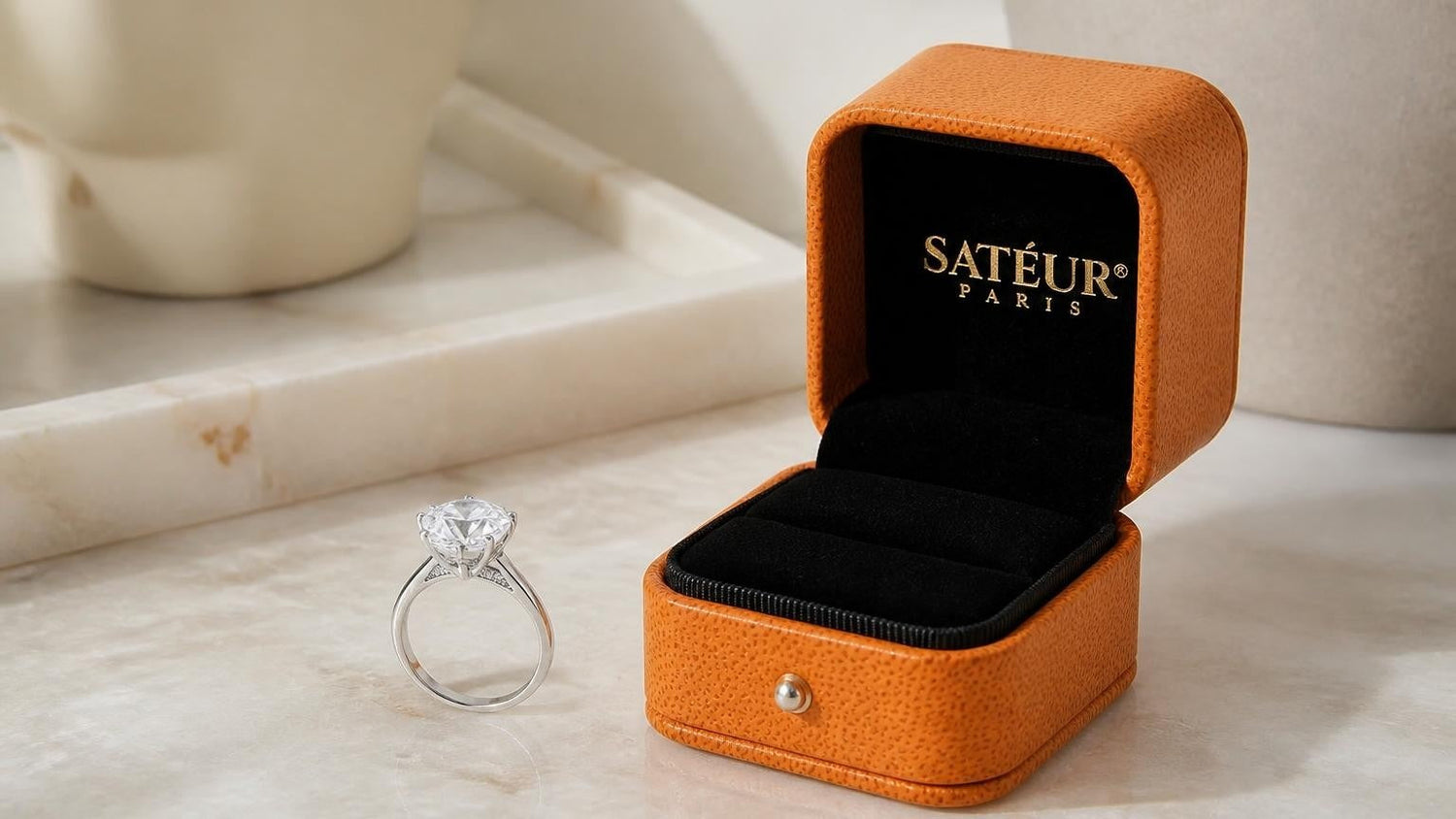
Metal choice follows the same logic. The 18k white gold finishing of the Satéur Destinée Ring™ reads cleanly against both yellow gold and platinum wedding bands. Where the hidden halo provides brilliance from below, a yellow gold band adds warmth from the side — a combination that has gained consistent traction as a deliberate two-tone pairing rather than a mismatch.
For those exploring the full range of hidden halo ring designs, the Satéur collection includes both single-band and tapered-shank configurations, each engineered with the same under-setting approach and the same Satéur Gems® standard.
The wedding band question, ultimately, resolves itself when the engagement ring is designed with that pairing in mind from the outset. The hidden halo was built as a solution, not a compromise — and the pairing ease it offers is one of the reasons it has remained a consistent choice across engagement ring categories.
Those drawn to other The 1% Ring configurations — including the clean solitaire — will find that the same Satéur Gems® centre stone standard applies across every setting. The hidden halo is one expression of the same underlying position: maximum visual presence, at a fraction of the cost a traditional diamond industry would assign to it.

Frequently Asked Questions
What is a hidden halo engagement ring?
A hidden halo engagement ring features a row of small accent gemstones set beneath the centre stone, in the space between the girdle of the centre gem and the top of the ring's shank. From above, the ring reads as a solitaire. From the side, the hidden stones create a ring of light that lifts the centre gem and makes it appear larger. The design offers the visual warmth of a halo setting with a narrower crown profile and simpler wedding band pairing.
Which centre stone shapes complement a hidden halo setting best?
Round brilliant and cushion cuts are the most natural fit, as their curved outlines allow accent stones to follow the perimeter evenly beneath the girdle. Oval shapes work particularly well when the hidden halo follows the elongated form, amplifying both the apparent length and depth of the centre stone. Emerald cuts benefit from the added brilliance a hidden halo introduces beneath their characteristically quiet step facets. Princess cuts and pointed shapes such as pear or marquise are less common because the corners require more precision to set cleanly at the sub-girdle level.
How does a hidden halo differ from a traditional halo design?
A traditional halo sets accent stones around the perimeter of the centre gem at crown level — visible from above, adding apparent width and a decorative frame. A hidden halo moves the accent stones below the centre gem's girdle, so they are invisible from the top and visible only from the side. The crown profile stays narrow. Wedding band pairing is simpler. The ring reads as a clean solitaire in most lighting and reveals its depth only when examined from the side or caught in angled light.
Can I wear a wedding band with a hidden halo engagement ring?
Yes — the hidden halo is one of the more wedding-band-friendly engagement ring designs. Because the accent stones sit below the crown rather than around it, the outer profile at the top of the ring stays narrow. Most straight-edged wedding bands — flat court, D-shaped, plain pavé — sit flush without a visible gap. A contoured or shadow band is rarely necessary. Slender pavé or plain court bands in matching metal are the most common pairings.
What centre stone options are available for hidden halo rings?
Satéur hidden halo rings are available with three centre stone types. Satéur Gems® — the Maison's flagship trademarked diamond simulant, graded D–E colour, Excellent cut, delivering the clean white brilliance of a flawless diamond at approximately 1% of the price. Moissanite — a lab-created gemstone with more fire than a diamond, vivid in its dispersion, openly disclosed. Lab Diamond — IGI-certified, grown in a laboratory, chemically and optically identical to a mined diamond. All three are available in round and select fancy shapes across the hidden halo collection.
How do I care for and clean a hidden halo setting?
The hidden halo requires slightly more attention than a plain solitaire because the sub-girdle compartment can accumulate soap residue and fine dust. A soft toothbrush with warm water and a small amount of mild dish soap, worked gently beneath the centre stone, is sufficient for regular maintenance. An ultrasonic jewellery cleaner is safe for Satéur Gems® and moissanite centres and will reach the hidden halo compartment effectively. Rinse thoroughly under clean running water and dry with a lint-free cloth. For lab diamond centres, the same routine applies. Avoid abrasive cloths against the accent stones at the girdle level.
Find Your Hidden Halo Ring
The hidden halo is a design that earns its reputation through precision. The accent stones beneath the centre gem do not announce themselves — they work quietly, adding light from below, making the centre stone appear to float above its setting. It is the right choice for those who want detail without ornament, and presence without scale.
Satéur Gems® — D–E colour, Excellent cut, the clean white brilliance of a flawless diamond — are the centre stone this design was made for. At approximately 1% of the price of a mined diamond of equivalent colour and cut, the hidden halo ring becomes a statement of discernment rather than expenditure. The New Diamond Standard, expressed in one of fine jewellery's most considered settings.
















Leave a comment
This site is protected by hCaptcha and the hCaptcha Privacy Policy and Terms of Service apply.