



Moissanite Color Over Time: What Really Changes — and What Does Not
One of the most persistent questions about moissanite is whether its colour holds. Will a D–E grade stone look the same in ten years as it does today? The answer is yes — permanently. Quality moissanite is a chemically stable gemstone. Its colour grade does not shift, its brilliance does not dull, and its optical properties do not degrade with age or exposure. This article explains why, and what the science tells us about moissanite as a gemstone built to last.
Key Takeaways
- Moissanite gemstones graded D–E–F colourless remain optically stable throughout their lifetime — no chemical degradation occurs.
- At 9.25 on the Mohs hardness scale, moissanite resists surface scratching that causes softer simulants to appear dull within years.
- Moissanite does not yellow, cloud, or shift hue over time under normal wearing conditions.
- Its refractive index and dispersion are fixed physical constants — they cannot change with age or exposure.
- Modern moissanite exhibits approximately 2.4 times the fire of diamond, a consistent optical property unaffected by time.
- Satéur moissanite rings start from approximately $88, offering lasting visual clarity at roughly 1% of the price of a comparable diamond.
What Is Moissanite and How Does It Compare to Diamond
Moissanite is a lab-created gemstone composed of silicon carbide. It was first discovered in a meteorite crater in Arizona in 1893 by Nobel laureate Henri Moissan — hence the name. The natural mineral is extraordinarily rare; every moissanite gemstone sold today is grown in a controlled laboratory environment that produces consistent, top-grade optical quality.
Compared to diamond, moissanite is a distinct gemstone with its own optical fingerprint. It produces more fire — the rainbow dispersion of light — than a diamond. Its refractive index of approximately 2.65 sits above diamond's 2.42, which is why moissanite scatters light into vivid spectral flashes with particular intensity. This makes it a gemstone with its own visual identity: lively, brilliant, and unmistakable.
For those exploring moissanite rings as an alternative to diamond, the key differentiators are cost, optical character, and longevity. The question most buyers return to is whether that visual presence is permanent — and the science says it is. Moissanite engagement rings offer comparable brilliance to diamond at a fraction of the price, without the ethical concerns of mined stones.


Moissanite Color Grades: D to E Range and Long-Term Stability
Modern lab-created moissanite is graded on the same colour scale used for diamonds: D (perfectly colourless) through Z (visibly warm). Premium moissanite — the kind found in quality jewellery — is routinely graded in the D–E–F range, meaning it registers as colourless to the trained eye under controlled gemological lighting conditions.
Colour stability in moissanite is a function of its crystal structure. Silicon carbide does not undergo the chemical reactions that cause organic compounds or softer simulants to yellow. There is no moisture absorption, no UV-triggered compound breakdown, and no thermal stress within the temperature ranges encountered in daily life that would alter the stone's colour grade. The colourless character at purchase is the colourless character the stone holds indefinitely.
Older moissanite — manufactured before roughly 2012 — occasionally showed a faint greenish or yellowish tint under certain lighting conditions. Modern manufacturing processes have eliminated this entirely. Contemporary moissanite gemstones are optically consistent and stable across the full colour grade range. The colour time window is permanent from the outset.
Does Moissanite Discolor or Fade Over Time
No. Moissanite does not discolour, yellow, cloud, or fade under ordinary wearing conditions. This is one of the clearest distinctions between moissanite and other non-diamond stones used in jewellery. Cubic zirconia, for example, clouds and scratches within a year or two of daily wear. Moissanite behaves fundamentally differently.
The gemstone's silicon carbide structure is chemically inert in contact with the substances typically encountered in daily life: water, soap, perfume, body lotion, and moderate temperature changes. None of these cause structural or optical degradation. The refractive index — the property governing how light bends and disperses inside the stone — is a fixed physical constant of the material. It does not drift with age or exposure.
What can temporarily reduce apparent brilliance is surface contamination: a film of body oil, soap residue, or mineral deposits from hard water. This is not colour change. It is surface obscuration, and it is entirely reversible with routine cleaning. The gemstone beneath remains unchanged.
There is also the question of the setting. Yellowing or dulling apparent around a moissanite stone often comes from the ring band rather than the gemstone itself — particularly with lower-quality plating. A high-quality setting in 18k gold finish holds its appearance far longer. A premium gemstone deserves a setting that matches its longevity.
Moissanite Durability: Scratch Resistance and Surface Wear
Colour stability is one dimension of long-term appearance; scratch resistance is another. A stone that accumulates fine surface abrasions will begin to scatter light diffusely rather than refracting it cleanly — this is what gives aged glass a frosted appearance. For moissanite, this is not a practical concern across a lifetime of wear.
Moissanite rates 9.25 on the Mohs hardness scale, placing it just below diamond (10) and well above nearly every other gemstone. Only diamond and certain other carbides can scratch moissanite under normal conditions. Everyday abrasives — dust, sand, ceramics — will not leave visible marks on the stone's surface. This scratch resistance is why moissanite retains its optical clarity across decades of daily engagement ring wear.
The practical result: moissanite stones do not develop the micro-abrasion haze that limits the lifespan of softer simulants. The surface remains optically smooth, and the brilliance measured at point of purchase is the brilliance the stone still demonstrates years later. For engagement rings worn every day, this is not a minor consideration — it is the reason the choice holds.
How to Maintain Moissanite Brilliance and Clarity
Maintaining moissanite requires very little. The gemstone does not need specialist care, and there are no treatments that require renewing.
Regular cleaning: Warm water, mild dish soap, and a soft-bristle toothbrush every few weeks. Work gently around the stone and underneath the setting where oils accumulate. Rinse thoroughly. That is all.
Ultrasonic and steam cleaning: Both are safe for moissanite. The 9.25 Mohs hardness means ultrasonic vibration causes no harm; check for loose prong settings before use. Professional steam cleaning temperatures do not affect colour or crystal structure.
Storage and what to avoid: Keep moissanite jewellery separated from other pieces to prevent contact wear on the band. Avoid prolonged exposure to chlorine bleach or acetone, which can affect metal settings. The moissanite gemstone itself is chemically resistant — the metal surround is the only concern.
Why Moissanite Retains Its Color and Sparkle
The permanence of moissanite's optical properties comes down to physics. Colour in a gemstone is determined by how its crystal structure interacts with light — which wavelengths it absorbs, which it transmits. For a D-grade moissanite, the silicon carbide lattice does not preferentially absorb any wavelength of visible light. The stone transmits the full spectrum cleanly, and that property is fixed by the crystal structure itself — not by a surface treatment or coating that could wear away.
The fire is the same. Moissanite's dispersion value of 0.104 (versus diamond's 0.044) is an intrinsic physical constant, producing approximately 2.4 times the fire of diamond. It does not diminish with age, exposure, or wear. The brilliance and colour grade you choose are the brilliance and colour grade that remain. For those considering the full range of options, it is also worth understanding how moissanite compares to diamond and Satéur Gems® across the properties that matter over a lifetime.
Satéur Moissanite Rings: The Value of Lasting Clarity
What makes the moissanite proposition compelling is not just the initial visual impact — it is the certainty that the impact holds. A gemstone that yellowed or clouded within a decade would not be worth owning regardless of its upfront cost. Moissanite does not present this compromise.
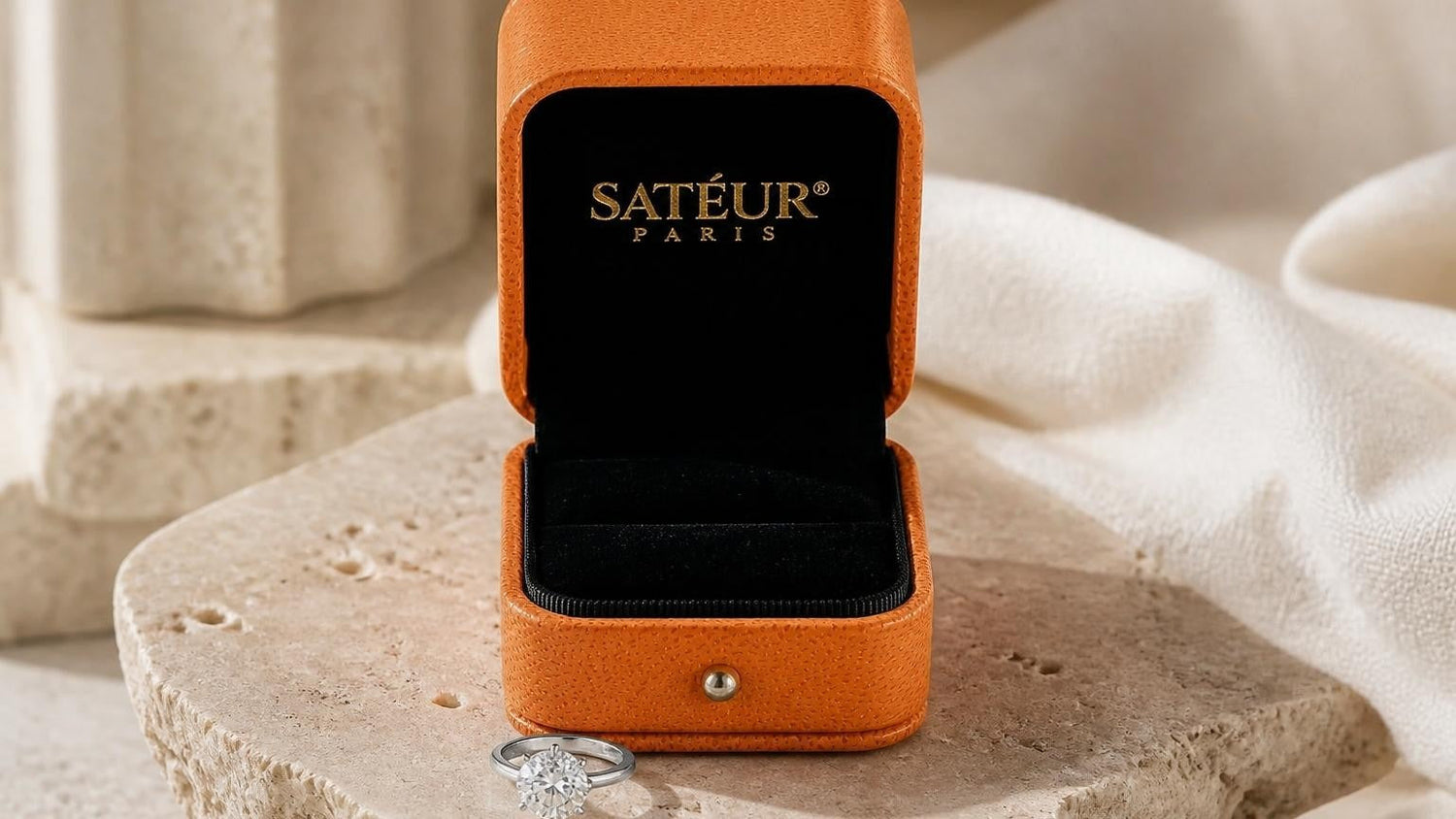
At Satéur, our moissanite collection is built around this permanence. Each stone is lab-created, graded in the top colour range, and set in designs that hold their presence across a lifetime.
The price point makes this durability remarkable. Satéur moissanite rings begin from approximately $88 — a fraction of what a comparable diamond would cost, delivered with the same optical longevity. The 1% Ring® is the clearest demonstration of this principle: the look of a $10,000 diamond, at roughly 1% of the price, with colour stability that does not compromise over time.
The comparison between moissanite and diamond rings has shifted considerably in the last decade. The moissanite solitaire remains the clearest expression of the gemstone's optical quality: nothing to compete with, nothing to distract, just the stone and the light.
For those who want the diamond look with full transparency about what they are wearing, moissanite represents The New Diamond Standard: a real gemstone, graded colourless, built to last.

Frequently Asked Questions About Moissanite Color and Longevity
Does moissanite change color or turn yellow over time?
No. Quality moissanite graded D–E–F colourless does not yellow or change colour over time. The silicon carbide crystal structure is chemically stable. What is sometimes mistaken for colour change is surface contamination — oils or mineral deposits — which cleans off entirely with warm water and soap.
Will my moissanite ring lose its sparkle or become cloudy?
Not from age or wear alone. Moissanite's brilliance is governed by its fixed refractive index and dispersion — physical constants that do not degrade. Temporary cloudiness from surface oil or soap residue is fully reversible with routine cleaning.
How durable is moissanite compared to diamond over a lifetime?
Moissanite rates 9.25 on the Mohs hardness scale — second only to diamond at 10. It resists scratching from virtually all surfaces encountered in daily life, and its optical clarity remains intact across decades of engagement ring wear.
Can moissanite be scratched or damaged by daily wear?
Moissanite is extremely scratch-resistant. At 9.25 Mohs, only diamond and a small number of other materials are harder. Household surfaces, jewellery metal, and ceramic will not mark the stone. The band may show wear before the gemstone does.
What is the difference between moissanite color grades?
Moissanite is graded on the D–Z colour scale. D–F grades are colourless; G–J are near-colourless with a faint warmth visible only under direct comparison. Because moissanite is colour-stable, the grade at purchase is the permanent condition of the stone.
How should I clean and maintain my moissanite ring to preserve its clarity?
Warm water, mild dish soap, and a soft toothbrush every few weeks is all that is required. Moissanite is safe in ultrasonic and steam cleaning machines. Avoid prolonged contact with chlorine bleach or acetone, which can affect metal settings.
Moissanite's optical stability is not a marketing claim. It is a consequence of the gemstone's fixed crystalline structure. The colour grade you select is the colour grade that remains — and that permanence, for a ring worn every day, is the argument that matters most. For a full picture of how moissanite compares to diamond and lab diamond across the full range of buying considerations, the guide covers every dimension of the decision.

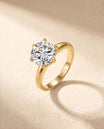
Satéur Destinée Ring™
The look of a brilliant moissanite gemstone. Lasting colour. Lasting clarity.
Compare to a $10,000 mined diamond
Joined by 100,000+ couples across 150+ countries.
Shop the Satéur Destinée RingFree worldwide shipping · 30-day returns · Lifetime Satéur Care

















Hinterlasse einen Kommentar
Diese Website ist durch hCaptcha geschützt und es gelten die allgemeinen Geschäftsbedingungen und Datenschutzbestimmungen von hCaptcha.