

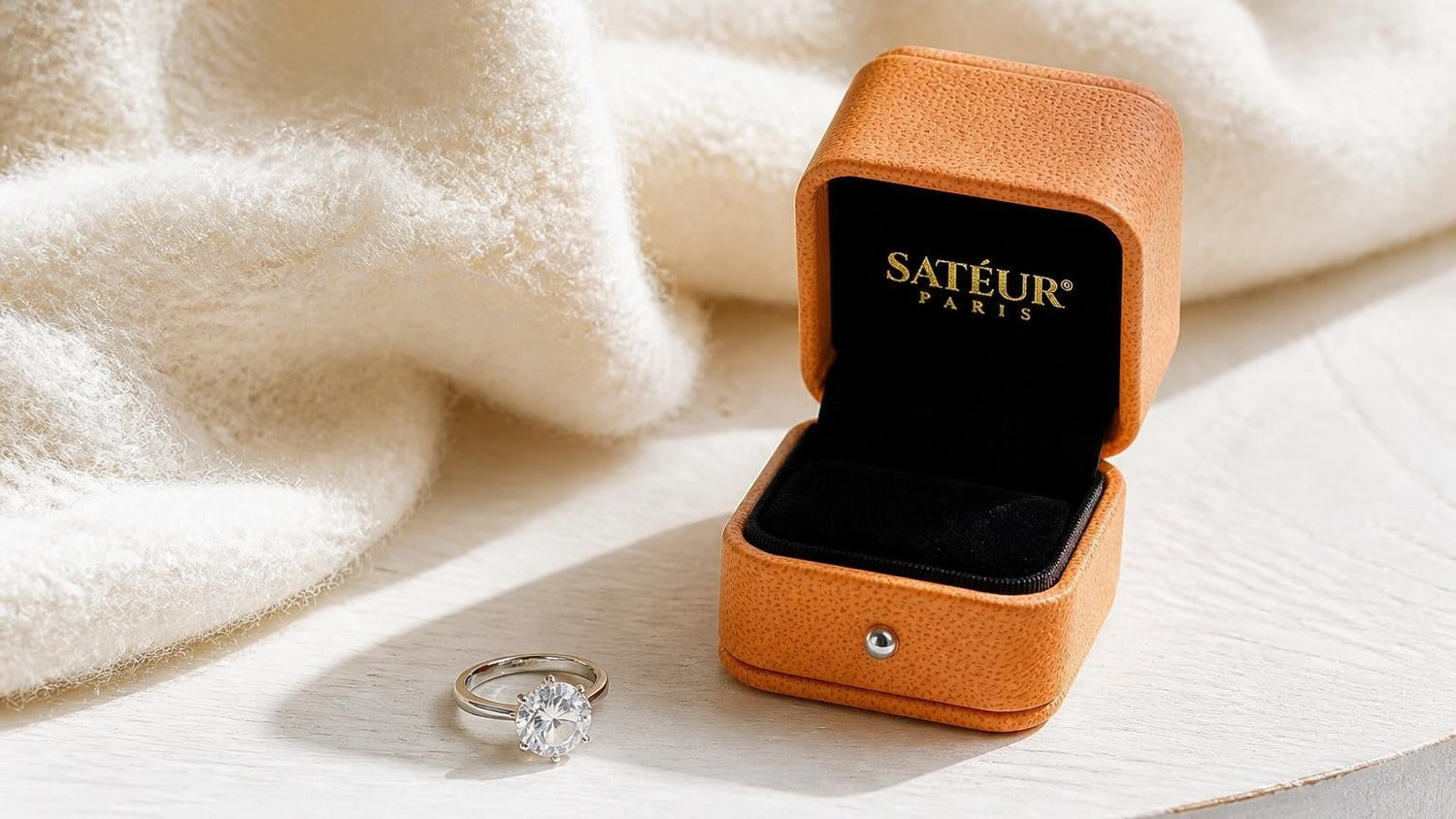
Real Diamond vs Fake: What Actually Sets Them Apart
The question surfaces in every jewellery conversation: how does a real diamond differ from a fake one? The honest answer, stripped of industry mythology, is less dramatic than the trade would have you believe. A real diamond is defined by specific physical and optical properties. Diamond simulants — gemstones engineered to replicate those properties — can achieve the diamond look to the naked eye at a fraction of the price. This article maps what genuinely separates them, and what does not.
For a broader view of The 1% Ring collection and the diamond-alternatives movement, the comparison below frames the full picture clearly.
Key Takeaways
- A real diamond rates 10 on the Mohs hardness scale; premium simulants range from approximately 8.8 to 9.25 — both extremely durable for daily wear.
- Real diamonds display crisp white brilliance; moissanite shows more rainbow fire; Satéur Gems® replicates the clean white brilliance of a flawless diamond.
- Diamond simulants can achieve D–E colour and Excellent cut clarity comparable to the finest mined stones.
- The price difference is structural, not aesthetic: a quality simulant costs approximately 1% of an equivalent real diamond.
- Visual differences between a quality simulant and a real diamond are not detectable with the naked eye under normal conditions.
- Satéur Gems® simulant rings start at $138 — the look of a $10,000 diamond, for 1% of the price.
What Constitutes a Real Diamond
A real diamond is carbon crystallised under extreme pressure and heat over billions of years. Its defining characteristic is hardness: 10 on the Mohs scale, the highest achievable. Its optical behaviour is governed by a refractive index of approximately 2.42, which determines how light bends and scatters within the stone.
Real diamonds are graded on the four Cs — cut, colour, clarity and carat weight. A flawless, D-colour, excellently cut one-carat real diamond commands prices in the range of $8,000–$12,000. The price reflects geological scarcity and a century of marketing conditioning, not optical superiority that cannot be replicated.
Certification is the other marker. Mined diamonds and lab-grown diamonds carry IGI or GIA grading reports. Simulants do not — because they are not real diamonds and make no claim to be. The distinction is transparency, not hierarchy.
Diamond Simulants: The Diamond-Look Alternative
A diamond simulant is a gemstone engineered to replicate the visual appearance of a real diamond. It shares no chemical or structural relationship with carbon crystal — it is not a real diamond and does not pretend to be. The simulant category spans a wide quality range: from inexpensive cubic zirconia, which clouds and loses brilliance within a year, to precision-engineered trademarked simulants like Satéur Gems®, designed for lifelong optical performance.
The critical question for the consumer is not whether the stone is a diamond. It is whether the stone delivers the diamond look reliably, durably, and at what price. When people ask how to tell a diamond real from a fake diamond, they are usually asking whether any eye can tell the difference in normal wear. For quality simulants, the answer is: not with the naked eye.
Fake diamonds range from worthless glass imitations to sophisticated gemstones with real optical properties. The label is imprecise. What matters is where on that spectrum a particular stone sits — and Satéur Gems® sits at the engineered-for-diamond-accuracy end. The broader context of real versus fake diamond shine is explored in more detail in how real and fake diamonds differ in their shine and brilliance.

Visual Characteristics of Authentic Diamonds
Under standard lighting, a well-cut real diamond produces crisp white flashes — brilliance — combined with dispersion: the splitting of light into spectral colours, known as fire. In a D–E colour, excellently cut stone, white light dominates. The fire is present but restrained, never overwhelming.
This restraint is the diamond's visual signature. It reads as clarity and depth rather than spectacle. It is precisely this characteristic — the clean white brilliance of a flawless real stone — that premium simulants aim to replicate.
Cubic zirconia typically shows excess fire relative to its size, and warms in body colour as it ages. Fake diamonds of lower quality can be identified by this excessive rainbow dispersion and by surface cloudiness that develops over time. Premium simulants such as Satéur Gems® are engineered to avoid both problems, delivering diamond-accurate optical behaviour across their lifespan. A more detailed comparison of how specific stones differ in their light behaviour is covered in spotting the differences: real diamonds vs fake including Satéur.
How Light Behaves in Real Diamonds
Light enters a real diamond, refracts, bounces internally between facets, and exits as brilliance and fire. The angles at which facets are cut determine what percentage of entering light returns through the table versus leaks through the pavilion. An excellent cut maximises return — this is why cut is the most consequential of the four Cs for visual presence.
The refractive index governs the mathematics of that refraction. Diamond's index of approximately 2.42 is high, which is why diamonds appear so optically alive. Moissanite's refractive index of approximately 2.65 is higher still — which is why moissanite produces more fire than a real diamond. Satéur Gems® carries a refractive index of approximately 2.39, calibrated for diamond-accurate brilliance: crisp, white, and optically clean rather than vivid and rainbow-forward.
These differences are visible under close examination or strong directional lighting. Across a table, to the naked eye, under the light of daily life, they are not discernible. The test of visual similarity is not a specialist's setting — it is a ring on a hand at dinner.
Physical Properties That Define a Diamond
Beyond optics, a real diamond possesses specific physical characteristics. Its thermal conductivity is exceptionally high — diamonds conduct heat faster than almost any other material. Its electrical conductivity is negligible. Moissanite, uniquely among simulants, is also a semiconductor, which distinguishes it from real diamond on electrical tests. Diamond's density is approximately 3.52 g/cm³. These properties, taken together, define the material science of real diamond.
Diamond simulants differ on all these measures. The differences are detectable with specialised instruments in professional settings. In daily wear — a stone set in ring jewellery, on a hand, every day — none of these instrument-level properties have any relevance to the wearer's experience.
The properties that matter in real life are hardness (resistance to scratching), brilliance (visual presence under actual light), and durability over time. Satéur Gems® is extremely durable on all three counts for everyday rings and jewellery, scoring approximately 8.8 on the Mohs scale — a hardness that withstands the demands of daily wear without compromise.
Diamond Simulants vs Real Diamonds: Key Differences
| Property | Mined Diamond | Satéur Gems® | Moissanite |
|---|---|---|---|
| Mohs Hardness | 10 | ~8.8 | ~9.25 |
| Refractive Index | ~2.42 | ~2.39 | ~2.65 |
| Brilliance Character | Crisp white | Clean white (diamond-accurate) | Vivid, rainbow-forward |
| Colour Grade | D–Z (natural variation) | D–E | D–E (lab-controlled) |
| Price (1ct equivalent) | $5,000–$12,000+ | From $138 | From $98 |
| Composition | Carbon crystal | Trademarked simulant | Silicon carbide (lab-created gemstone) |
| Disclosure | Real diamond | Openly a simulant | Openly a gemstone |
Satéur Gems® is a trademarked diamond simulant. Moissanite is a real lab-created gemstone — silicon carbide — with its own distinct optical character. Neither is a real diamond, and neither pretends to be. The difference between real diamonds and fake diamonds matters for material science and certification; it does not determine which stone looks better wearing a ring.

Satéur Gems®: Diamond-Look Value at a Fraction of the Cost
Satéur was founded on a specific observation: the brilliance of a stone has nothing to do with its price tag. A real mined diamond commands its price because of geological scarcity and decades of industry conditioning — not because its optical properties are unreplicable.
Satéur Gems® is the Maison's flagship trademarked simulant, engineered to replicate the clean white brilliance of a flawless D–E diamond. It carries a Mohs hardness of approximately 8.8 — extremely durable for everyday jewellery wear. Its colour grade is D–E. Its cut is Excellent. To the naked eye, it delivers what a $10,000 real diamond delivers, for approximately 1% of the price.
The entry point is the Satéur Destinée Ring™, starting from $138. For those seeking the engagement ring without the engagement-ring debt, it represents a different framework of value: discernment over obligation, presence over expenditure. The 1% Ring® and The New Diamond Standard® are not marketing phrases. They are a precise description of the mathematics.
For moissanite's distinct optical character — more fire, higher refractive index, lab-created silicon carbide gemstone — the moissanite collection offers precision options from $98. For those who want a verified lab-grown diamond with IGI certification, the lab diamond range provides that option at a fraction of mined-diamond pricing. Three distinct stones. One decision framework: what does the stone look like on your hand, and what is the honest price for that look.
Over 100,000 customers across 150+ countries have made that calculation. The answer, consistently, is that the look of a flawless real diamond does not require the price of one.

Satéur Destinée Ring™
The look of a flawless diamond, for 1% of the price.
Compare to a $10,000 mined diamond
Joined by 100,000+ couples across 150+ countries.
Shop The Destinée RingFree worldwide shipping · 30-day returns · Lifetime Satéur Care

The question of real versus fake is, ultimately, a question about what is being measured. A real diamond is real by geological definition. A quality simulant is real in every dimension that matters in daily life: its brilliance, its durability, its presence in a ring worn every day. The distinction is material science, not lived experience. The Maison leaves the calculation to the wearer.
Frequently Asked Questions About Diamond Authenticity
What are the main visual differences between a real diamond and a diamond simulant?
Under close examination or strong directional light, the key visual difference is the character of fire — spectral dispersion of light. Real diamonds produce crisp, restrained white brilliance. Moissanite produces more vivid, rainbow-forward fire due to its higher refractive index. Satéur Gems® replicates the clean white brilliance of a flawless real diamond. With the naked eye, in normal lighting conditions, quality simulants and real diamonds are visually indistinguishable to the vast majority of observers.
Can you identify a diamond simulant by examining its light refraction with the naked eye?
Not reliably. A quality simulant engineered for diamond-accurate optical performance will not reveal itself under ordinary conditions. The differences in refractive index that distinguish a real diamond from a simulant produce subtle optical variations difficult to detect with the naked eye, particularly in the ring-on-finger context of daily wear. With the naked eye, a well-cut Satéur Gems® is indistinguishable from a mined diamond.
How do the colour and clarity grades of diamond simulants compare to mined diamonds?
Premium simulants like Satéur Gems® are produced to D–E colour — the highest grade on the diamond colour scale, equivalent to colourless. Their cut achieves Excellent grade. Mined real diamonds vary across the D–Z colour range depending on natural formation; D–E stones are among the rarest and most expensive. Simulants achieve this colour consistency by design, without natural variation.
What physical properties define an authentic diamond versus a simulant stone?
A real diamond is defined by carbon crystal structure, Mohs hardness of 10, refractive index of approximately 2.42, and exceptional thermal conductivity. Premium simulants differ on composition (not carbon crystal), hardness (approximately 8.8 to 9.25 Mohs), and thermal properties. These differences are measurable with specialised instruments. In everyday ring and jewellery wear, only hardness has practical relevance — and both premium simulants and real diamonds are extremely durable for daily use.
Why would someone choose a diamond simulant over a mined diamond for an engagement ring?
The choice reflects a different framework of value. A real mined diamond's price is largely driven by geological scarcity and market conditioning, not optical properties that cannot be replicated. A quality simulant like Satéur Gems® delivers the same visual presence at approximately 1% of the cost, with D–E colour, Excellent cut, and diamond-accurate brilliance to the naked eye. The decision to choose a simulant engagement ring is not a compromise — it is a precise assessment of what actually matters in jewellery worn every day for life.
Are diamond simulants a permanent alternative, or do they degrade over time?
It depends on the simulant. Cubic zirconia — the most common low-end fake diamond — typically clouds and loses brilliance within months to a year. Premium engineered simulants such as Satéur Gems® are designed for long-term optical performance. With a Mohs hardness of approximately 8.8, they resist everyday scratching and hold their brilliance for life. The price difference between entry-level fake diamonds and precision-engineered simulants reflects a genuine difference in lasting quality.

















コメントを残す
このサイトはhCaptchaによって保護されており、hCaptchaプライバシーポリシーおよび利用規約が適用されます。