

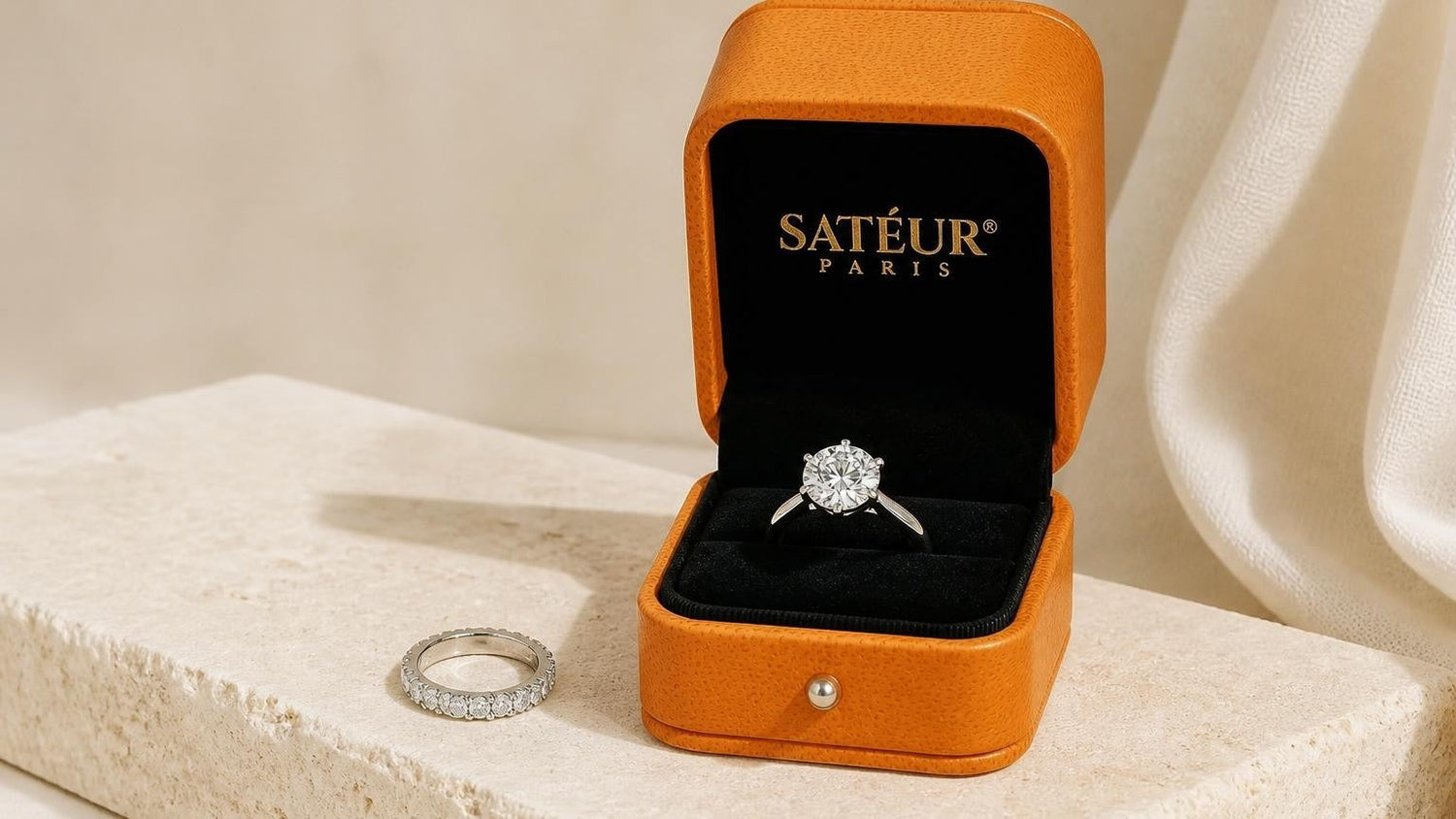
White Sapphire Engagement Rings: A Complete Guide
White sapphire engagement rings occupy a genuine place in fine jewellery. Corundum — the mineral family that produces rubies and blue sapphires — is a hard, durable gemstone worn for centuries. In its colourless form it offers real longevity and a clean, understated look at a fraction of mined diamond pricing. That is its honest case.
It is also worth knowing what white sapphire does not do well. Its optical properties differ meaningfully from diamond: lower refractive index, softer brilliance, a tendency toward a milky or glassy character over time. For buyers whose priority is the clean white brilliance of a flawless diamond, it falls short of that standard. Understanding both sides leads to a better decision — whether that ends at a white sapphire ring, a Satéur Gems® simulant, or somewhere else entirely.
This guide covers white sapphire's properties, durability, care requirements, and how it compares to diamond simulants. It is written for the buyer who wants honest information before committing to an engagement ring that will be worn every day for decades.
Key Takeaways
- White sapphire (corundum) rates Mohs 9.0 — genuinely durable for daily wear in a protective setting.
- Its refractive index (~1.77) is lower than diamond (~2.42), producing a milkier, less brilliant appearance than diamond simulants.
- Satéur Gems® achieves D–E colour equivalent and Excellent cut grades — the clean white brilliance of a flawless diamond — at approximately 1% of the price of a comparable mined stone, entering at ~$88.
- Moissanite (~9.25 Mohs, RI ~2.65) offers the highest hardness and fire dispersion roughly 2.4 times that of a mined diamond — a vivid, rainbow-forward aesthetic.
- White sapphire requires periodic professional cleaning to counter surface haze; higher-RI gems maintain their light return through minor surface wear.
Why White Sapphire for Engagement
The appeal is real and historically grounded. White sapphire has been present in fine jewellery for well over a century — found in vintage and antique pieces long before the modern diamond industry consolidated its hold on engagement culture. It is a genuine gemstone with traceable mineralogy, natural hardness, and a refined, understated visual character.
For buyers drawn to coloured-gemstone tradition, or to the idea of an engagement ring built around corundum heritage rather than a manufactured simulant, white sapphire is a credible choice. It pairs naturally with white gold, yellow gold, and platinum settings. It takes a variety of cuts — round brilliant, oval, cushion, emerald — though its optical behaviour rewards certain cuts more than others.
The budget case is straightforward. A white sapphire in a fine white gold setting costs meaningfully less than a mined diamond of comparable size. That gap can fund a better metal quality, a more intricate design, or simply represent a considered refusal to pay for artificially maintained scarcity. Among non-diamond engagement rings, white sapphire occupies a comfortable middle ground — more traditional in gemstone origin than synthetic simulants, more accessible than mined diamonds.
The relevant question, approached honestly, is whether the ring will deliver the look the buyer has in mind. That is where the trade-offs matter.
Specs: Colour, Cut, Durability
White sapphire is the colourless variety of corundum (Al₂O₃). Its key optical and physical properties, set against the diamond standard and available alternatives:
| Property | White Sapphire | Mined Diamond | Satéur Gems® | Moissanite |
|---|---|---|---|---|
| Mohs Hardness | 9.0 | 10.0 | ~8.8 | ~9.25 |
| Refractive Index | ~1.77 | ~2.42 | ~2.39 | ~2.65 |
| Brilliance character | Milky/glassy; lower fire | Crisp white; high brilliance | Clean white, diamond-accurate | Vivid; more fire than diamond |
| Colour equivalence | Near-colourless; prone to warmth | D–Z graded scale | D–E equivalent | Near-colourless |
| Price (1ct equivalent) | $150–$600 | $4,000–$12,000+ | From ~$138 | From ~$98 |
The hardness gap between white sapphire (9.0) and diamond (10.0) is smaller than it reads in daily life. White sapphire resists surface scratching from typical household and outdoor contact. The meaningful durability concern is impact resistance: corundum, while very hard, can chip under a sharp perpendicular blow, particularly in pointed cuts — princess, marquise, and pear are more vulnerable than round or oval. A protective setting compensates significantly.
The optical gap is where white sapphire shows its limits most clearly. A refractive index of ~1.77 — versus diamond at ~2.42 and Satéur Gems® at ~2.39 — produces a noticeably different quality of light return. White sapphire tends toward a bright but flat, glassy appearance rather than the brilliant, multi-directional play of light associated with diamond. In white gold or platinum settings, this difference is visible across the table with the naked eye.
Moissanite presents a different contrast: with RI ~2.65 and fire dispersion roughly 2.4 times that of a mined diamond, it delivers a vivid, rainbow-forward sparkle that reads distinctly more brilliant than both white sapphire and diamond. For buyers who want maximum light play, moissanite delivers it — though its fire signature reads as its own aesthetic rather than diamond-accurate.

Satéur Gems® vs White Sapphire: Comparative Value
For the buyer whose goal is the look of a flawless diamond, white sapphire does not fully deliver it. That is not a criticism of the gemstone — it is a different optical category. White sapphire has its own understated elegance, and for certain buyers and certain aesthetics it is exactly right.
For the buyer who specifically wants the clean white brilliance of a flawless diamond — across the table, with the naked eye, in every light — a Satéur Gems® simulant achieves that standard. Its refractive index of ~2.39 sits within the diamond range. Cut to Excellent grade with D–E colour equivalent, it returns light in the crisp white pattern associated with a fine mined diamond rather than the flatter, milkier return of corundum. Diamond-accurate brilliance is the optical specification the gem is cut to meet.
The price comparison is unambiguous. A comparable mined diamond: $4,000–$12,000+ for one carat. White sapphire in a fine sapphire ring setting: $150–$600. The Satéur Destinée Ring™ — The 1% Ring® — enters at approximately $88, sitting at about 1% of the price of a comparable mined diamond. That figure is structural. It reflects what the Maison was built to demonstrate: that the brilliance of a gemstone has nothing to do with its extraction cost.

Satéur Destinée Ring™
The clean white brilliance of a flawless diamond. For 1% of the price.
Compare to a $10,000 mined diamond
Joined by 100,000+ couples across 150+ countries.
Discover The 1% RingFree worldwide shipping · 30-day returns · Lifetime Satéur Care
Satéur Gems® achieves D–E colour equivalent and Excellent cut grades — visible to the naked eye, delivering the clean white diamond-accurate brilliance that white sapphire does not replicate. The comparison is not adversarial. Both represent a departure from the mined-diamond benchmark. The difference is in how closely each approaches the thing itself.
Over 100,000 customers across 150+ countries have arrived at the same conclusion about what constitutes an intelligent jewellery choice. The New Diamond Standard® is not a slogan. It is the specification the Gems® tier is cut to.
White Sapphire Durability and Care
At Mohs 9.0, white sapphire is genuinely suited to daily wear. It will not scratch from contact with most surfaces encountered in ordinary life — fabric, skin, common metals, wood. The practical durability concern is brittleness under impact: corundum, while hard, can fracture under a sharp blow, particularly at corners and edges. A bezel, halo, or well-proportioned prong setting mitigates this substantially. Round brilliant and oval cuts perform better than princess or marquise in everyday conditions.
Standard cleaning applies: warm water, mild dish soap, and a soft brush. Ultrasonic cleaners are safe for untreated white sapphire; avoid them for treated or fracture-filled stones, which account for a meaningful share of lower-priced sapphires. If uncertain, ask the vendor whether the stone has been treated.
The maintenance consideration specific to white sapphire is surface haze. Because its lower refractive index makes any surface dulling more visible than on a higher-RI gem, white sapphire looks substantially better clean than it does with even minor build-up. For a ring worn daily, professional cleaning every 12–18 months is not optional maintenance — it is the difference between the ring at its best and the ring looking flat.

For buyers researching the full range of alternative engagement ring gemstones, care requirements across stone types are a practical filter. Moissanite (~9.25 Mohs) and Satéur Gems® (~8.8 Mohs) are both extremely durable, built for everyday wear, and maintain their light return through minor surface wear more readily than white sapphire.
Custom Designs and Sizing
White sapphire is available in a full range of cuts and sets naturally in white gold, yellow gold, and platinum. Its softer optical character rewards high-set solitaire designs that place the gem in clean light. Heavy pavé accent detailing can read as busy alongside white sapphire's flatter brilliance; a clean, unadorned solitaire often suits it better and allows the stone's understated character to read correctly.
Cut selection matters more for white sapphire than for higher-RI gems. Round brilliant maximises the light return available; oval distributes it elegantly. Emerald and cushion cuts lean into the gem's understated quality and are appropriate for buyers who prefer a more subdued, antique-adjacent look. Avoid princess and marquise cuts if daily wear and longevity are priorities.
Sizing follows standard ring-sizing conventions. Corundum can be resized by a skilled jeweller without structural compromise to the gemstone itself. The practical check after any resize is prong integrity: prongs should be inspected and re-tightened following a resize to ensure the sapphire ring remains securely set.

For Satéur Gems® rings, the full 1% Ring collection is available across standard sizes. Each ring is built to a consistent Maison specification — Excellent cut, D–E colour equivalent, 18K gold finishing — whether chosen as an engagement piece or a considered statement of The New Diamond Standard®.
FAQ: White Sapphire Rings
What is the difference between white sapphire and a diamond simulant?
White sapphire is a natural or lab-grown gemstone — corundum (Al₂O₃) — with Mohs hardness 9.0 and a refractive index of ~1.77. It produces a milky, lower-fire brilliance that differs visibly from diamond. A diamond simulant such as Satéur Gems® is a trademarked lab-crafted gem engineered to match the optical profile of a flawless diamond: refractive index ~2.39, D–E colour equivalent, Excellent cut. The difference is clear with the naked eye — white sapphire reads as a different optical category; Satéur Gems® delivers the clean white brilliance of a flawless diamond. Both are more accessible than mined diamond; the choice depends on whether the buyer prioritises gemstone tradition or diamond-accurate optics.
How durable is white sapphire for everyday wear?
White sapphire rates Mohs 9.0 and resists surface scratching well in normal daily use. The durability consideration is impact: corundum can chip under a sharp perpendicular blow, particularly in pointed cuts. Round and oval cuts in protective settings — bezel or halo — handle everyday wear reliably. Surface haze from micro-abrasion will develop over time and requires periodic professional cleaning to maintain the gem's appearance.
Can white sapphire be used in an engagement ring setting?
Yes. White sapphire is a legitimate gemstone for engagement rings with genuine durability and a long history in fine jewellery. The key consideration is optical expectation: white sapphire produces a milky, flatter quality of light rather than crisp white diamond brilliance. For buyers who value gemstone heritage and understated elegance, it is well suited. For buyers who specifically want the diamond look, a simulant such as Satéur Gems® is the more accurate choice.
What colour grade should I choose for a white sapphire ring?
The cleanest white sapphires — referred to as "extra white" by many suppliers — correspond broadly to G–H diamond colour. Sapphires with a detectable warm or grey tint read noticeably off-white in certain lights. Inspect the stone in natural daylight before purchasing, and request near-colourless grading confirmation from the vendor. Satéur Gems® is held to D–E colour equivalent — the two highest colour grades — by specification.
How does the price of white sapphire compare to diamond?
White sapphire runs approximately $150–$600 for a one-carat equivalent in a fine setting — a fraction of the $4,000–$12,000+ for a comparable mined diamond. Satéur Gems® enters at approximately $138, at about 1% of the price of a comparable mined diamond. The three price points reflect different choices: white sapphire buys gemstone tradition at low cost; Satéur Gems® buys diamond-accurate optics at the lowest price in the category; mined diamond buys the original.
Do white sapphire rings require special cleaning or maintenance?
Standard cleaning applies: warm water, mild dish soap, soft brush. Ultrasonic cleaners are safe for untreated white sapphire — check whether the stone has been treated before using one. Because white sapphire's lower refractive index makes surface dulling more visible than on higher-RI gems, professional cleaning every 12–18 months is worth scheduling for a ring worn daily. A clean white sapphire looks substantially better than a dulled one. Satéur Gems® and moissanite maintain their light return through minor surface wear more readily, requiring less frequent professional care.

















コメントを残す
このサイトはhCaptchaによって保護されており、hCaptchaプライバシーポリシーおよび利用規約が適用されます。