

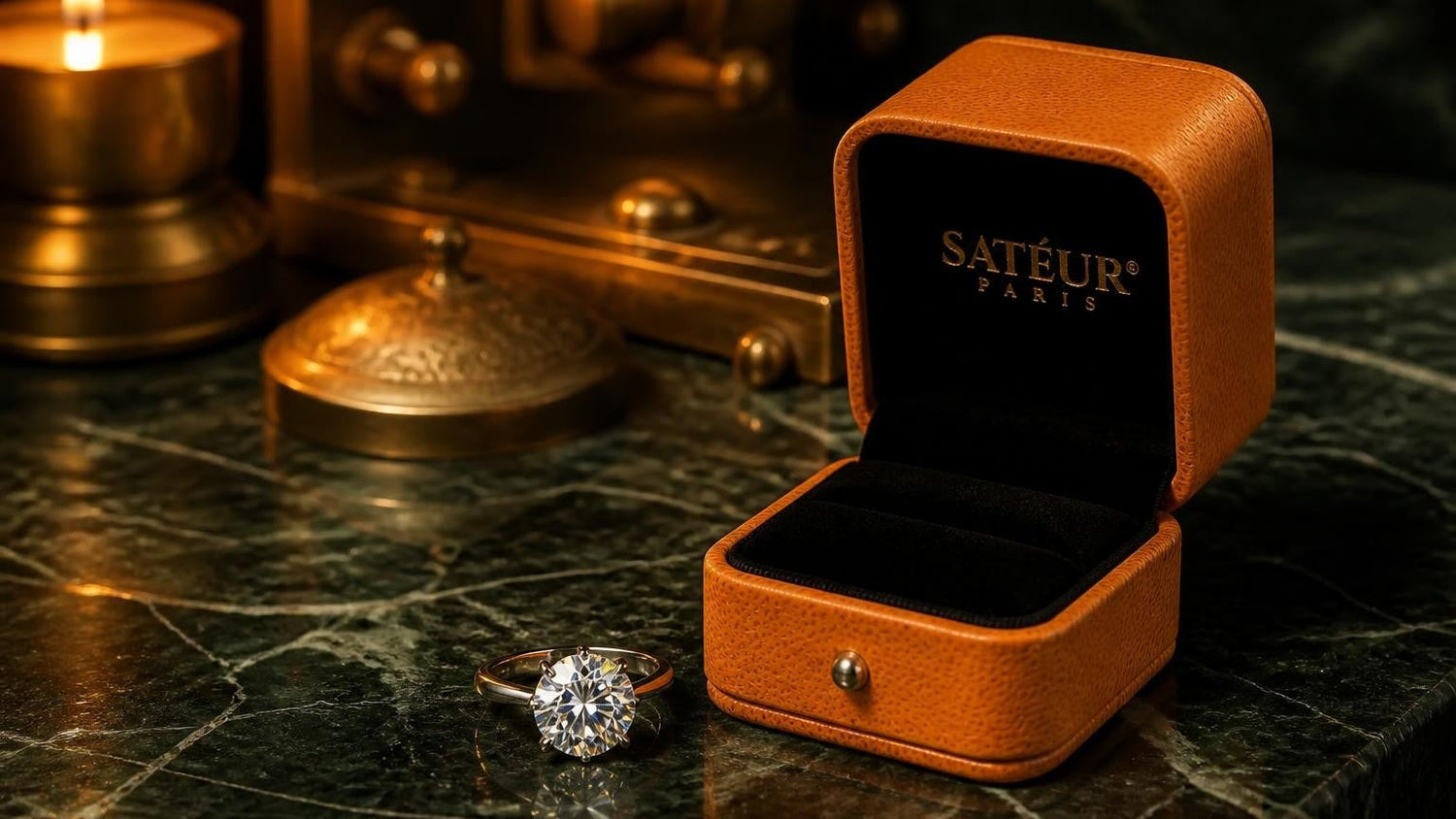
Moissanite vs Diamond Durability: The Complete Comparison
When choosing a gemstone for a ring worn every day, moissanite vs diamond durability is the right question to ask. The short answer is reassuring for both: moissanite rates 9.25 on the Mohs hardness scale, second only to diamond at 10, placing it above every other gemstone available for jewellery. Both are built for a lifetime of daily wear. But hardness tells only part of the story. Toughness, optical character, colour stability and long-term value all factor into a considered decision. This guide covers every dimension of the comparison, with accurate specifications and no industry mythology.
For the full introduction to the gemstone — origin, grading and how it is produced — read the moissanite collection and its editorial context on Satéur.
Key Takeaways
- Moissanite rates 9.25 Mohs; diamond rates 10. Both are exceptionally durable for daily-wear engagement rings.
- Moissanite has no cleavage planes, making it more resistant to chipping than diamond under direct impact.
- Moissanite exhibits 2.4× the fire dispersion of diamond — vivid rainbow sparkle vs diamond's crisp white brilliance.
- Premium moissanite is graded D–E colour (colourless) and retains its optical properties indefinitely without clouding or yellowing.
- Both gemstones require similar care: warm water, a soft brush, and periodic setting inspection.
- Satéur moissanite engagement rings start from approximately $98 — the look of a premium stone at roughly 1% of equivalent mined diamond cost.
Moissanite vs Diamond: Key Differences
Moissanite and diamond are both genuinely exceptional gemstones. They share enough physical and optical properties to appear nearly identical with the naked eye in many settings, yet each has a distinct character worth understanding before choosing one for a ring intended to last a lifetime.
Diamond is pure crystallised carbon — the hardest natural substance on Earth, formed over billions of years under extreme geological pressure. Moissanite is silicon carbide: a lab-created gemstone first discovered naturally in a meteorite crater in Arizona in 1893 by Nobel Prize-winning chemist Henri Moissan. Today all gem-quality moissanite is grown in controlled laboratory environments, ensuring consistency that geological formation cannot guarantee.

| Property | Moissanite | Diamond |
|---|---|---|
| Mohs Hardness | 9.25 | 10 |
| Toughness | Very Good (no cleavage) | Good (four cleavage planes) |
| Refractive Index | ~2.65 | ~2.42 |
| Fire / Dispersion | 0.104 (2.4× diamond) | 0.044 |
| Brilliance (BRI) | 2.65 | 2.42 |
| Colour Grade | D–E colourless | D–Z range |
| Clouds / Yellows Over Time | No | No |
| Origin | Lab-created silicon carbide | Mined or lab-grown carbon |
| Price (1ct round equiv.) | From ~$98 | $4,000–$12,000+ |
The comparison sharpens around two questions: how will the stone wear over time, and how will it look. Both questions deserve precise answers rather than marketing summary.
Durability and Hardness Comparison
The Mohs scale measures a mineral's resistance to surface scratching on a relative scale of 1 to 10. Moissanite at 9.25 sits above every gemstone commonly used in jewellery except diamond — above sapphire and ruby (both 9.0), well above topaz (8.0), and substantially above the quartz dust present in everyday air and surfaces (7.0). In practical terms, this means that ordinary daily activity — carrying bags, typing, household tasks — will not scratch a moissanite gemstone. The same is true of diamond at 10.
What the Mohs scale does not capture is toughness: resistance to fracture and chipping under impact. This is where moissanite vs diamond durability produces a more nuanced answer. Diamond, despite being the hardest substance on Earth, has four planes of perfect cleavage — structural directions along which the crystal can fracture cleanly if struck with a sharp blow in precisely the wrong direction. Jewellers work carefully around this property when setting and resetting diamonds, and a dropped diamond ring landing at an unfortunate angle can occasionally chip a corner or facet edge.
Moissanite has no preferential cleavage planes. Its crystalline structure is isotropic in terms of fracture resistance, which means it does not have a directional vulnerability. This gives moissanite very good toughness — a meaningful practical advantage over diamond in resistance to chipping from accidental impact.
The diamond durability picture is therefore nuanced: unmatched for scratch resistance, slightly more vulnerable to chipping than moissanite. In day-to-day ring wear, neither is likely to be scratched or chipped under normal use. The differences become relevant only in edge cases — a ring caught on a hard surface at a bad angle, or very active hands working with tools. For the overwhelming majority of wearers, the moissanite diamond durability comparison resolves to a practical draw: both will last a lifetime without visible wear.
For a detailed durability comparison within the lab-grown category, the article on lab diamond vs moissanite durability covers the mechanical and optical distinctions in full.
Brilliance and Fire: How They Compare
Brilliance and fire are the two optical measures that most affect how a gemstone reads in the world. Brilliance refers to the intensity and quality of white light return — the flash and depth that makes a gem appear alive. Fire (technically dispersion) refers to the splitting of white light into spectral colour as it passes through the gemstone — the rainbow flashes.
Diamond's refractive index of ~2.42 produces the crisp, concentrated white brilliance that defined the gemstone benchmark for centuries. Its fire (dispersion value: 0.044) is elegant and measured — rainbow flashes present but restrained. The result is a stone that reads as pure, white light.
Moissanite's refractive index of ~2.65 is higher than diamond's, and its dispersion value of 0.104 is approximately 2.4× that of diamond. Under bright, direct light — outdoors in sunlight, beneath spotlights, near a window — this produces vivid, spectral rainbow flashes that are distinctly more vivid than diamond. In lower, ambient light, moissanite and diamond are visually very similar.
Neither optical profile is objectively superior. They represent different aesthetic choices: diamond's restrained white brilliance has been the traditional standard for over a century; moissanite's vivid, rainbow-forward sparkle is its own distinct character. The choice is personal, not a quality judgment. Many buyers who prioritise the classic diamond look specifically choose moissanite for its diamond moissanite visual proximity in everyday conditions, with the fire difference only becoming apparent in direct, bright light.
For a side-by-side visual analysis across different lighting conditions, read moissanite vs diamond rings: which reigns supreme.

Colour Grades and Clarity
Premium moissanite is produced in D–E colour — the colourless band at the top of the GIA diamond colour scale. This is the same colour range as the finest mined diamonds, which command a significant premium precisely because colourless stones are rare in geological formation. In laboratory conditions, colourless moissanite can be produced consistently.
Moissanite retains its colour permanently. It does not yellow, warm or shift colour over time, regardless of exposure to light, heat or cleaning products. This is one of the practical advantages of a lab-created gemstone: optical consistency is built into the process.
Natural diamonds range from D (truly colourless) through Z (visibly yellow or brown). Selecting a colourless or near-colourless diamond (D–H) is substantially more expensive than selecting a stone in the J–M range, even at equivalent size and cut quality. With moissanite, colourlessness is standard in premium tiers, not a premium add-on.
For clarity, premium moissanite is grown under controlled conditions and typically presents no visible inclusions to the naked eye. The gem's stone clarity is inherent to the production process rather than a graded variable requiring careful selection, as it is with mined diamond.
The common misconception that moissanite clouds over time is false. Temporary haziness from accumulated soap residue or skin oils on the facets can be entirely reversed by a five-minute soak in warm water and a gentle brush. The gemstone itself does not change.
Price: Diamond vs Moissanite
The price differential between moissanite and diamond is the most dramatic in gemstone comparison. A 1-carat round brilliant cut diamond at G colour, VS2 clarity — a well-regarded, eye-clean stone — typically retails from $4,000 to $8,000 for the gemstone alone, before setting costs. A comparable 1-carat round brilliant moissanite costs between $80 and $400, depending on the brand and source.
For larger stones, the gap widens. A 2-carat diamond of equivalent quality is typically priced between $15,000 and $30,000. A 2-carat moissanite sits between $200 and $600. The same physical size, the same colour grade, comparable daily wear durability — at approximately 1–2% of the cost.
This differential is not a reflection of durability, beauty or longevity. Moissanite at 9.25 Mohs is not a fraction of a diamond's durability; it is within one scale point at the very top of the hardness spectrum. The price difference reflects the diamond industry's century-long positioning around geological rarity and emotional significance — a narrative constructed over decades of marketing investment, not a physical property of the stone.
For buyers weighing moissanite vs diamond price in full context — including the lab-grown diamond category — the guide to moissanite vs diamond vs lab diamond provides the complete cost analysis.
Why Moissanite Offers Superior Value
The intelligent case for moissanite is not that it approximates diamond. It is that moissanite is a distinct gemstone with genuine advantages — and that the premium commanded by mined diamond reflects market positioning rather than superior wearability.
Moissanite is harder to scratch than 99% of materials you will encounter in daily life. It has no cleavage planes, giving it an advantage in chipping resistance. It is graded colourless and retains that colour permanently. It is a real gemstone — lab-created silicon carbide — not a simulant or glass substitute. And it costs around 1% of an equivalent mined diamond.
Over 100,000 customers across 150+ countries have made this choice. The Satéur moissanite rings collection starts from approximately $98, set in 18k gold finish, with D–E colourless gemstones built for a lifetime of daily wear. The look of a $10,000 diamond ring. The intelligence of The New Diamond Standard.

Satéur Destinée Ring™
The look of a flawless diamond, for 1% of the price.
Compare to a $10,000 mined diamond
Joined by 100,000+ couples across 150+ countries.
Discover The 1% RingFree worldwide shipping · 30-day returns · Lifetime Satéur Care
Long-Term Wear and Maintenance

Both moissanite and diamond are low-maintenance gemstones with nearly identical care requirements. The gemstone itself demands little; the setting demands more attention over a lifetime.
For regular cleaning, warm water, a small amount of mild dish soap and a soft-bristle brush are sufficient. A five-minute soak followed by gentle brushing removes the skin oils, hand creams and product residue that accumulate in prong settings over time and dull the perceived brilliance of any gemstone. Rinse thoroughly and air dry or pat dry with a lint-free cloth. Do this every few weeks for a ring worn daily.
Both stones are chemically stable. Neither is damaged by water, perfume, household cleaning products, sunscreen or ordinary environmental exposure. Ultrasonic cleaners are generally safe for both moissanite and diamond, though very fine pavé settings warrant care with any ultrasonic regardless of the centre stone.
Periodic professional inspection of the setting — every one to two years — is sensible for any fine jewellery. The gemstone does not require this; the prongs, bezels and pavé elements that hold it do. Prongs wear slightly over years of daily contact, and a stone that has worked slightly loose is better caught early than after loss. This maintenance interval applies equally to moissanite and diamond rings.
The long-term outlook is identical: a well-set moissanite ring, cleaned regularly and inspected periodically, will look the same in forty years as on the day it was worn for the first time. The same is true of a well-set diamond ring. Neither gemstone ages. Both hold their brilliance for life.
Explore the full engagement ring collection to see the full range of cuts and settings available.
Frequently Asked Questions
How does moissanite durability compare to diamond over a lifetime?
Moissanite rates 9.25 on the Mohs hardness scale — second only to diamond at 10. Both are built for a lifetime of daily wear and will show no scratching from ordinary use. Moissanite has no cleavage planes, making it more resistant to chipping under impact than diamond, which has four. In practical, everyday terms, moissanite diamond durability differences are imperceptible: both stones look unchanged after decades of daily wear.
Will moissanite scratch or cloud over time with daily wear?
Moissanite will not scratch under normal daily conditions — at 9.25 Mohs hardness, only diamond (10) can scratch it. It will not cloud over time. The gemstone's optical properties — its brilliance, fire and colour — are permanent. Temporary haziness from soap residue or skin oils is common to any gemstone and is easily reversed with warm water and a soft brush. The stone itself does not degrade.
What is the difference in brilliance and fire between moissanite and diamond?
Diamond returns crisp, concentrated white brilliance with measured, elegant fire — the traditional optical benchmark. Moissanite has a higher refractive index (~2.65 vs ~2.42) and approximately 2.4× the fire dispersion of diamond, producing vivid rainbow flashes under direct and bright light. Neither is superior; they are different optical characters. Those who want the classic diamond look often prefer diamond's restrained white brilliance. Those drawn to vivid spectral sparkle favour moissanite's colorless brilliance and fire.
Can moissanite be used for an everyday engagement ring?
Yes. At 9.25 Mohs, moissanite is one of the most durable gemstones available and is well suited to daily wear in any ring style — solitaire, halo, pavé or band. Its toughness is rated very good, with no cleavage planes that might lead to fracturing under impact. Standard care applies: regular cleaning and periodic setting inspection. No special precautions are needed for everyday activities.
How do colour grades differ between moissanite and diamond?
Premium moissanite is produced in D–E colour — the colourless band at the top of the GIA diamond colour scale. This mirrors the finest diamond colour grades. Unlike natural diamonds, moissanite does not yellow or shift colour over time; its colorless quality is permanent. Natural diamonds span D (colourless) to Z (visibly warm), with colourless grades commanding significant price premiums. A moissanite at D–E colour is visually equivalent to a top-colour diamond to the naked eye.
Why is moissanite a more affordable alternative to diamond?
Moissanite is lab-created, so its supply is not constrained by geological rarity or the extraction and distribution infrastructure of the mining industry. The price difference between moissanite and mined diamond reflects market positioning and supply chain structure — not durability, beauty or longevity. A comparable moissanite engagement ring typically costs around 1% of the equivalent mined diamond ring, while wearing identically and lasting just as long. The 1% Ring® — The New Diamond Standard.
















댓글을 남기세요
이 사이트는 hCaptcha에 의해 보호되며, hCaptcha의 개인 정보 보호 정책 과 서비스 약관 이 적용됩니다.