

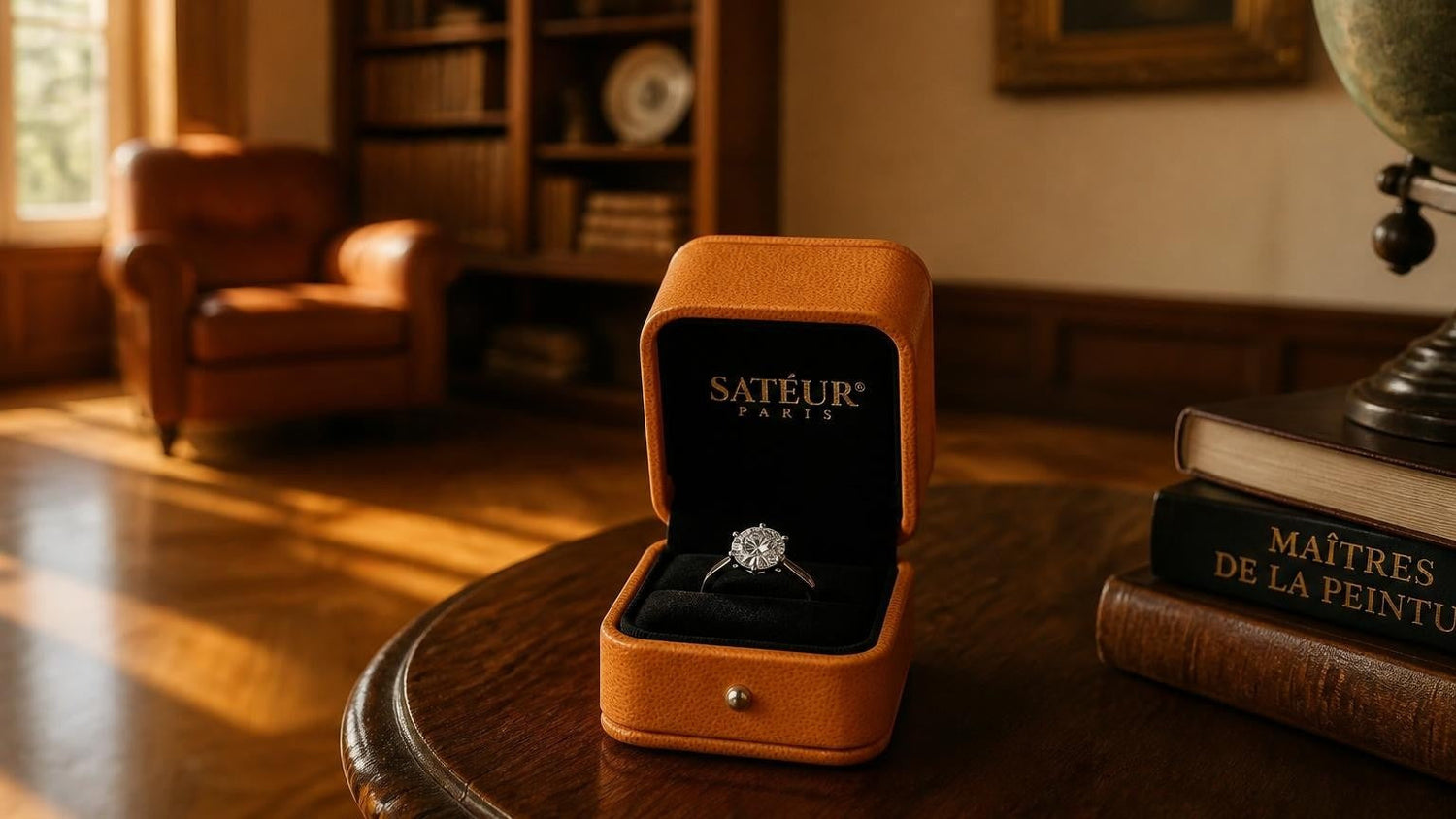
How Much Is the Average Engagement Ring?
In the United States, the average engagement ring costs between $5,500 and $7,000. That figure — drawn from annual Knot surveys and retail industry data — reflects one thing above all: the enduring dominance of the mined diamond. Strip the diamond out and the cost drops by more than half. What remains is the setting, the craftsmanship, and the decision about which stone carries the light.
Understanding what drives that average is the first step toward spending wisely. Whether the budget is $500 or $15,000, the variables that move ring cost are the same: metal, stone quality, carat weight, and cut grade. This guide breaks each of them down — and ends with a question worth asking. Does the price determine the look, or does the look stand entirely on its own?
Key Takeaways
- The average engagement ring in the US costs between $5,500 and $7,000, driven primarily by mined diamond pricing.
- Metal choice (platinum versus 14k gold) shifts the ring cost by $800 to $2,000 or more.
- Lab-grown diamonds offer 40–60% savings over mined equivalents with identical chemical and optical properties.
- Satéur Gems® deliver the clean, white brilliance of a flawless diamond at approximately 1% of a mined diamond's price, with entry rings starting near $88.
- 30% of buyers prioritise carat weight; the most informed buyers prioritise cut and colour.
- Budget satisfaction correlates with thoughtfulness, not with spend — surveys consistently confirm this.
What Is the Average Engagement Ring Cost
According to The Knot's annual Real Weddings Study, the national average engagement ring cost in the US sits at approximately $5,500 to $7,000, depending on the year and region surveyed. Urban markets — New York, Los Angeles, Chicago — push that average higher. The median figure, representing the midpoint of all buyers, lands closer to $3,500.
These averages include the stone, the setting, and any customisation. In most cases, the stone accounts for 60–80% of the total cost. A 1-carat round brilliant in G/VS2 quality, mined, retails for approximately $4,500 to $6,000 in a standard solitaire setting. A 2-carat equivalent in D/VVS1 quality exceeds $20,000.
The number is not arbitrary — but it is largely a product of decades of advertising, not inherent value. Understanding the full engagement ring cost guide means separating what drives the price from what drives the look. They are not always the same thing.
| Budget Range | What It Typically Buys | Approximate Share of Buyers |
|---|---|---|
| Under $1,000 | Diamond simulant or gemstone solitaire in silver or gold finish setting | ~15% |
| $1,000–$3,500 | Mined diamond 0.5–0.7ct (SI clarity) or lab-grown 1ct diamond, gold setting | ~35% |
| $3,500–$7,500 | Mined diamond 1ct (G-H/VS2) in white or yellow gold setting | ~35% |
| Above $7,500 | Mined diamond 1.5ct+ (D-F/VVS) in platinum setting, halo or custom design | ~15% |
Engagement Ring Price by Metal and Setting
The setting — the metal framework that holds the stone — typically accounts for 20–40% of the ring's total cost. Metal choice is the single largest variable within that range.
Platinum is the most durable and most expensive setting metal. At 95% purity and higher density than gold, it holds stones securely over decades of daily wear. A platinum band adds $800 to $2,000 to the total ring cost compared with a 14k gold equivalent. For buyers prioritising longevity, the premium is defensible.
14k gold — in yellow, white, or rose — is the most common choice. At 58.3% pure gold, it balances durability with price and suits all three colour variants. White gold requires periodic rhodium plating to maintain its bright finish; yellow and rose gold do not. A standard 14k white gold solitaire setting runs $300–$600 before the stone is added.
18k gold carries a richer colour and higher purity (75% gold) with a modest premium over 14k. Satéur uses an 18k gold finish across its ring collection — a specification chosen for visual richness and warmth of tone.
Setting style adds further variation to the ring cost. A simple four-claw solitaire is the most affordable design. Pavé settings — small accent diamonds set around the band — add $500 to $2,000. Halo settings, which place a ring of small stones around the centre gem, can add $1,000 to $3,000 and amplify the apparent size of the centre stone by approximately 0.5 carats visually. Channel settings and bezel designs fall between these poles.

Diamond Colour and Clarity Impact on Ring Price
Diamond pricing follows the 4Cs: cut, colour, clarity, and carat weight. Of these, cut is the most important variable for visual impact — and the least understood by most buyers. A well-cut stone in G/VS2 returns more light than a poorly cut D/IF stone of twice the price.
Colour grades run from D (colourless) to Z (light yellow tint). The visual difference between D and G is invisible to the naked eye in most setting styles; the price difference is not. A D-colour 1-carat mined diamond commands a 30–50% premium over an equivalent G-colour stone. For most engagement ring styles — particularly in white gold or platinum — the G/H range offers a near-colourless appearance at meaningfully lower cost.
Clarity grades, from FL (flawless) through I3 (visible inclusions), measure internal characteristics. VS2 and SI1 are the practical sweet spot — any inclusions exist but are invisible without magnification. Paying for FL or IF clarity adds meaningful cost for a characteristic that cannot be seen in normal wear. The certificate changes. The ring's appearance in natural light does not.
This is where informed buyers have always found value. The premium for D-IF over G-VS2 rarely reflects anything visible to the wearer or to anyone else in the room. It reflects a grading report.
Lab-Grown vs. Mined Diamond Engagement Rings
Lab-grown diamonds are chemically and optically identical to mined diamonds. They are real diamonds — grown in a controlled environment over weeks rather than billions of years underground. IGI-certified lab-grown diamonds in D-colour, VS+ clarity, and Excellent cut now retail at 40–60% below comparable mined stones. A 1-carat D/VS2 lab diamond runs approximately $800–$1,500, versus $5,000–$7,000 for a mined equivalent.
That gap is substantial. It has also compressed the resale value of mined diamonds, as lab-diamond production scales and the optical difference between the two remains zero. The mined diamond's premium now rests largely on provenance and tradition — not on cut, colour, or performance.
For buyers whose priority is a certified diamond at a lower ring cost, the lab-grown diamond collection is the rational choice. For buyers whose priority is the diamond look — without requiring a certificate — there is a further step worth understanding.
Satéur also carries a range of moissanite rings for buyers who prefer a lab-created gemstone with openly disclosed properties. Moissanite has a higher dispersion than diamond — a more vivid, rainbow-forward sparkle — and a Mohs hardness of approximately 9.25, making it extremely durable for everyday wear. It is a distinct choice from a diamond simulant, with its own optical signature.

How Much Should You Spend on an Engagement Ring
The "two months' salary" rule was created by a diamond advertiser in the 1940s. It has no basis in financial wisdom, relationship value, or ring quality. The only figure that matters is the one that does not create financial stress in the first year of a marriage. Debt taken on for a wedding ring is rarely a sound beginning.
A 2024 survey found that 38% of couples describe themselves as very satisfied with rings costing under $1,500 — the same percentage as those who spent $3,500–$7,500. Satisfaction correlates with thought and intention, not with spend.
A more useful frame is the category approach, matched to what each budget range can genuinely deliver:
- Under $500: A well-made setting with a Satéur Gems® stone delivers the clean, white brilliance of a flawless diamond. Entry engagement rings from $138. The look is the same. The cost is not.
- $500–$2,000: Moissanite or premium lab-created gemstones in 14k gold settings. Full carat-weight visual presence without the mined-diamond premium.
- $2,000–$5,000: Lab-grown diamond in 14k or 18k gold, 1-carat-plus in VS+ clarity. Certified, chemically identical to mined, at a fraction of the traditional ring cost.
- Above $5,000: Mined diamond territory. The average engagement ring cost of $5,500–$7,000 lands here. The premium is real. So is the tradition, for buyers who place weight on it.
Across all budgets, cut grade should be the non-negotiable. A well-cut 0.7-carat stone outperforms a poorly cut 1-carat in daily light. The diamond look lives in the cut first, the colour second, and the carat weight third.
Browse the full range of engagement rings to see how different stone tiers compare in real settings.
Satéur Gems: Premium Diamond-Look Engagement Rings at Entry Price
Satéur Gems® are a trademarked diamond simulant engineered for one specific outcome: the appearance of a flawless diamond, for approximately 1% of the mined stone's price. They are not lab-grown diamonds, not cubic zirconia, not moissanite. They are a distinct proprietary gem tier — the founding stone of the Satéur movement — with D-E colour equivalent optical performance and the restrained, white brilliance of a fine diamond to the naked eye.
The specification: D-E colour equivalent. Excellent cut, 58-facet round brilliant. The optical result — clean, white, high-presence — is calibrated to diamond accuracy. Across the table, in daylight or candlelight, the appearance is that of a flawless diamond. The difference is not visible with the naked eye.

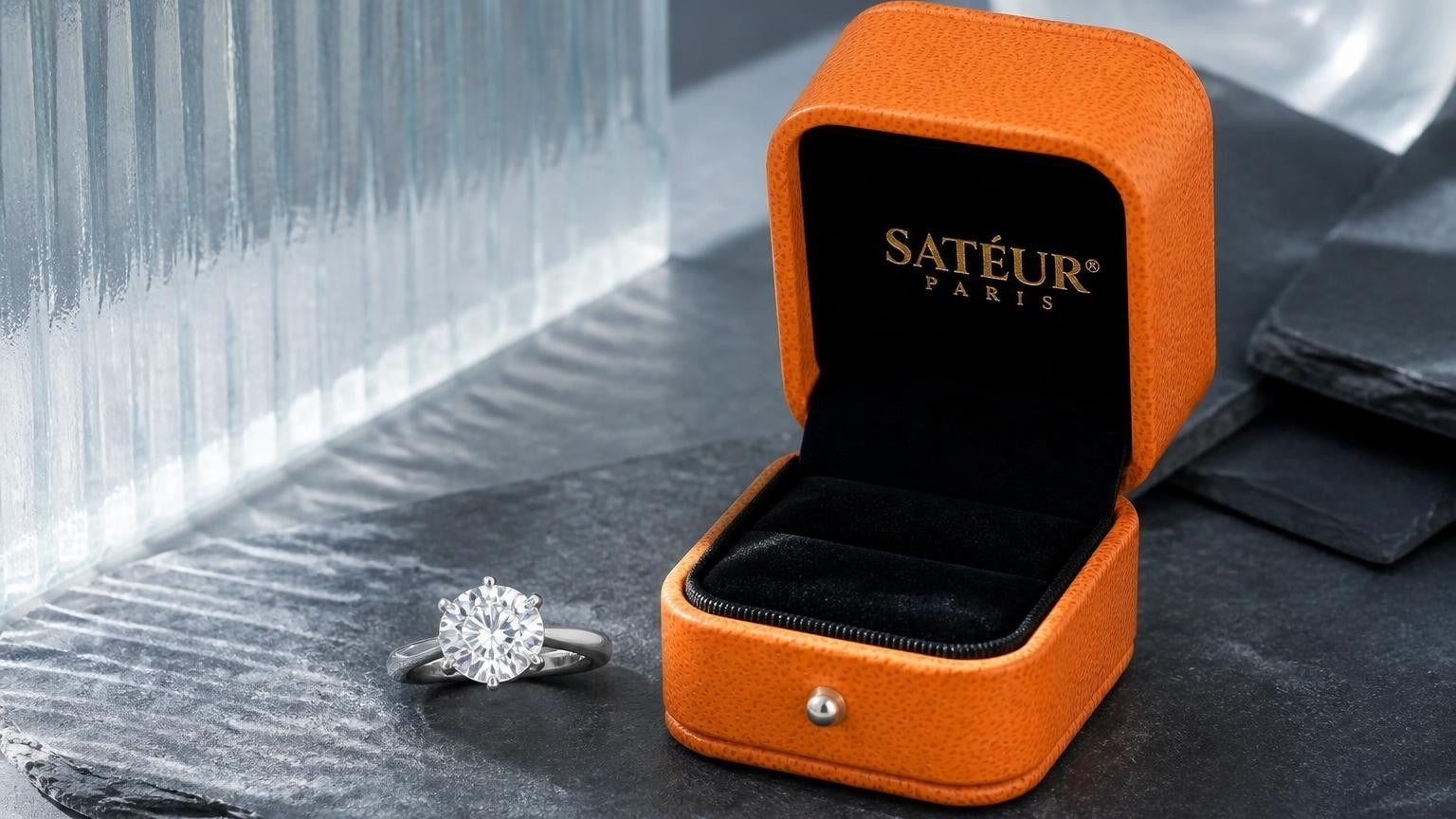
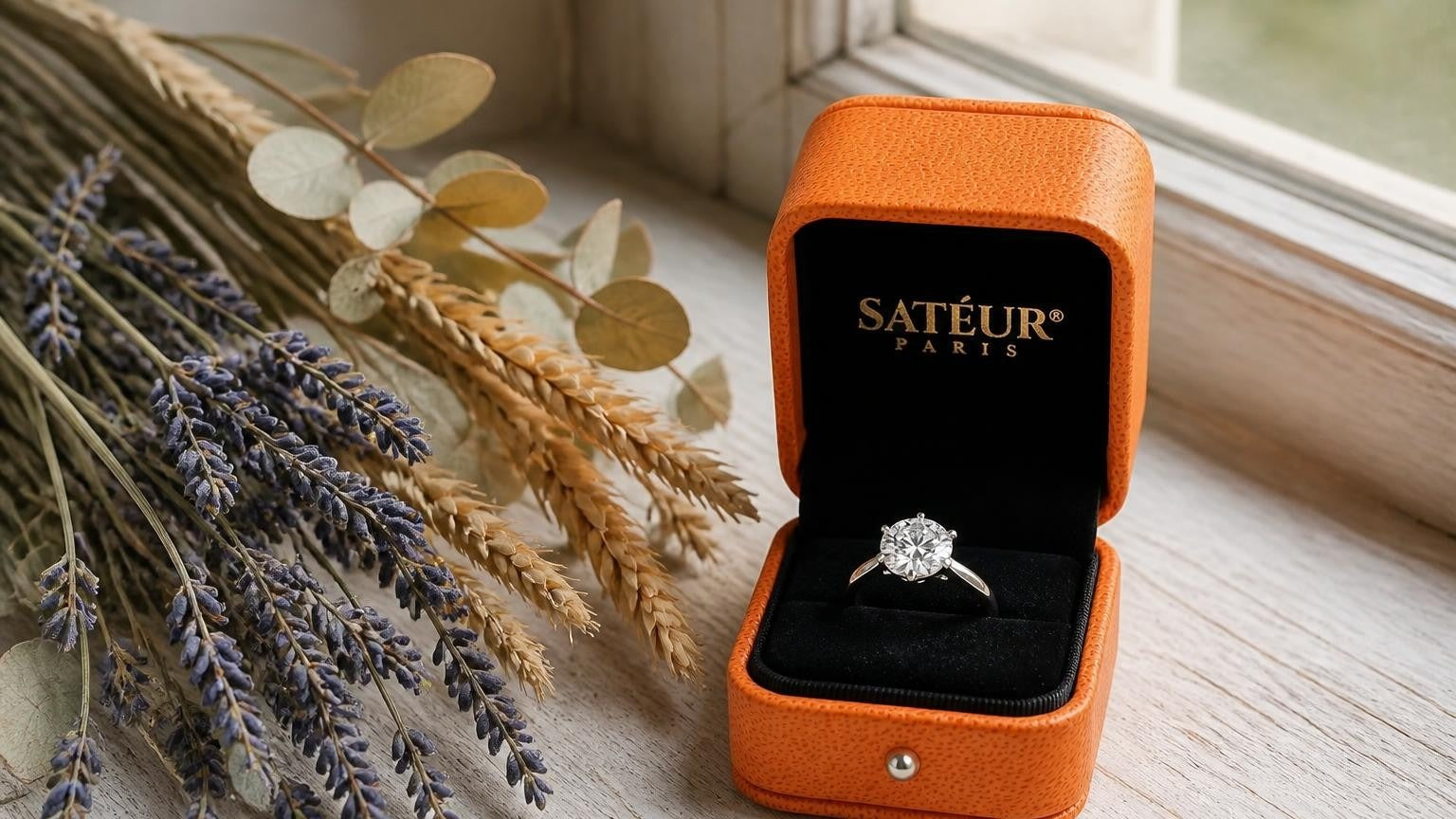
The Satéur Destinée Ring™ — The 1% Ring® — begins at $138 in an 18k white gold finish solitaire. Set against the $5,500–$7,000 average engagement ring cost, the contrast is clear. The presence is the same. The financial overhead is not.
Over 100,000 customers across 150 countries have chosen that path — not from compromise, but from the kind of clarity that comes from understanding what a diamond actually is, and what it is not. The The 1% Ring collection spans a range of carat weights, cuts, and gold finish options — from the classic Destinée solitaire to more architectural settings. Each is built to the same optical standard: the clean, white diamond look that defines The New Diamond Standard®.
The decision is not between luxury and compromise. It is between a mined diamond's provenance and a diamond simulant's precision. Both are real choices. Only one makes sense at the current average engagement ring cost.

Satéur Destinée Ring™
The look of a flawless diamond, for approximately 1% of the price.
Compare to a $10,000 mined diamond
Joined by 100,000+ couples across 150+ countries.
Discover The 1% RingFree worldwide shipping · 30-day returns · Lifetime Satéur Care
Frequently Asked Questions About Engagement Ring Cost
What is the average cost of an engagement ring in 2025?
The average engagement ring in the US costs between $5,500 and $7,000, based on The Knot's annual Real Weddings Study. The median — the point at which half of all buyers spend more and half spend less — sits closer to $3,500. Urban markets push the average higher; buyers outside major cities typically spend 20–30% below the national average engagement ring cost.
How does metal type affect the total cost of an engagement ring?
Platinum adds $800 to $2,000 or more over a comparable 14k gold setting, due to its higher density and 95% purity. White gold is the most common choice at mid-range budgets. 18k gold adds a modest premium over 14k for higher purity and warmer colour. In all cases, the metal accounts for 20–40% of the total ring cost; the stone — particularly a diamond — drives the balance.
What is the difference in price between mined and lab-grown diamond engagement rings?
Lab-grown diamonds are chemically and optically identical to mined diamonds and are certified by the same grading bodies. They typically cost 40–60% less than mined equivalents at equivalent grades. A 1-carat D/VS2 mined diamond retails at approximately $5,000–$7,000; the lab-grown equivalent runs $800–$1,500. Satéur's lab-grown diamond range offers certified stones in that price tier.
How much should you budget for an engagement ring?
The "two months' salary" guideline was a marketing construct, not financial guidance. A more useful principle: spend what does not create financial stress in the first year of a marriage. Research consistently shows that satisfaction with a ring correlates with personal meaning and thoughtfulness — not with the spend. Budgets under $1,000 can achieve full visual presence via engineered gem tiers; budgets above $5,000 enter mined diamond territory where the premium is largely provenance.
Does ring size affect the overall cost of an engagement ring?
Ring size affects the total gold weight in the band. For most standard solitaire settings, a larger size adds $50–$200 to the setting cost — negligible relative to the stone. For pavé or eternity band designs, where additional stones must fill the larger circumference, the cost differential can reach $300–$800 depending on stone count and quality. The wedding band is a separate consideration, typically $200–$800 in gold.
What are the advantages of choosing a diamond simulant for an engagement ring?
A diamond simulant engineered to the optical specification of a flawless diamond — such as Satéur Gems® — delivers the clean, white brilliance of a D-colour, Excellent-cut diamond for approximately 1% of the mined stone's price. The visual result in any social setting is the same. Satéur Gems® are extremely durable, built for everyday wear, and hold their brilliance for life. The practical advantages are material: the same presence, at a fraction of the average engagement ring cost, without the financial overhead that has become the norm in modern wedding culture.














Deixe um comentário
Este site está protegido pela Política de privacidade da hCaptcha e da hCaptcha e aplicam-se os Termos de serviço das mesmas.