

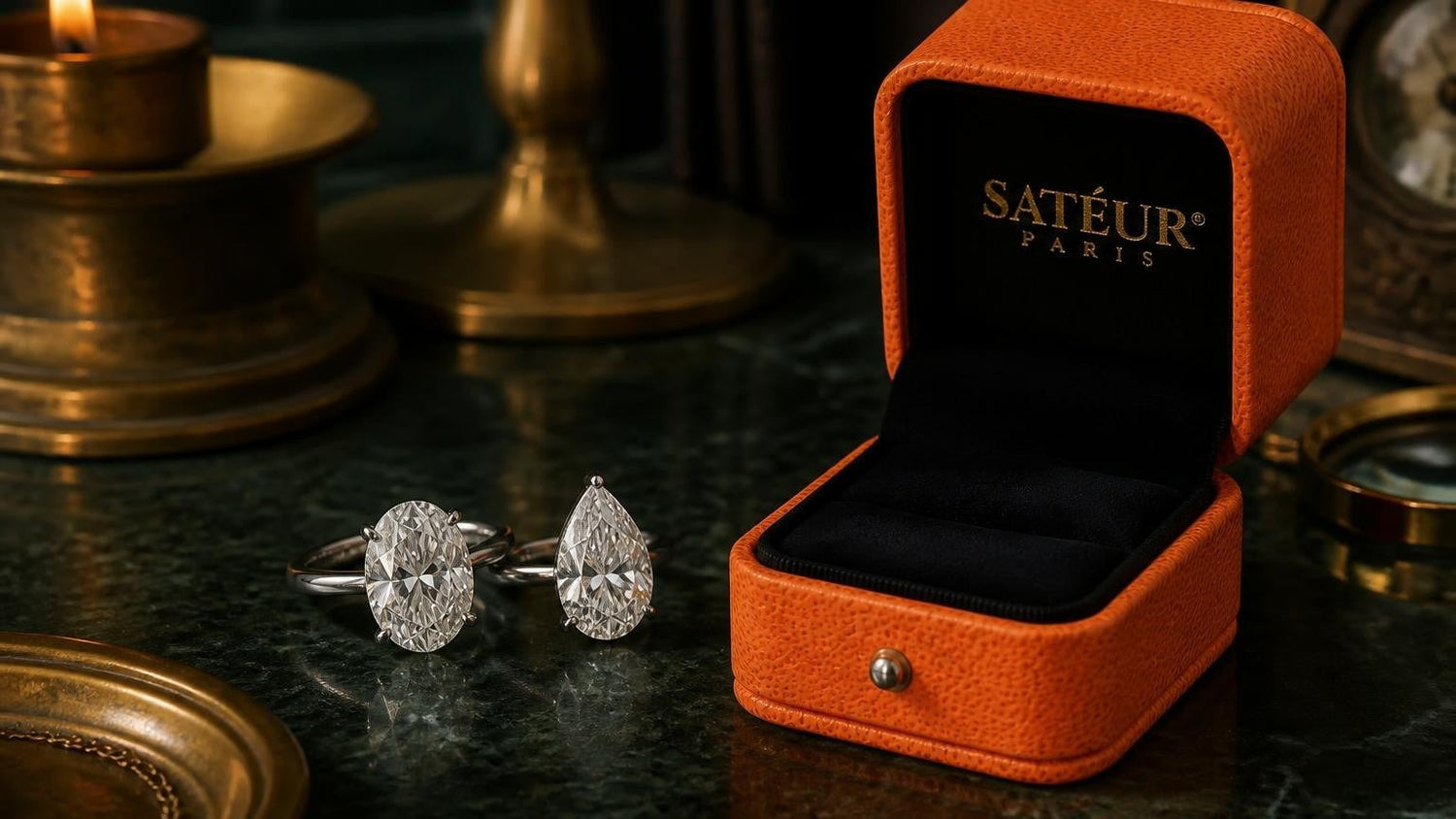
Moissanite Oval vs Pear Shape: Which Cut Is Right for You?
Two of the most distinctive moissanite cuts available today — the oval and the pear — share a family resemblance but diverge in character. Both elongate the finger. Both reward a good setting. The oval offers quiet continuity; the pear introduces a pointed directional energy that reads differently on every hand. Understanding the distinction before you choose is worth the time.
This guide draws direct comparisons across silhouette, light behaviour, setting compatibility, and practical wear. For a broader foundation on the full range of moissanite rings and what makes each cut work, that context sits alongside this piece.
Key Takeaways
- Oval cuts display a gentle, elongated silhouette that flatters most hand shapes and can appear larger than round cuts of equivalent carat weight.
- Pear cuts combine a rounded base with a single tapered point — a teardrop profile suited to solitaire and three-stone settings.
- Both cuts in moissanite display approximately 2.4 times more fire (spectral dispersion) than a mined diamond — vivid rainbow flashes in direct light.
- Moissanite rates approximately 9.25 on the Mohs scale — extremely durable, built for daily engagement ring wear.
- D-E colour moissanite shows no visible tint under daylight or standard indoor lighting.
- Satéur moissanite begins from approximately $98 — the diamond look at a fraction of the mined diamond price.
Oval vs Pear: Understanding the Key Differences
The oval is a modified brilliant cut — its proportions evolved directly from the round brilliant, preserving the same 58-facet architecture while redistributing its geometry along a longer axis. The result is a gemstone with a continuous curved outline, no sharp termination points, and a silhouette that feels familiar yet more expansive.
The pear — also called the pendeloque or teardrop — introduces asymmetry through a single pointed crown above a rounded pavilion base. This combination of the round and the marquise creates a directional gemstone: one with visual orientation, one that requires more deliberate positioning within its setting.
The key technical differences read most clearly in direct comparison:
| Property | Oval Cut | Pear Cut |
|---|---|---|
| Silhouette | Symmetrical elongated ellipse | Asymmetrical teardrop — round base, tapered point |
| Facet count | 58 (modified brilliant) | 58 (hybrid round-marquise) |
| Visual orientation | Neutral — no dominant point | Directional — tip reads upward or downward |
| Length-to-width ratio | Typically 1.30–1.50 | Typically 1.45–1.75 |
| Finger coverage | Even and broad | Elongated, tapered at one end |
| Bow-tie effect risk | Present in some proportions | Present near the shoulder |
| Setting complexity | Moderate — prong or bezel both straightforward | Higher — tip protection required |
| Mohs hardness (moissanite) | ~9.25 — both equally suitable for daily engagement ring wear | |

Oval Cut: Profile and Visual Character
The oval's primary strength is versatility. Its symmetrical outline reads well at virtually every orientation — no wrong angle, no dominant tip to consider. On the finger, the elongated form covers more surface area than a round cut of the same carat weight, creating the perception of a larger gem without a corresponding price increase.
For hands with shorter or wider fingers, the oval's length introduces visual proportion. For narrower hands, it adds presence without overwhelming the digit. This neutral compatibility is why oval cuts have become one of the most consistently requested shapes in oval moissanite engagement rings.
Optically, the oval returns a broad, even brilliance pattern. Its continuous curved outline means light exits from the gemstone in a rounded cascade — no concentrated bright spots, no dramatic directional flash. In moissanite, this is amplified by the approximately 2.4× higher spectral dispersion compared to a mined diamond, producing vivid colour flares across the entire face of the gemstone.
One quality to verify before purchase is the bow-tie — a dark shadow band running through the centre of some poorly-proportioned ovals. Well-cut ovals rated Excellent or Very Good minimise this effect to near-invisibility in most lighting conditions.
Pear Cut: Profile and Visual Character
The pear shape carries inherent drama. Its pointed tip draws the eye upward along the finger when worn tip-up — an effect many find distinctly elongating. Worn tip-down toward the knuckle, the reading changes entirely, the rounded base becoming the dominant visual anchor. This orientation flexibility is one of the pear's distinguishing qualities.
In a solitaire, the tip conventionally points toward the fingernail. In a pendant or drop earring, the tip faces down, following gravity. The gemstone adapts its character to its context in ways the oval does not.
For engagement rings, the pear works particularly well in solitaire and three-stone settings, where flanking side gemstones echo the curve of the base. A well-designed pear ring reads as a considered, architectural choice.
Protection of the tip is a practical matter. A V-tip prong or wraparound setting at the point guards against chipping during daily activity. Moissanite's ~9.25 Mohs hardness makes it extremely durable in both oval and pear-shaped engagement ring settings — but the pear's singular point benefits from that additional setting care.

Fire and Sparkle Across Both Shapes
Both oval and pear moissanite deliver the same fundamental optical signature: more fire than a mined diamond. The approximately 2.4× higher spectral dispersion produces visible rainbow flashes in direct light — a vivid, energetic sparkle that distinguishes moissanite from its mined counterpart.
The distribution of that fire differs by shape. In the oval, fire spreads evenly across the broad face, creating a consistent prismatic display. In the pear, fire concentrates more visibly at the rounded base and shoulders, with the tapered end producing subtler flashes — most of the spectral performance arrives from the frontal viewing angle.
Both cuts in D-E colour moissanite show no visible tint under daylight or standard indoor lighting. The absence of colour allows fire and brilliance to read cleanly — which is why colour grade matters alongside cut grade when evaluating either shape.
Carat weight reads differently across these two outlines. A 2 carat oval, with its broad table, may appear larger face-up than a 2 carat pear. A 2 carat pear, however, may elongate the finger more visibly. Carat weight alone does not determine visual impact — shape, length-to-width ratio, and setting all contribute to the final reading.
Satéur Gems® Value: Diamond Look at Comparative Price
Moissanite is a real gemstone — lab-created, not mined — rated D-E colour and Excellent cut across the Satéur range. A mined oval or pear diamond at 2 carats, D colour, Excellent cut, would typically retail between $15,000 and $24,000. The same visual presence in Satéur moissanite is achievable at approximately 1% of that cost.
The reason is not a compromise in quality. It is a refusal to pay for artificial scarcity.
Satéur moissanite rates approximately 9.25 Mohs hardness, returns vivid fire indistinguishable with the naked eye from a mined diamond's sparkle, and carries the same setting craftsmanship as any fine ring. It is The New Diamond Standard — accessible because the intelligence of the choice has replaced the mythology of the price tag.
For those who prefer the most diamond-accurate look — the restrained, clean white brilliance of a flawless diamond rather than moissanite's vivid rainbow fire — Satéur Gems®, the Maison's trademarked flagship gemstone, begins from $138. Both paths arrive at the same standard of craftsmanship. The choice between them is one of optical character, not quality.

Satéur Destinée Ring™
The look of a flawless diamond, for 1% of the price.
Compare to a $10,000 mined diamond
Joined by 100,000+ couples across 150+ countries.
Discover The 1% RingFree worldwide shipping · 30-day returns · Lifetime Satéur Care
How to Choose Between Oval and Pear for Your Ring
The decision comes down to three questions: hand shape, setting preference, and the energy you want the ring to carry.
For hand shape, the oval is the more universally accommodating choice. Its even elongation reads well on most finger widths and lengths. The pear is more expressive — it adds a directional, architectural quality that suits longer fingers particularly well, and can make shorter fingers appear more slender when the tip points upward.
For settings, the oval is straightforward — four or six prongs, a bezel, a halo, all work cleanly. The pear demands more deliberate setting design: a V-tip prong to protect the point and a setting that balances the asymmetry. Three-stone settings with matching pear or trillion side gemstones can be particularly effective.
For character: the oval expresses elegance through restraint. The pear is a shape with a point of view — it is meant to be noticed, and it earns that attention actively. If the ring is meant to accrue its beauty slowly, the oval serves that intention. If it is meant to declare something, the pear does.
For a broader guide on which ring shapes suit different hand types, that resource offers a detailed framework. Over 100,000 customers across 150+ countries have chosen a different path — the diamond look at a fraction of the mined diamond price. Both the oval and pear carry that intelligence equally.
Care and Durability of Diamond Simulants
Moissanite at approximately 9.25 Mohs hardness is the second hardest gem material after diamond. Both oval and pear cuts are built for daily engagement ring wear without concern for scratching from ordinary surfaces.
The pear's tip warrants one specific care note: a V-tip prong is the preferred setting to guard against lateral impact at the point. This is a setting consideration, not a material weakness — the gemstone itself is robust.
Cleaning is straightforward for both shapes: warm water, a drop of mild soap, a soft brush. Ultrasonic cleaners are generally safe for moissanite in secure settings. No special maintenance schedule is required. Both shapes, properly set, hold their brilliance for life.

FAQ: Oval and Pear Cut Questions
What is the main visual difference between oval and pear cut diamond simulants?
The oval has a symmetrical, continuous elliptical outline — no points, no directional axis. The pear has one rounded end and one tapered point, creating a teardrop shape that reads directionally on the finger. The oval reads universally; the pear reads architecturally. Both in moissanite deliver vivid fire and D-E colour brilliance with no visible tint to the naked eye.
Do oval and pear cuts work equally well in solitaire settings?
Both work in solitaire settings, but with different requirements. The oval is straightforward — four or six prongs, a bezel, or a halo all complement it cleanly. The pear requires a V-tip prong or wrapped setting at the point to protect the tapered end from lateral impact. A pear solitaire with this protection is a clean, strong design choice.
How does fire appearance differ between these two cuts?
In the oval, fire distributes evenly across the broad face, producing a consistent prismatic display from most viewing angles. In the pear, fire concentrates more visibly at the rounded base and shoulders, with the point delivering subtler flashes. Both cuts in moissanite produce approximately 2.4 times more spectral dispersion than a mined diamond, resulting in vivid rainbow fire in direct light.
Which shape flatters a wider range of hand types?
The oval is the more universally flattering shape. Its even elongation accommodates most finger widths and lengths without creating visual imbalance. The pear works particularly well on longer fingers and can create an elongating effect on shorter fingers when worn tip-up. Neither shape is universally superior — the question is how the ring's character aligns with the wearer's hand and intention.
Are oval and pear cuts equally durable for daily engagement ring wear?
Yes. Both cuts in moissanite share approximately 9.25 Mohs hardness, extremely durable for daily wear. The pear benefits from a V-tip prong setting to protect its point from lateral impact. Once properly set, both shapes are built for everyday wear without concern for scratching or chipping from ordinary activity.
How does the price of an oval simulant compare to a pear simulant of similar size?
For moissanite, the price difference between oval and pear cuts of the same carat weight and colour grade is minimal — determined by carat weight and setting complexity, not shape alone. Both shapes sit far below an equivalent mined diamond: a 2 carat mined oval or pear in D colour, Excellent cut, would typically cost $15,000–$24,000. The same visual presence in Satéur moissanite is achievable at approximately 1% of that cost.












Deixe um comentário
Este site está protegido pela Política de privacidade da hCaptcha e da hCaptcha e aplicam-se os Termos de serviço das mesmas.