

Does Moissanite Pass a Diamond Tester?
Yes — and no. The answer depends entirely on which type of tester is used. A basic thermal-conductivity tester, the instrument found in most jewellery stores for decades, will typically read moissanite as diamond. A modern dual-mode tester — which adds electrical conductivity measurement — will correctly identify moissanite as a distinct gemstone. This is not a flaw. It is a direct consequence of moissanite's extraordinary physical properties, the same properties that make it one of the most durable and brilliant gemstones available.
Understanding why requires a brief look at the science. Satéur's moissanite collection is sold openly as moissanite — a lab-created gemstone with its own properties and identity — so the question of how a probe reads it is purely academic for our customers. But it is a question worth answering precisely, because the science reveals something more interesting than a simple pass or fail.
Key Takeaways
- Basic thermal-only testers read moissanite as diamond due to near-identical heat conductivity.
- Modern dual-mode testers (thermal + electrical) correctly distinguish moissanite from diamond.
- Moissanite is a real gemstone — lab-created silicon carbide — not an imitation or simulant.
- Moissanite has a Mohs hardness of approximately 9.25 and approximately 2.4× the chromatic fire of diamond.
- To the naked eye, moissanite and diamond are visually indistinguishable under everyday conditions.
- Satéur moissanite rings start from approximately $88 — the look of a fine diamond, for roughly 1% of the price.

How Diamond Testers Work
Diamond testers were designed to solve a single retail problem: distinguishing cubic zirconia from diamond quickly. The earliest devices measured thermal conductivity — how efficiently a gemstone transfers heat away from a heated probe tip. Diamond conducts heat exceptionally well. Cubic zirconia does not. A thermal tester signals "diamond" when it detects a high heat-transfer rate.
The engineering logic was sound for its era. Diamond's thermal conductivity — among the highest of any known material — stems from its pure carbon cubic lattice. Every quantum of thermal energy travels through that structure with minimal resistance. When the probe touches a real diamond, the heat dissipates rapidly into the stone. The device registers this dissipation rate and returns a positive reading.
Cubic zirconia, by contrast, conducts heat much more slowly. The probe tip stays warm. The tester signals "not diamond." For the purposes the device was designed for, this two-outcome model was sufficient for years.
The limitation of thermal-only testing became apparent when moissanite entered the commercial jewellery market. Moissanite — silicon carbide — happens to have thermal conductivity that approaches diamond's range. The probe cannot feel the difference. Thermal-only testers therefore register moissanite in the diamond range, producing what is technically a false positive.
Manufacturers responded with dual-mode testers that also measure electrical conductivity. Diamond is an electrical insulator — electrons do not pass through it. Moissanite is a mild semiconductor. A dual-mode tester that detects this difference will identify moissanite correctly as a non-diamond gemstone, even though its thermal signature resembles diamond.
Why Moissanite and Diamonds Respond Differently
Diamond is pure carbon arranged in a cubic crystal lattice. Its thermal conductivity is among the highest of any material: approximately 900–2320 W/m·K depending on purity and cut. That figure reflects the efficiency of phonon (heat quantum) travel through the tightly bonded carbon structure.
Moissanite is silicon carbide — a compound of silicon and carbon atoms in a hexagonal lattice. Its thermal conductivity is high for a compound material, measuring approximately 370–490 W/m·K. That range is lower than diamond's peak, but for older thermal testers calibrated to detect the general heat-transfer behaviour, it falls within the positive-response threshold.
The crucial distinction is electrical. Pure diamond is an insulator at room temperature. Its wide band gap means electrons cannot flow through it under normal conditions. Moissanite's carbon-silicon bond creates a narrower band gap — a small but measurable electron flow is possible. This is what a dual-mode tester detects. When the instrument sends a small current through the stone and detects conductivity, it returns a "moissanite" reading.
Neither property — thermal similarity to diamond, or mild electrical conductivity — says anything about quality or visual appearance. They describe atomic structure. Moissanite's semiconducting nature has no effect on how it looks worn.


Electrical Conductivity and Thermal Properties
The following table summarises the key physical properties relevant to gemstone testing and visual performance.
| Property | Diamond | Moissanite |
|---|---|---|
| Thermal conductivity | 900–2320 W/m·K | ~370–490 W/m·K |
| Electrical conductivity | Insulator | Mild semiconductor |
| Thermal tester result | Diamond | Diamond (thermal false positive) |
| Dual-mode tester result | Diamond | Moissanite (correct) |
| Mohs hardness | 10 | ~9.25 |
| Refractive index | 2.42 | ~2.65 |
| Chromatic dispersion (fire) | 0.044 | 0.104 (~2.4× diamond) |
| Crystal structure | Cubic carbon lattice | Hexagonal silicon carbide |
The fire figure deserves particular attention. Chromatic dispersion — the ability to split white light into spectral colour — is what gives moissanite its vivid, rainbow-forward brilliance. At approximately 2.4 times diamond's dispersion value, moissanite under direct light shows more visible colour play. Under ambient indoor light and with the naked eye, this distinction is subtle in smaller stones; it is more apparent in stones of one carat and above.
The refractive index — 2.65 for moissanite versus 2.42 for diamond — means light bends more sharply as it enters moissanite. This contributes both to its brilliance and to its fire signature. These are properties of the material itself, not enhancements. They are why moissanite was eventually recognised as a gemstone in its own right, rather than merely assessed against diamond.
What to Expect When Testing Moissanite
If you have a moissanite gemstone and a jeweller tests it with an older thermal probe, the device will likely signal diamond. This outcome is physically expected — the materials share enough thermal behaviour to trigger the instrument's threshold. It is not a meaningful statement about the gemstone's identity.
Any jeweller with a current dual-mode tester will correctly identify the stone as moissanite. This is equally expected and accurate. Moissanite is what it is: a lab-created gemstone with exceptional properties, offered and purchased openly as moissanite. There is nothing to verify beyond the material facts.
The relevant question for most buyers is not what a probe reads in a back room. It is what the ring looks like in the places it will actually be worn — across a dinner table, at a celebration, in everyday light. Under those conditions, the visual difference between high-quality moissanite and a fine diamond is indistinguishable with the naked eye.
For buyers weighing moissanite engagement rings, the testing question is context — an explanation of the science, not a caveat about the gemstone's beauty, durability, or suitability.
Moissanite vs. Diamond: Key Differences
Testing aside, the practical comparison between moissanite and diamond comes down to a handful of properties that actually affect the experience of wearing the ring.
- Fire and brilliance: Moissanite produces approximately 2.4× the chromatic dispersion of diamond. This is the rainbow-forward sparkle that distinguishes it in direct light. Diamond returns crisp, white brilliance. Both are exceptional. The preference is personal.
- Durability: Diamond is a 10 on the Mohs scale. Moissanite is approximately 9.25 — among the hardest gemstones available and entirely appropriate for daily engagement ring wear. The difference in practical scratch resistance is negligible for jewellery purposes.
- Origin: Mined diamonds form over billions of years under the earth. Moissanite is lab-created silicon carbide. Natural moissanite was first discovered in a meteor crater in Arizona in 1893 by Henri Moissan — the same crater impact chemistry is replicated in laboratory conditions today.
- Colour: Satéur moissanite is graded at D-E colour, the finest colourless range — equivalent to the top category in the diamond grading system.
- Price: A one-carat mined diamond of D-F colour and Excellent cut typically retails from $3,000 to $10,000 or more. A comparable moissanite in Satéur's collection begins from approximately $88. The visual result worn is equivalent to the naked eye. The financial difference is material.
For a detailed side-by-side evaluation, our comprehensive guide to moissanite vs. diamond rings covers every dimension a buyer needs. Those evaluating all three categories — moissanite, natural diamond, and lab diamond — can find the full comparison in our guide to moissanite vs. diamond vs. lab diamond.

Satéur's Moissanite Value Proposition
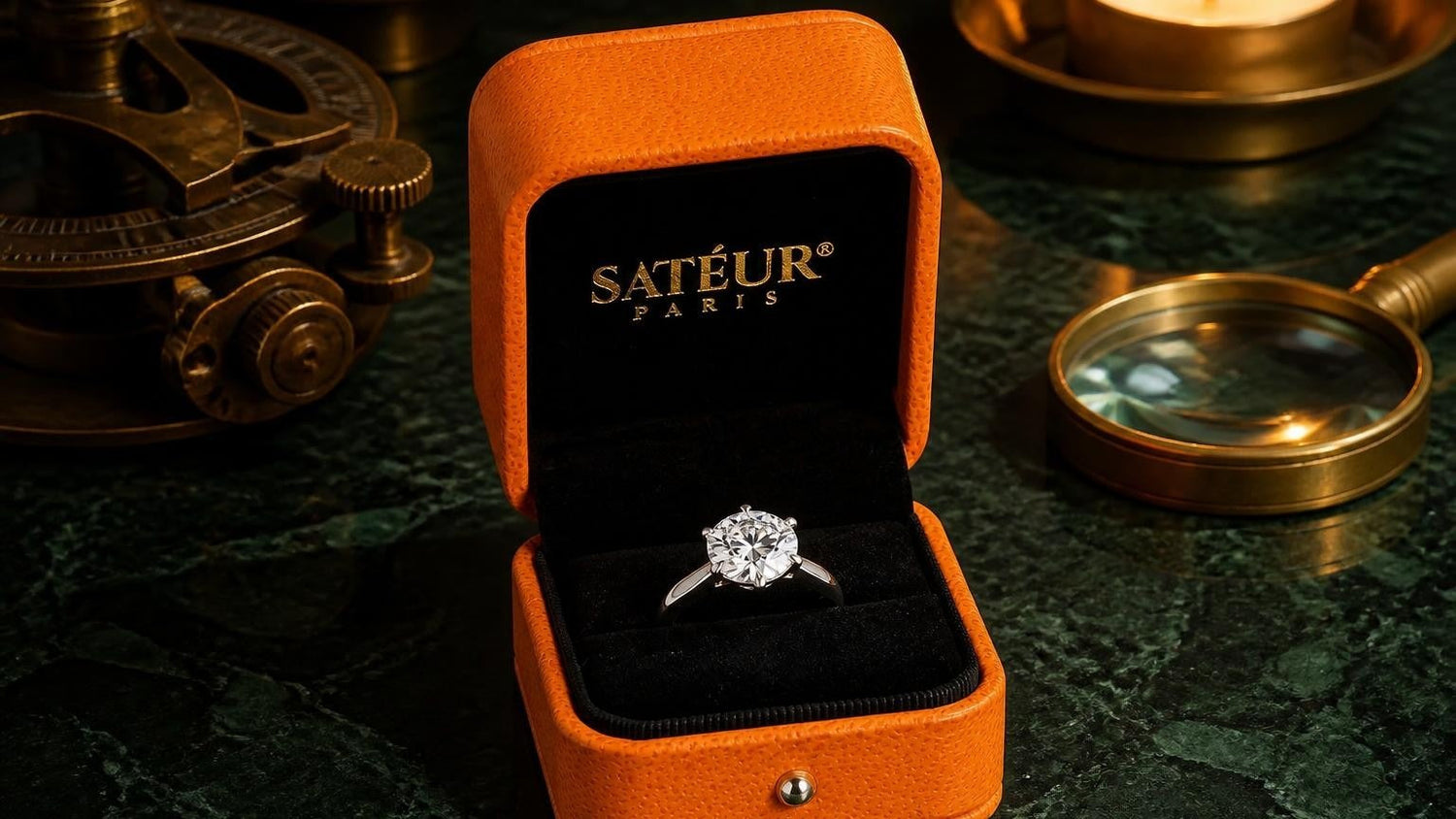
Satéur's moissanite is graded D-E colour, Excellent cut, with a Mohs hardness of approximately 9.25. Every stone is lab-created — a real gemstone with properties that rival the finest mined alternatives. The collection spans rings, earrings, and necklaces, beginning from approximately $88.
A comparable mined diamond would typically begin at several thousand dollars. The visual difference to the naked eye, worn at the occasions that matter, is not practically apparent. That gap — between what you pay and what you see — is the foundation of The New Diamond Standard.
This is not a compromise. It is a decision made with full knowledge of the science: moissanite is a distinct gemstone, openly identified, with properties that make it an outstanding choice on its own terms. The question of what an older probe reads is interesting science. It does not change what the ring looks like on a hand, or what it means to the person wearing it.
For those exploring where moissanite sits alongside Satéur's other gem tiers, our comparison of moissanite, diamond, and Satéur Gems® covers the complete picture. The full moissanite range is available at Satéur moissanite rings.
With Satéur, there is no question of passing or failing anything. The gemstone is presented for what it is — and what it is, is exceptional.

Satéur Destinée Ring™
The look of a flawless diamond, for approximately 1% of the price.
Compare to a $10,000 mined diamond
Joined by 100,000+ couples across 150+ countries.
Discover The 1% RingFree worldwide shipping · 30-day returns · Lifetime Satéur Care
FAQ: Moissanite Testing and Selection
What is the difference between moissanite and diamond when tested?
A basic thermal-conductivity tester measures how efficiently a gemstone conducts heat. Because moissanite has thermal conductivity approaching diamond's range, a thermal-only tester typically reads moissanite as diamond. A dual-mode tester — which also measures electrical conductivity — correctly identifies moissanite as a separate gemstone, because moissanite is a mild semiconductor while diamond is an electrical insulator. Neither result reflects quality; both reflect the underlying atomic structure of the materials.
Do all diamond testers detect moissanite?
No. Older thermal-only testers do not reliably distinguish moissanite from diamond because both materials conduct heat at rates that register within the tester's positive threshold. Modern dual-mode testers, which measure both thermal and electrical conductivity, will correctly identify moissanite as a separate gemstone. The type of tester available varies by jeweller and context. Satéur sells moissanite openly as moissanite — the tester result is a scientific footnote, not a practical concern for buyers.
Can moissanite be distinguished from diamond with the naked eye?
Under most everyday conditions — restaurant lighting, natural indoor light, general social settings — moissanite and diamond are visually indistinguishable with the naked eye. In very direct or intense light, moissanite may show more vivid chromatic fire, the rainbow-like dispersion of colour, due to its higher refractive index of approximately 2.65 versus diamond's 2.42. This is more apparent in larger stones and under light conditions that specifically elicit chromatic dispersion. For practical daily wear, the visual equivalence holds.
What are the colour and clarity specifications of Satéur's moissanite?
Satéur moissanite is graded at D-E colour — equivalent to the finest colourless category in the diamond grading system. Cut grade is Excellent. Mohs hardness is approximately 9.25, placing it among the hardest gemstones available and making it entirely suitable for an engagement ring worn every day. The stone holds its brilliance indefinitely; there is no clouding or degradation over time.
How does the price of moissanite compare to diamond?
A one-carat mined diamond of D-F colour and Excellent cut typically retails from $3,000 to $10,000 or more depending on clarity and source. A comparable moissanite of D-E colour, Excellent cut can be acquired for significantly less — in Satéur's collection, moissanite rings start from approximately $88. The visual result worn at the occasions that matter is equivalent to the naked eye. The financial difference is significant and is the central reason moissanite has become a considered and deliberate choice for modern buyers.
Is moissanite suitable for everyday wear in an engagement ring?
Yes. Moissanite's Mohs hardness of approximately 9.25 places it second only to diamond among common jewellery gemstones. It is resistant to scratching, chipping, and the demands of daily wear. Satéur moissanite engagement rings are built for lifetime use. The gemstone does not cloud, dull, or degrade with time — it retains its optical properties permanently. There are no special care requirements beyond the standard maintenance appropriate for any fine jewellery.
















留下評論
此網站已受到 hCaptcha 保護,且適用 hCaptcha 隱私政策以及服務條款。