




What Is the Name for a Fake Diamond? Understanding Diamond Simulant Names
The word "fake" is consumer shorthand. The industry's correct and respectful term is diamond simulant — a gemstone or material engineered to replicate the visual appearance of a mined diamond while remaining its own distinct substance. Diamond simulants are not deceptions. Many are genuine gemstones with documented chemical identities, independent optical properties, and recognised value. This guide covers the principal diamond alternative names used in the trade today — their proper terminology, real characteristics, and why choosing one is an informed act, not an apology.
Key Takeaways
- The industry term for what people call a "fake diamond" is diamond simulant — a material that replicates diamond's appearance without sharing its chemistry.
- Principal simulant names: moissanite, cubic zirconia, white sapphire, white topaz, and trademarked simulants such as Satéur Gems®.
- Diamond simulants typically cost approximately 1% of an equivalent mined diamond's price.
- Moissanite is a genuine lab-created gemstone with Mohs hardness ~9.25 and more fire than a diamond.
- Satéur Gems® achieves D-E colour and Excellent cut, delivering the clean white brilliance of a flawless diamond.
- Lab-grown diamonds are a separate category — they share the chemistry of mined diamonds and are not simulants.
Understanding Diamond Simulant Names
A diamond simulant is any material — natural, lab-created, or manufactured — used to replicate the appearance of a mined diamond. The simulant does not share diamond's chemical composition (pure carbon in a cubic crystal lattice). It achieves a similar look through its own refractive index, dispersion, and precision cut. The term is accurate and neutral; it carries no implication of inferiority.
The phrase "fake diamond name" surfaces frequently in consumer searches because it is how the question forms instinctively. Within the jewellery industry, gemological laboratories, and reputable retailers, the preferred language is diamond simulant or diamond alternative. These names reflect a straightforward fact: the gemstone is openly sold as a non-diamond option, chosen deliberately for its combination of appearance and value.
Diamond simulants should not be confused with lab-grown diamonds, which are chemically and optically identical to mined diamonds and form a distinct category of their own. A simulant looks like a diamond. A lab-grown diamond is a diamond, grown in a controlled environment rather than extracted from the earth.
Common Diamond Simulant Materials
Several distinct materials carry recognised trade names. Each has its own optical properties, durability rating, and price position.

Moissanite
Moissanite is a lab-created gemstone — silicon carbide (SiC) — first discovered in nature by Henri Moissan in 1893 and now produced entirely in controlled laboratory conditions. It is openly sold under its own name, carries a Mohs hardness of approximately 9.25, and is characterised by more fire than a diamond. Its refractive index (~2.65) produces a vivid, rainbow-forward sparkle that distinguishes it clearly from the optical signature of a mined diamond. That distinction is a feature, not a limitation, for buyers who favour vivid optical drama. The moissanite collection at Satéur offers this tier openly, with full disclosure of material and origin.
Cubic Zirconia
Cubic zirconia — abbreviated CZ — is the most widely produced diamond simulant by volume. It is zirconium dioxide (ZrO₂) stabilised in a cubic crystal structure, manufactured synthetically since the 1970s. Standard cubic zirconia carries a Mohs hardness of approximately 8 to 8.5. Its surface can develop micro-abrasions with extended daily wear, dulling brilliance over time. At entry-level price points, it presents the diamond look accessibly — though longevity relative to moissanite or premium trademarked simulants remains the primary difference between the tiers.
White Sapphire
White sapphire is the colourless variety of corundum — the same mineral family as ruby and coloured sapphires. It occurs naturally and is also produced in laboratory conditions. With a Mohs hardness of 9, it is exceptionally durable. Its lower refractive index (~1.77), however, produces a softer and less brilliant optical output than diamond, moissanite, or high-grade trademarked simulants. It reads as a refined, understated option rather than a high-sparkle one.
White Topaz
White topaz is a natural mineral with a Mohs hardness of 8, used in budget-positioned jewellery as a diamond alternative. Its refractive index (~1.62) produces noticeably lower sparkle. White topaz scratches readily and is generally considered an entry-level simulant, positioned below moissanite and premium branded simulants in both performance and longevity.
Trademarked Diamond Simulants
A growing and distinct category comprises proprietary simulants created by specific Maisons to precise optical and durability standards. These carry brand names rather than generic material names, and their composition is intentionally undisclosed — the intellectual property of the Maison, in the same manner that Swarovski has never disclosed its crystal formula. The most prominent trademarked simulant is Satéur Gems®.
Diamond Simulant vs Mined Diamond: Key Differences
| Property | Mined Diamond | Moissanite | Cubic Zirconia | Satéur Gems® |
|---|---|---|---|---|
| Chemistry | Pure carbon (C) | Silicon carbide (SiC) | Zirconium dioxide (ZrO₂) | Trademarked — not disclosed |
| Mohs Hardness | 10 | ~9.25 | ~8–8.5 | ~8.8 |
| Optical Character | Crisp white brilliance | More fire than diamond — vivid rainbow sparkle | Softer; dulls over time | Clean white diamond-accurate brilliance |
| Colour Grade (top) | D (colourless) | D equivalent | D equivalent at point of sale | D-E colour grade |
| Price (1 ct equivalent) | $5,000–$15,000+ | From ~$98 | $50+ | From ~$138 |
| Category | Natural gemstone | Lab-created gemstone | Synthetic material | Trademarked simulant |
The price difference between a mined diamond and a diamond simulant is the most consequential data point for most buyers. Diamond simulants typically cost approximately 1% of an equivalent mined diamond's retail price. A one-carat mined diamond ring retailing at $10,000 corresponds visually to a Satéur Gems® ring beginning at a fraction of that figure. To the naked eye, across the table, the look is equivalent.

Satéur Gems®: Comparative-Value Diamond Simulant
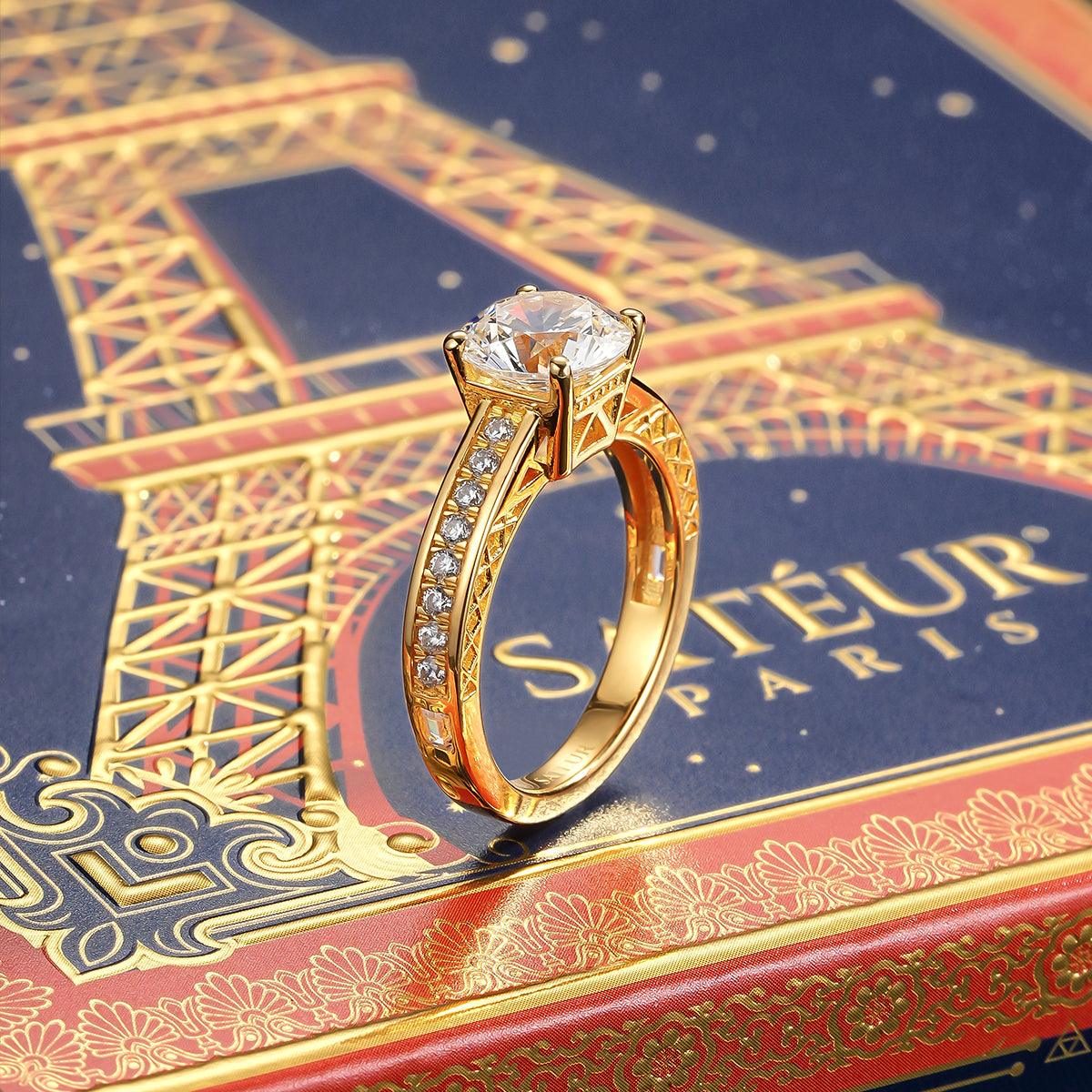
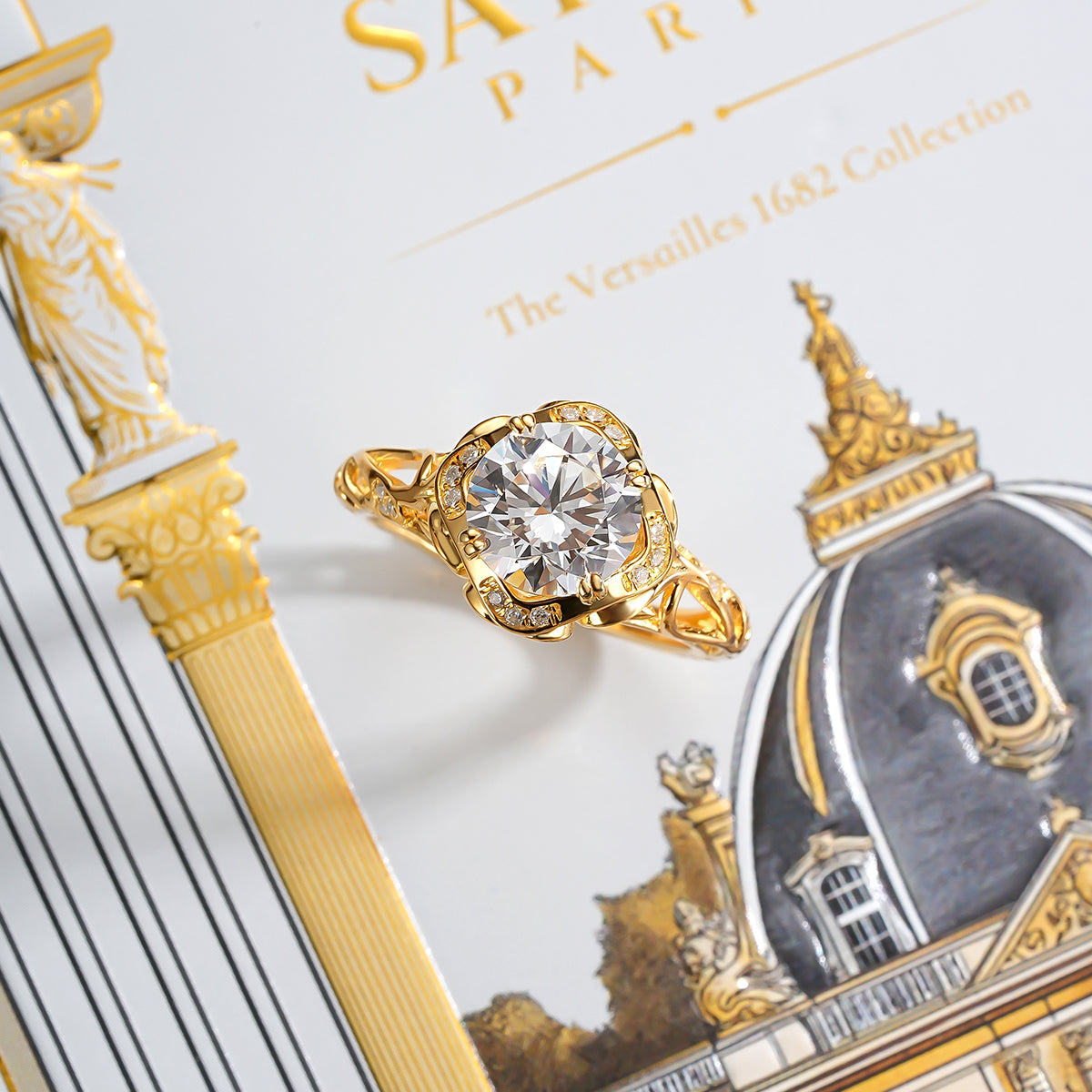
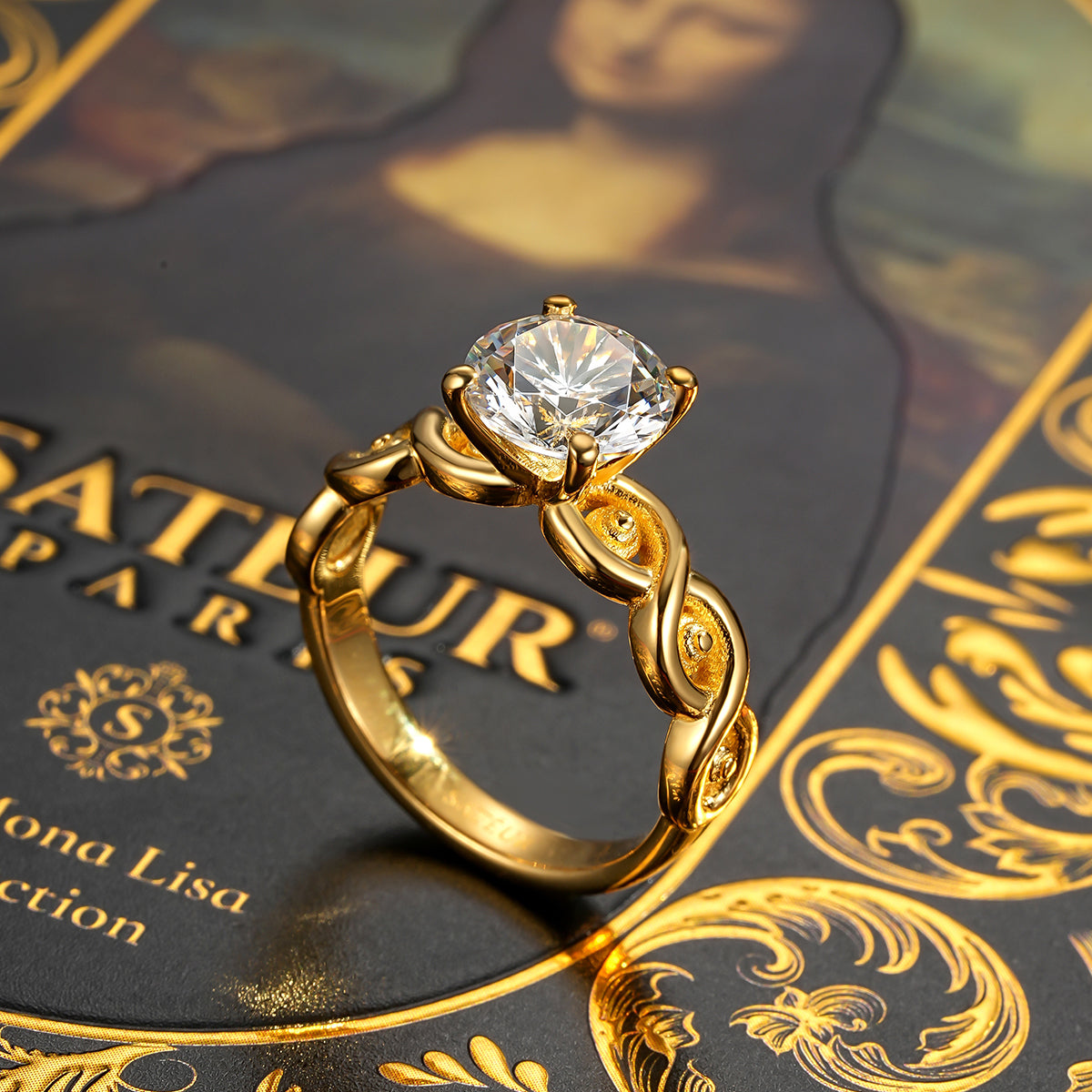
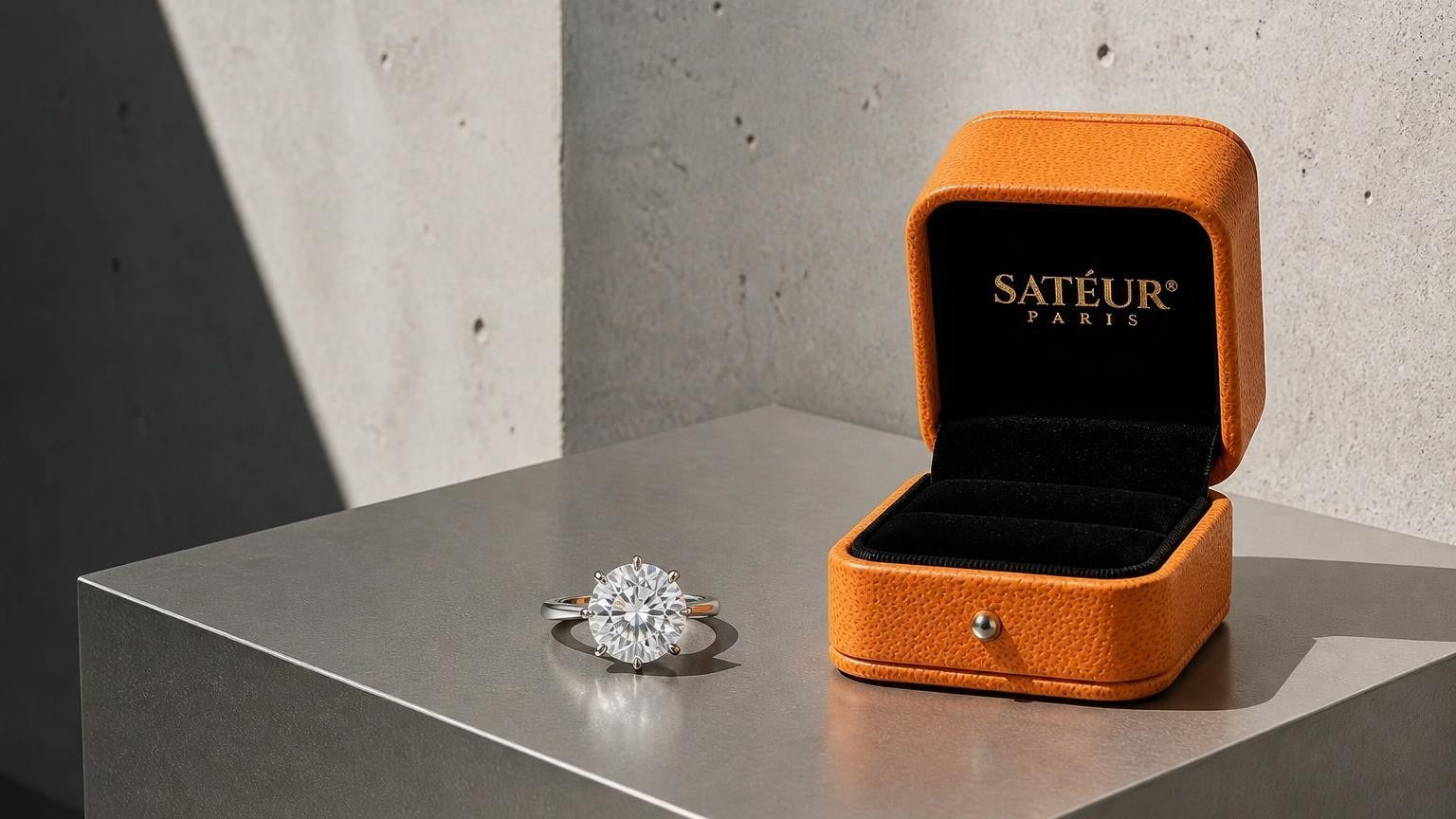
Satéur Gems® is a trademarked diamond simulant engineered to deliver the restrained, white brilliance of a fine diamond. Unlike standard cubic zirconia, which clouds and loses brilliance over time, Satéur Gems® is specified to D-E colour, Excellent cut, and a Mohs hardness of approximately 8.8 — extremely durable and built for everyday wear across a lifetime.
The defining property is diamond accuracy. Moissanite achieves more fire than a diamond — a vivid rainbow-forward dispersion from its higher refractive index (~2.65). Satéur Gems® is calibrated instead to replicate the clean, white brilliance of a flawless diamond. Its refractive index (~2.39) sits at diamond-adjacent optical territory. The result: a gem that reads as a flawless diamond to the naked eye, across the table. That is the precise effect for which it was designed.
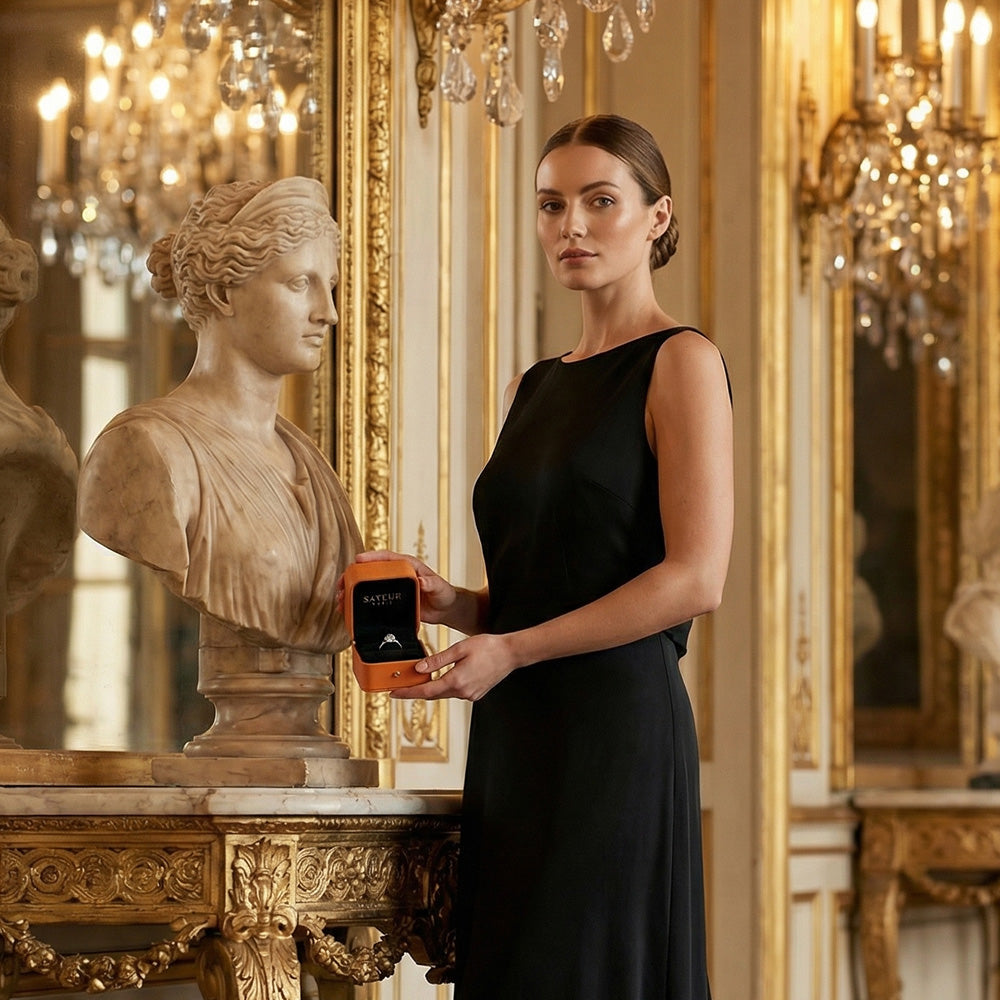
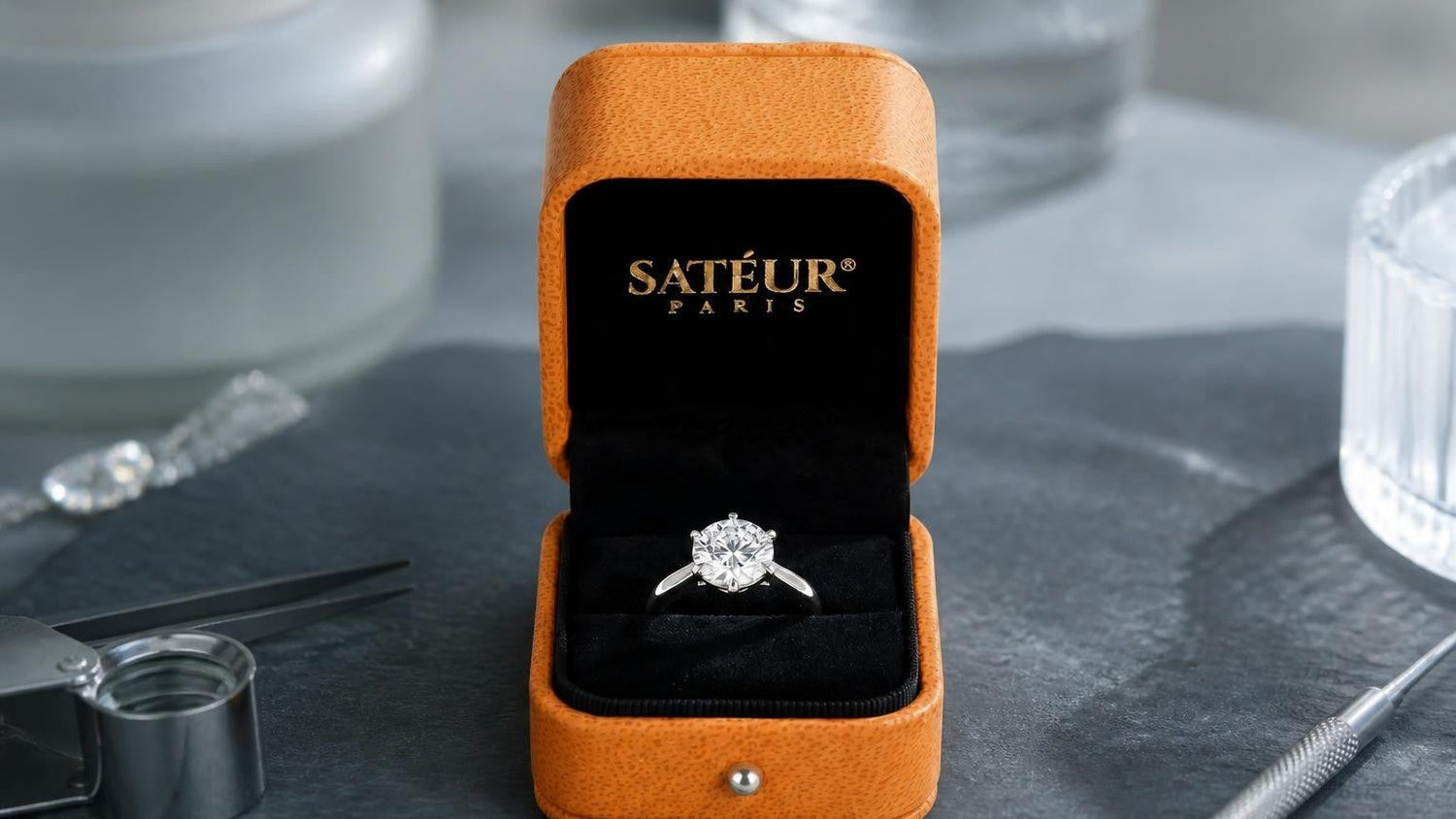
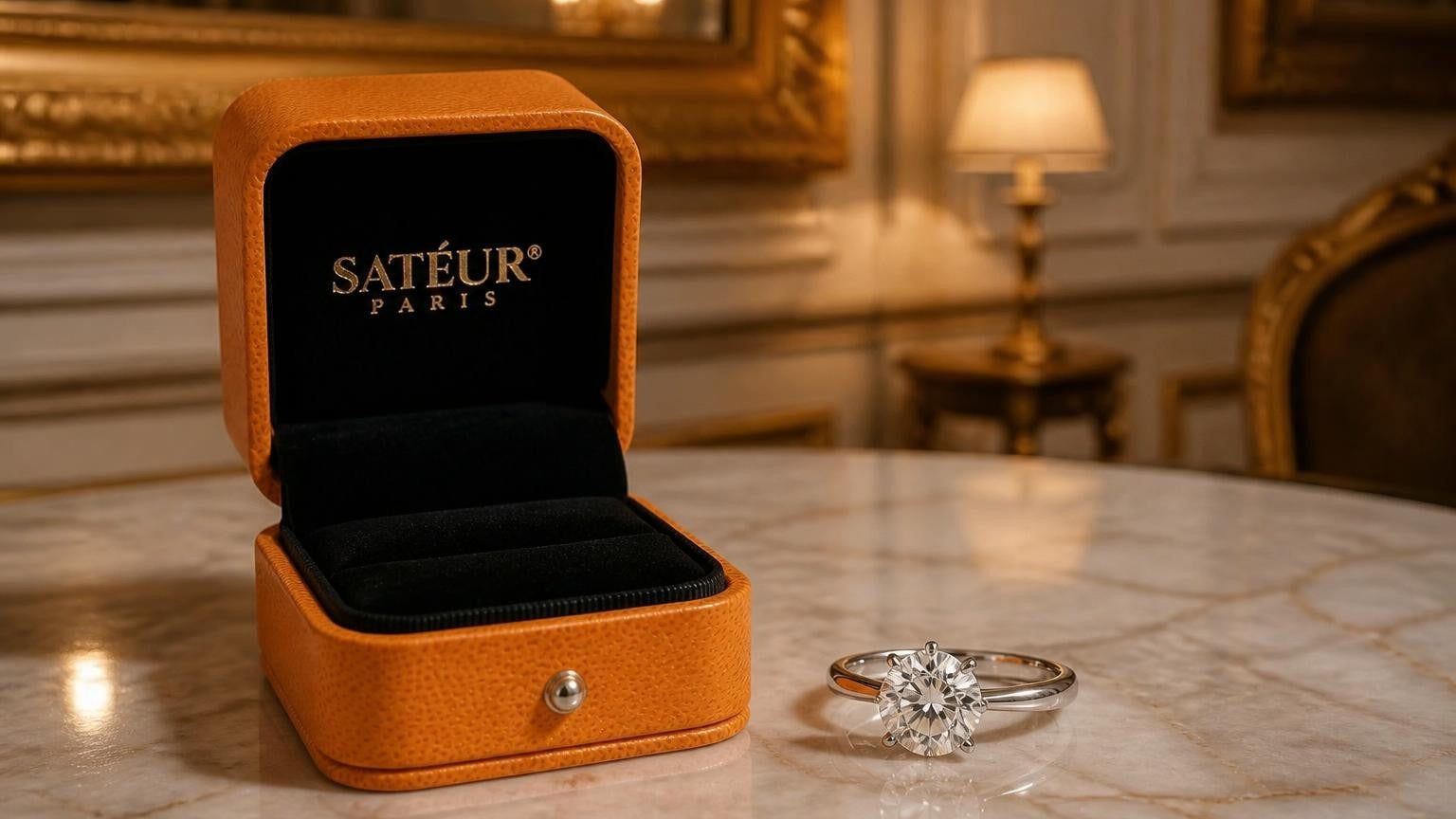
Entry pieces in the Satéur Gems® range begin at approximately $138. The flagship is The 1% Ring® — available in the The 1% Ring collection — a 1.00 carat round-cut Satéur Gems® solitaire in 18k white gold finishing that delivers the diamond engagement ring experience at 1% of the price of a comparable mined diamond. The composition of Satéur Gems® is the intellectual property of the Maison and is not disclosed publicly — in the same tradition as other proprietary gemstone formulations.

Satéur Destinée Ring™
The look of a flawless diamond, for 1% of the price.
Compare to a $10,000 mined diamond
Joined by 100,000+ couples across 150+ countries.
Discover The 1% RingFree worldwide shipping · 30-day returns · Lifetime Satéur Care
Why Choose a Diamond Simulant for Engagement Rings
The case for a diamond simulant engagement ring rests on three pillars: visual equivalence, financial intelligence, and transparent choice. On the first: a quality diamond simulant such as Satéur Gems® is indistinguishable from a mined diamond with the naked eye. On the second: capital redirected from a $10,000 mined diamond ring purchase has meaningful alternative uses — a home deposit, shared travel, or financial security at the start of a life together. On the third: the purchase is made with full knowledge. There is no pretence.
Diamond simulants are openly marketed as non-diamond alternatives. The buyer knows exactly what they are choosing, and chooses it on the merits of appearance, durability, and value. That is a fundamentally different transaction from the artificial scarcity and opaque pricing structures that have defined the traditional diamond industry for the better part of a century.
For engagement rings specifically, the symbolic function of the stone is identical to a mined diamond. The ring signifies commitment, not geological origin. Over 100,000 customers across 150 countries have arrived at this conclusion. The shift in the market for diamond simulants reflects a genuine change in consumer values — not a compromise, but a considered upgrade in how people think about jewellery.
Further reading: what to know about the best fake diamond rings and is cubic zirconia a valuable diamond alternative.

FAQ: Diamond Simulant Questions & Specifications
What are the main names for diamond simulants available today?
The principal names for diamond simulants are moissanite, cubic zirconia, white sapphire, white topaz, and trademarked simulants such as Satéur Gems®. Each carries its own proper name and is openly sold as a non-diamond alternative. Of the trademarked category, Satéur Gems® is the most prominent — engineered to D-E colour and Excellent cut with diamond-accurate white brilliance.
How do diamond simulant materials differ in durability and appearance?
Diamond simulants range in durability from Mohs 8 (standard cubic zirconia, white topaz) to Mohs 9.25 (moissanite). Satéur Gems® sits at approximately Mohs 8.8 — extremely durable for daily wear. In appearance, moissanite displays more fire than a diamond (vivid rainbow dispersion from its higher refractive index ~2.65), while Satéur Gems® replicates the clean, white brilliance of a flawless diamond (refractive index ~2.39). White sapphire and white topaz read softer and less brilliant than the premium simulant tier.
What is the price difference between a diamond simulant and a mined diamond?
Diamond simulants typically cost approximately 1% of an equivalent mined diamond's retail price. A mined diamond solitaire may retail between $5,000 and $15,000 for a one-carat stone. An equivalent-looking Satéur Gems® ring begins at approximately $138 for entry pieces and from ~$138 for the Gems® tier proper. The visual result to the naked eye is equivalent across the table.
Can a diamond simulant be used in an engagement ring?
Yes — and they are, with increasing frequency. Premium diamond simulants including moissanite and Satéur Gems® are routinely chosen for engagement rings by buyers who prioritise visual equivalence and intelligent value. Both are extremely durable for daily wear. The symbolic and visual function of the ring is identical to a mined diamond ring. Over 100,000 customers across 150 countries have chosen a Satéur diamond simulant for exactly this reason.
What colour and cut grades are available in quality diamond simulants?
Premium diamond simulants are available to D-E colour equivalents — the colourless end of the grading scale. Satéur Gems® is specified to D-E colour and Excellent cut as standard. Fire dispersion in moissanite reaches approximately 2.4 times that of a mined diamond, producing its distinctive optical character. Satéur Gems® is calibrated instead for diamond-accurate white brilliance.
Why do some diamond simulants display more fire than mined diamonds?
Fire — technically dispersion — is determined by a material's refractive index and how it separates white light into spectral colours. Moissanite's refractive index of approximately 2.65, higher than diamond (~2.42), produces its vivid rainbow flash. This is a documented property of the gemstone. Satéur Gems® carries a refractive index of approximately 2.39, calibrated deliberately for the crisp, white optical signature of a diamond rather than moissanite's vivid dispersion profile.
The New Diamond Standard is not a claim. It is a reorientation of value — away from artificial scarcity and toward the intelligence of genuine brilliance. Whether that brilliance takes the form of moissanite's vivid fire or Satéur Gems®' diamond-accurate white light, the intelligent choice begins with one thing: knowing what each material is actually called, and what it actually does.















Leave a comment
This site is protected by hCaptcha and the hCaptcha Privacy Policy and Terms of Service apply.