

Diamond vs Moissanite in Sunlight: Which Sparkles More?
Step outside on a bright afternoon with both stones side by side, and the distinction becomes unmistakable. Diamond vs moissanite in sunlight is not simply a question of which is brighter — it is a question of what kind of optical character each returns, and what that means for how a piece reads on the hand.
Diamonds deliver crisp white optical return: a deep, mirror-like flash with restraint. Moissanite returns something more vivid — a dispersed spectral display that, in direct sunlight, amplifies into a pronounced rainbow effect. Neither is wrong. They are optically distinct, by design, and understanding that distinction is the foundation of a well-considered jewelry choice.
For a broader view of how these gemstones compare across price, durability, and long-term value, read our complete guide to moissanite vs diamond rings.
Key Takeaways
- Diamonds have an optical index of 2.42; moissanite sits at 2.65 — producing approximately 2.4× greater spectral dispersion in direct sunlight.
- Diamonds return predominantly white brilliance with subtle colour flashes; moissanite exhibits pronounced rainbow dispersion in bright outdoor conditions.
- In diffuse indoor conditions, both stones appear similarly brilliant; direct sunlight is where the optical gap widens most noticeably.
- Moissanite ranks 9.25 on the Mohs hardness scale — engineered for daily-wear engagement jewelry across decades.
- Satéur moissanite pieces begin from $98, offering exceptional optical character at roughly 1% of comparable diamond pricing.
What Makes a Gemstone Sparkle in Daylight?
Visual character in a gemstone is not a single phenomenon. It is the sum of three optical properties: brilliance (white return), spectral dispersion (the separation of white into colour), and scintillation (the pattern of contrast as the stone or viewer moves).
Each property is governed by a material's optical index — the degree to which it bends incoming rays as they pass through the facets. A higher index bends more sharply, which increases colour dispersion at the cost of some white return. This is precisely the optical distinction between moissanite and its mined counterpart.
Direct sunlight, with its full visible spectrum and high intensity, acts as the most demanding test. Under softer indoor conditions, gaps between high-quality gems compress. Outdoor daylight exposes them fully. The carat weight also matters: larger gems offer more facet surface area, making the moissanite diamond contrast more pronounced at 1 carat and above.
Both have stable, permanent optical properties. Neither fades, yellows, or loses its character with age. Visual quality is fixed in the crystal structure.

Diamond in Sunlight: What You Actually See
The optical index of diamond is 2.42. Its dispersion value — the measure of how strongly it separates white into spectral colours — is 0.044. The result in direct sunlight is a stone that returns predominantly white brilliance, punctuated by sharp, discrete colour flashes at the crown facets.
The overall impression is one of depth and restraint. Diamond in sunlight reads as luminous and precise — each flash well-defined, each reflection drawing the eye inward. This is the visual language of fine diamonds: controlled rather than exuberant. Both natural and lab-grown diamonds share these same optical properties, because the index value is a function of carbon crystal structure, not origin.
In a solitaire setting, white optical return reads clean against any background — skin, fabric, or the ambient glow of a restaurant. Outdoors, the colour flashes become sharper and more defined, but remain subordinate to the dominant white return. Spectacular, but never overwhelming.
For those considering ethically produced alternatives, our lab diamond collection offers IGI-certified stones at a fraction of mined pricing.
Moissanite in Sunlight: What You Actually See
Moissanite has an optical index of 2.65 — notably higher than diamond. Its dispersion value is 0.104, more than double that of diamonds. In direct sunlight, this produces pronounced spectral arcs that emanate from the facets: wide rainbow bands of violet, blue, green, and orange radiating outward in strong outdoor conditions.
This is not a flaw. It is the distinctive optical signature of moissanite as a lab-created material. In certain conditions — particularly angled afternoon sun — the effect is genuinely spectacular. Opinions on the rainbow display are personal: some wear it as the gem's defining character; others prefer the more subdued return of diamonds.
What is unambiguous is the quality: Satéur moissanite is graded D–E colour with Excellent cut, making each piece one of the finest examples of the material available. Its 9.25 Mohs hardness — second only to diamonds on the scale — makes it one of the most durable options for daily-wear engagement rings.
Moissanite is silicon carbide grown under controlled lab conditions: a distinct material with its own character and its own devoted following in fine jewelry.

Brilliance and Fire: The Physics of Light Refraction
The gap between these two stones comes down to one number: the optical index. Here is what the physics produces in practice.
| Property | Moissanite | Diamond |
|---|---|---|
| Refractive Index | 2.65 | 2.42 |
| Dispersion (Fire) | 0.104 | 0.044 |
| Brilliance Style | Vivid, rainbow-forward | Crisp, white-dominant |
| Mohs Hardness | 9.25 | 10 |
| Colour Grade (Satéur) | D–E | D–F |
| Dispersion vs Diamond | Approximately 2.4× more | Baseline |
| Origin | Lab-created gemstone | Natural or lab-grown |
| Starting Price (Satéur) | From $98 | From $1,200+ |
The physics are neutral — neither value is objectively superior. What matters is the visual register you want a piece to occupy. Both represent entirely different optical approaches to jewelry, and the right choice depends on personal preference rather than any hierarchy of quality.
The Rainbow Effect: Understanding Moissanite's Distinctive Sparkle
Moissanite's rainbow display comes from its exceptionally high dispersion value. When white rays enter a facet, the stone separates them into component wavelengths more aggressively than any other commonly set material. The result in bright sunlight: wide spectral arcs — violet, blue, green, orange — radiating from the crown.
The effect is more visible at larger carat weights, where more facet surface allows dispersion to play fully. It also varies by cut style: round brilliant and cushion cuts, which maximise crown facet area, produce the most pronounced rainbow display in moissanite. Elongated styles such as oval and marquise distribute the effect differently.
Some buyers seek this specifically. Moissanite has developed its own devoted following — buyers who prize the vivid spectral display over the restrained white return of diamonds, and who wear the rainbow signature as the gem's character rather than a compromise. The moissanite engagement piece has become a meaningful choice in its own right, not merely an alternative.
For context on how these optical properties compare across moissanite, diamonds, and Satéur's own tiers, see our moissanite vs diamond vs Satéur breakdown.

Diamond vs Moissanite Sparkle: Side-by-Side Comparison
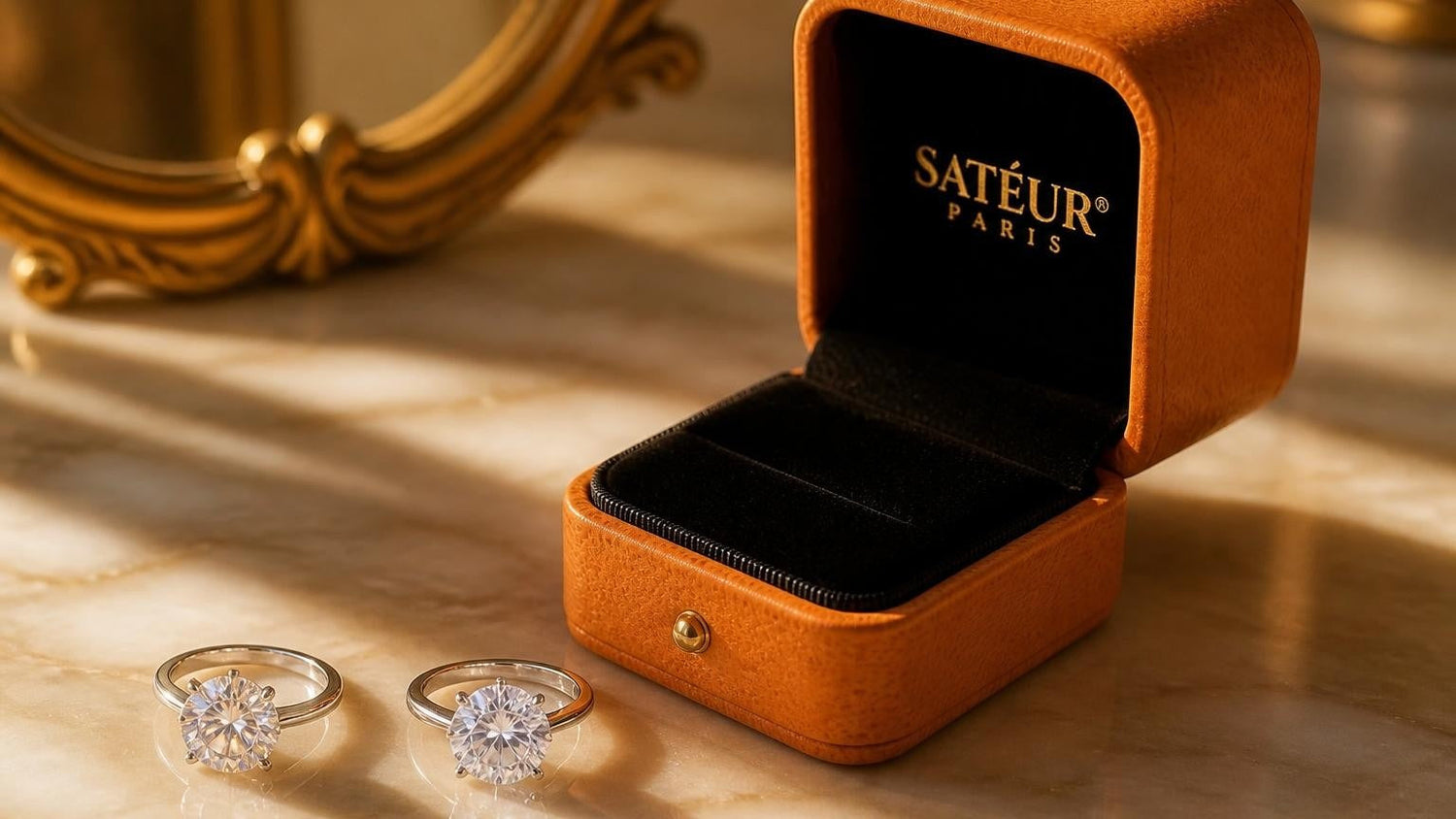
Positioned side by side under direct sunlight, the contrast resolves immediately. Diamond reads as deep, white, and precise. Moissanite reads as vivid, spectral, and energetic. Both are beautiful. The preference is entirely personal.
What matters practically: the optical gap is most pronounced in direct bright outdoor conditions. Under most indoor settings — office overhead, candlelight, restaurant ambient — both appear similarly brilliant to the naked eye, and the distinction compresses to near-invisible. This is the context in which most pieces are worn most of the time. The diamonds moissanite comparison looks most dramatic under conditions most wearers encounter only occasionally.
This is worth stating plainly: in everyday settings, a high-quality moissanite and a high-quality diamond are visually comparable. The optical distinctions are real and measurable, but require specific outdoor conditions to become clearly apparent.

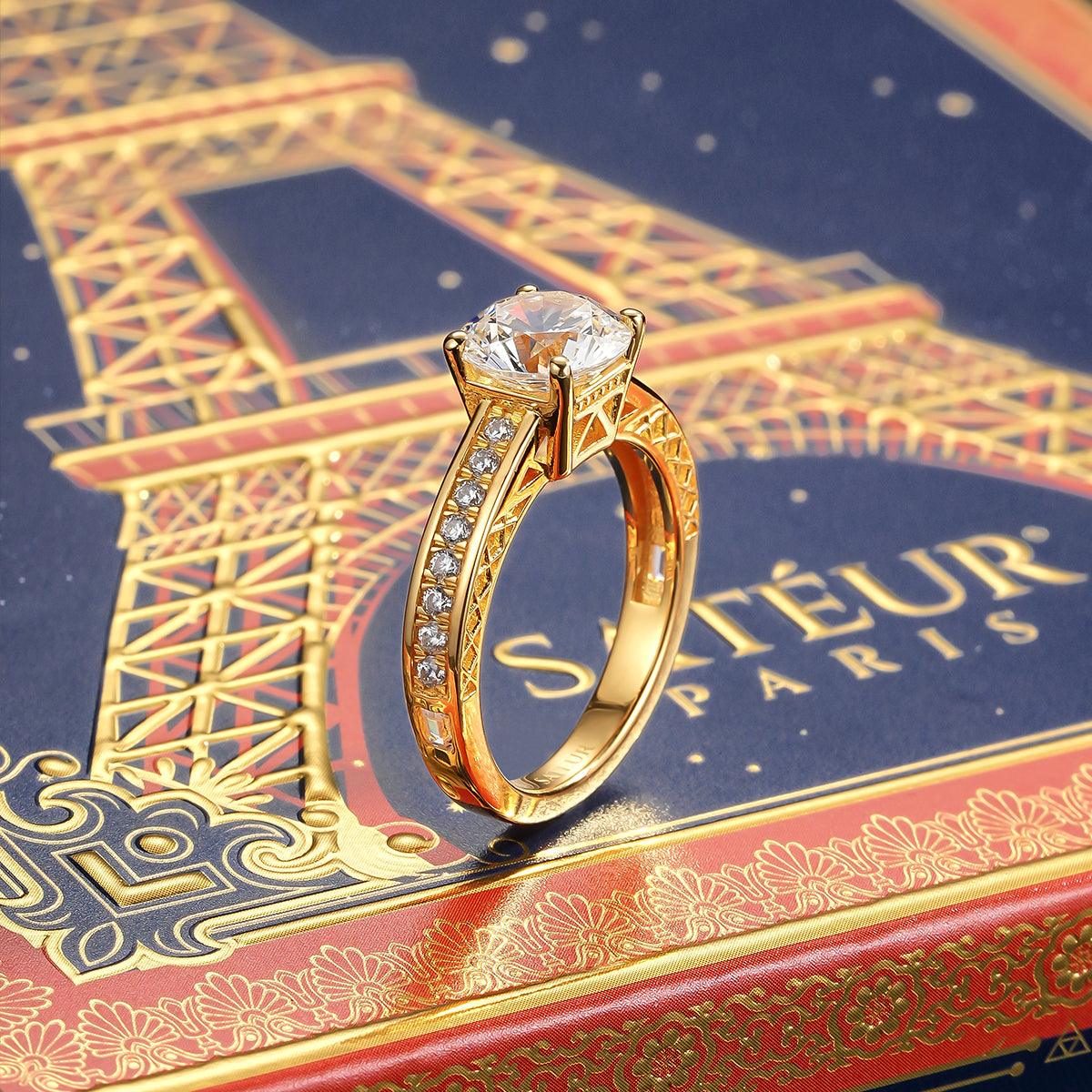
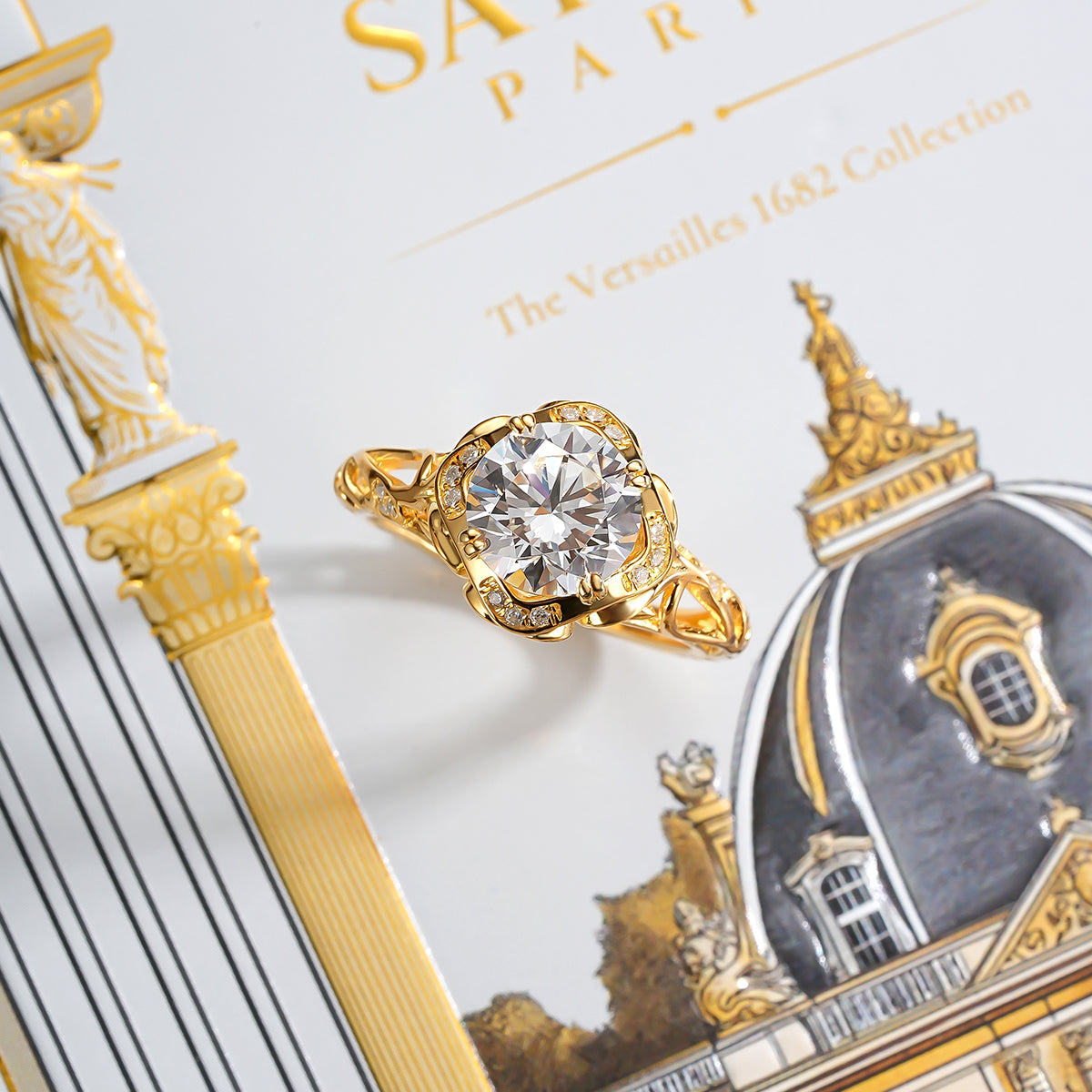
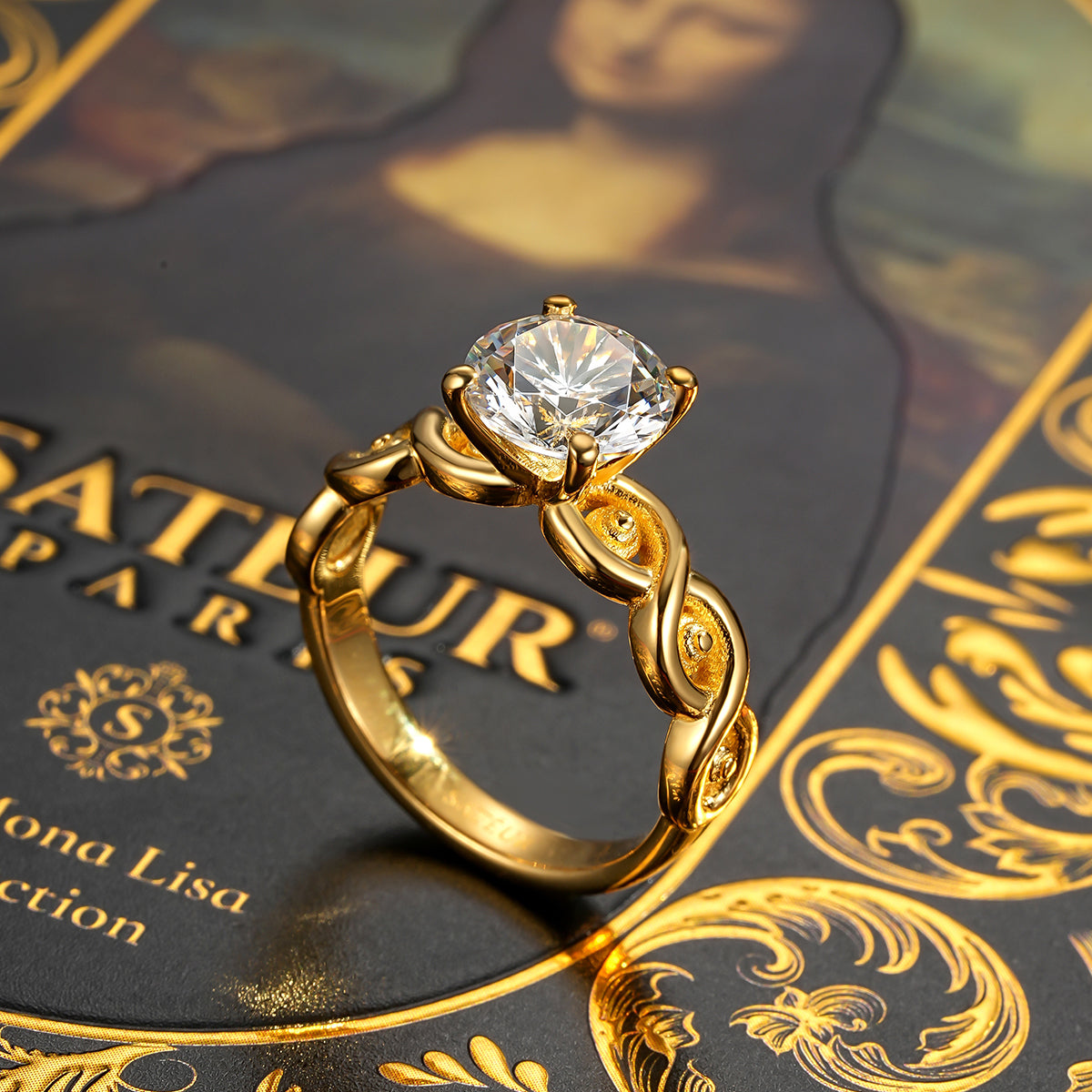
Satéur Destinée Ring™
The vivid fire of moissanite. The look of exceptional brilliance. For roughly 1% of comparable diamond pricing.
Compare to a $10,000 mined diamond
Joined by 100,000+ couples across 150+ countries.
Shop Moissanite RingsFree worldwide shipping · 30-day returns · Lifetime Satéur Care
Why Sunlight Reveals Different Optical Properties
Indoor conditions are predominantly diffuse — illumination arrives from multiple angles simultaneously, softening the interplay of optical return and spectral dispersion. Sunlight arrives in a narrow, intense beam from a single direction, which creates conditions for each stone's signature to express fully.
Diamonds' lower dispersion keeps most returned energy as white optical return under any conditions. Moissanite's higher index produces colour even in moderate settings, but the effect reaches its peak under direct solar illumination. This is why the side-by-side visual looks so different indoors versus outdoors — and why both gems should ideally be viewed in each setting before a decision.
One practical observation: moissanite activates more readily in overcast conditions than diamonds, which require stronger directional illumination to display colour flashes clearly. In the grey winter glare of northern climates, moissanite can appear more vivid — a reversal of the common assumption that diamonds always lead on brilliance.
For those exploring the full range of alternatives and their optical properties, our guide to buying moissanite vs diamond vs lab diamond covers the complete picture.
Satéur Moissanite: Exceptional Brilliance at Comparative Value
Satéur moissanite sits at D–E colour and Excellent cut — parameters that place it at the upper end of quality worldwide. The 9.25 Mohs hardness makes it appropriate for daily wear across decades, including in moissanite engagement rings and fine jewelry designed to last a lifetime.
The starting price of $98 positions it at approximately 1% of the cost of a comparable mined diamond. The optical display in direct sunlight is distinctive, vivid, and unambiguously high-quality. The contrast here is not between a premium and a compromise — it is between two different optical characters, each with its own integrity.
Over 100,000 customers across 150+ countries have chosen a different path to exceptional brilliance. The Satéur Destinée Ring™ represents that choice: a considered entry into fine jewelry that refuses to conflate price with quality, or rarity with beauty. The New Diamond Standard is not a phrase. It is a position.
Frequently Asked Questions
How does moissanite sparkle differently from diamond in direct sunlight?
Moissanite has an optical index of 2.65 versus 2.42 for diamonds, and a dispersion value of 0.104 versus 0.044 — producing approximately 2.4× greater spectral separation in direct sunlight. Diamonds return crisp white brilliance with discrete colour flashes; moissanite produces wider, more pronounced spectral arcs across the crown facets. The gap is most visible outdoors in bright conditions; under diffuse indoor conditions it compresses significantly.
Why does moissanite show more rainbow colours outdoors?
Moissanite's dispersion value of 0.104 causes it to separate white into its component wavelengths more aggressively than diamonds. In direct sunlight, with its full visible spectrum and high intensity, this produces visible spectral arcs — violet, blue, green, orange — across the crown facets. Diamonds' lower dispersion of 0.044 produces the same effect at much lower magnitude, yielding more restrained colour flashes within a predominantly white return.
Does moissanite look noticeably different in indoor versus outdoor light?
Yes, though the gap is contextual. Under diffuse indoor conditions — ambient office, candlelight, restaurant settings — both moissanite and diamond appear similarly brilliant to the naked eye. The optical contrast widens most noticeably in direct outdoor sunlight, where moissanite's higher dispersion plays out fully. Both maintain their optical character across all conditions; the difference is how it expresses in daylight.
Which stone maintains its appearance better in various lighting conditions?
Both maintain consistent optical quality across all settings. Moissanite can appear more vivid in overcast or lower-intensity conditions where diamonds' colour flashes are less active. Diamonds' white optical return reads consistent and restrained in all settings. Neither fades or degrades optically — they simply express different characters across the full range of conditions.
Can you see the difference between diamond and moissanite sparkle from a distance?
At close range in direct sunlight, the contrast in spectral dispersion is visible with the naked eye to an attentive observer. From across the table, in standard indoor settings, or in motion, the two gems appear comparably brilliant to most viewers. Both read as high-quality, luminous pieces in typical social and dining environments. The distinction requires specific conditions — direct outdoor sunlight, at close range — to become clearly apparent.
Is moissanite's distinctive sparkle style considered attractive in engagement rings?
Yes, and increasingly so. Moissanite's rainbow dispersion has its own devoted following — many buyers specifically seek the vivid spectral display as the defining character of the gem. D–E colour Excellent-cut moissanite, as used in Satéur settings, delivers consistent, high-quality optical performance. The choice is not whether moissanite is attractive, but which register — vivid spectral fire or restrained white brilliance — aligns with the wearer's personal preference and lifestyle.
















Laissez un commentaire
Ce site est protégé par hCaptcha, et la Politique de confidentialité et les Conditions de service de hCaptcha s’appliquent.